
Software teams do not lose customers because of missing features. They lose them because a checkout breaks on release day, a data sync corrupts records, or a login screen fails under load. Software testing services exist to stop exactly that. As a software engineering partner, KKRF Group builds quality assurance into products the same way we build the code: deliberately, and with measurable outcomes.
This guide breaks down what software testing services cost in 2026, the engagement models available, the real return on test automation, and a practical framework for choosing a QA partner. It is written for founders, product leaders, and engineering managers who need to invest in quality without overspending.
Key Takeaways
- Cost range: QA rates run roughly $18–$40/hr offshore, $35–$60/hr nearshore, and $70–$120/hr onshore in 2026; managed QA programs start near $4,000/month and dedicated teams reach $15,000–$25,000/month.
- Automation pays back fast: structured test automation typically returns 3–5x within 12 months, because a bug caught in QA costs a fraction of the same bug in production.
- Model matters more than rate: staff augmentation, managed QA, and QA-as-a-Service each fit a different stage of maturity. Picking the wrong one wastes budget.
- Vet with a paid pilot: the most reliable way to judge a software testing company is a small, scoped trial with agreed defect-detection metrics.
- Specialized testing carries a premium: security, performance, and compliance testing add 25–40% over standard functional rates.
On this page
- Quick answer
- What software testing services are
- Types of testing services
- How much they cost in 2026
- QA engagement models compared
- The ROI of software testing
- Our 6-step testing process
- Test automation explained
- Security, performance & compliance
- Common QA mistakes to avoid
- How to choose a QA partner
- Future trends in QA
Quick Answer: What Software Testing Services Cost and How to Choose
Software testing services are outsourced or dedicated quality assurance engagements that verify an application works correctly, securely, and at scale before and after release. In 2026, expect blended rates of roughly $18–$40 per hour offshore, $35–$60 nearshore, and $70–$120 onshore. Managed QA programs typically start around $4,000 per month, while a small dedicated team runs $15,000–$25,000 per month. Choose a provider by matching an engagement model to your product’s maturity, then validating the team with a short paid pilot tied to defect-detection metrics.
KKRF Group approaches testing as engineering, not as a checkbox at the end of a sprint. Our quality engineers work inside delivery teams, write automation alongside feature code, and report defects with the context developers actually need. That is the difference between a QA vendor and a long-term technology partner: one hands you a bug list, the other helps you ship with confidence.
What Are Software Testing Services? A Clear Definition
Software testing services cover the people, processes, and tools that validate software quality on your behalf. A provider may run a single test cycle for a release, or own quality end to end across every sprint. The scope usually spans test planning, manual and automated test execution, defect reporting, and sign-off before a release goes live.
Software testing services: A managed engagement in which an external or dedicated QA team plans, executes, and reports on tests that confirm an application meets its functional, performance, and security requirements. The service can be delivered per project, per release cycle, or as an ongoing quality function embedded in your development process.
Two ideas separate strong testing from weak testing. The first is coverage: how much of the product’s real behavior your tests actually exercise. The second is signal: whether a failing test tells a developer precisely what broke and why. We have seen teams with thousands of tests and almost no signal, because every failure required an hour of investigation. Good testing services optimize for both.
Types of Software Testing Services
Most engagements combine several testing types. Understanding each one helps you scope work accurately and avoid paying for coverage you do not need.
Functional testing: Verification that features behave according to requirements, from a single button to a full checkout flow. It answers one question: does the software do what it is supposed to do?
Regression testing: Re-running existing tests after a code change to confirm that new work did not break something that already worked. This is the category where automation delivers the largest and most durable payoff.
Performance testing: Measuring how an application behaves under expected and peak load, including response time, throughput, and stability. It surfaces the failures that only appear when thousands of users arrive at once.
Security testing: Probing an application for vulnerabilities such as injection flaws, broken access control, and insecure data handling, often mapped to the OWASP Top 10. It protects both users and the business from breach-related loss.
Beyond these, providers offer usability testing, accessibility testing (increasingly a legal requirement), API testing, and compatibility testing across devices and browsers. A capable partner recommends the mix your product actually needs rather than selling every service by default.
How Much Do Software Testing Services Cost in 2026?
Testing cost is driven by four things: the seniority of the engineers, how much work is automated versus manual, where the team is located, and how specialized the testing is. A junior manual tester in an offshore location and a senior security engineer onshore can differ by a factor of six on hourly rate alone.
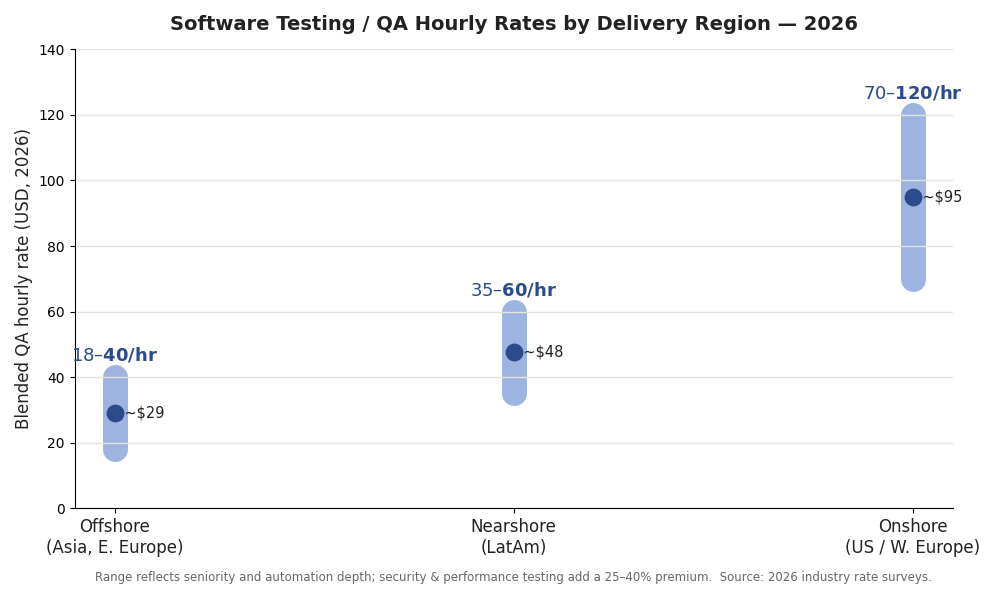
Here is what the market looks like in 2026. Blended QA rates average $18–$40 per hour offshore, $35–$60 nearshore, and $70–$120 onshore for skilled roles. Security and performance specialists command a 25–40% premium over standard functional testing. The chart below shows the typical spread.
Rates only tell part of the story. What you pay each month depends on the engagement shape. A hands-off managed QA service often runs $4,000–$8,000 per month for a defined scope. A small dedicated team of two to three testers typically costs $15,000–$25,000 per month but gives you deep product knowledge and day-to-day availability. A one-off release test cycle for a small product can be a few thousand dollars, while a full enterprise QA program can exceed $150,000 per year.
The cheapest quote rarely wins on total cost. A team that finds fewer defects, writes brittle automation, or needs constant hand-holding costs far more once you count the production incidents it misses. We encourage clients to compare providers on cost per defect prevented, not cost per hour.
Not sure whether your product needs a full QA team or a focused automation sprint? Our engineers can scope it in a short call and give you a straight, no-pressure recommendation. Start with a software engineering assessment.
Get a Technical Assessment →QA Engagement Models: Staff Augmentation vs Managed QA vs QaaS
Choosing an engagement model is half the decision. Each shape hands you a different balance of control, scalability, and accountability. The table compares the three most common options.
| Model | Who owns quality | Best for | Typical cost |
|---|---|---|---|
| Staff augmentation | You direct individual testers | Teams with a QA lead who need extra hands fast | Per tester, $2.5k–$18k/mo by region |
| Managed QA | The partner owns a defined scope | Products needing consistent release testing | $4k–$25k/mo by team size |
| QA-as-a-Service | The partner owns quality outcomes end to end | Scaling companies without an internal QA function | Outcome- or subscription-based |
QA-as-a-Service (QaaS): A subscription or outcome-based model in which a provider takes full responsibility for testing a product, supplying the people, tools, and processes so the client does not manage QA day to day. It suits companies that want quality guaranteed without building an internal test team.
A quick rule from experience: if you already have a strong QA lead, staff augmentation gives you speed. If you have engineers but no dedicated testers, managed QA fills the gap cleanly. If quality keeps slipping and nobody owns it, QaaS puts accountability in one place.
The ROI of Software Testing: What the Numbers Say
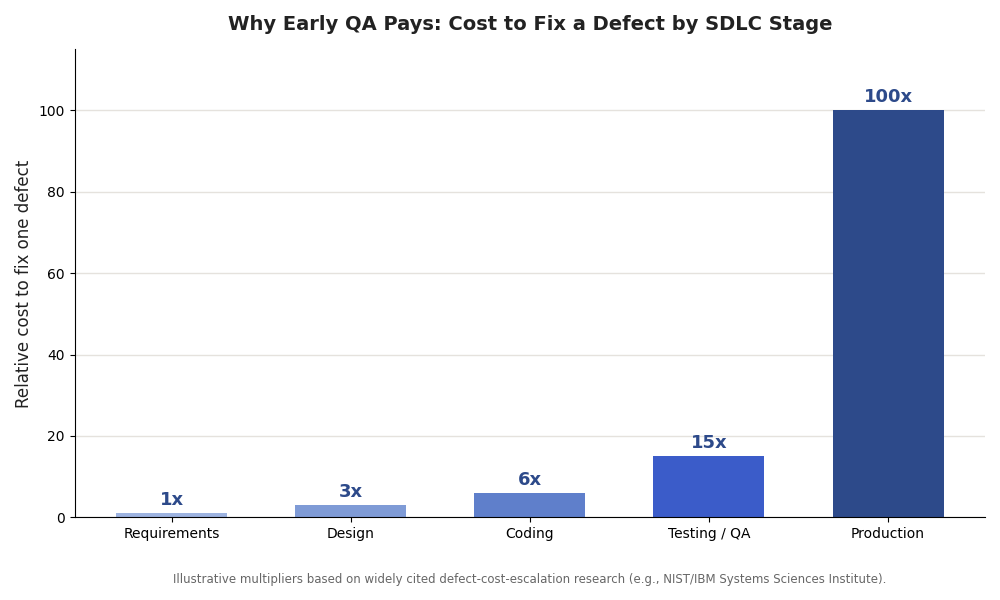
Testing is easy to cut when budgets tighten, because its value is invisible when it works. The cost of skipping it, though, is well documented. A defect that would cost one unit to fix while writing requirements costs roughly ten times more once it reaches production, where it can mean downtime, emergency fixes, and lost trust.
Automation sharpens the return further. Organizations that implement structured test automation commonly report a 3–5x return within twelve months, and the gain compounds as test suites mature. The reason is simple: a regression suite that runs in minutes replaces days of repetitive manual checking on every release, and it catches breakages the moment they happen rather than a week later.
There is a limit worth naming. Automation has real upfront cost, and automating the wrong things wastes it. Tests that change constantly, or that cover features nobody uses, drain effort without payback. The ROI comes from automating stable, high-value paths and leaving exploratory and one-off checks to skilled manual testers. Any honest partner will tell you what not to automate.
How KKRF Group Delivers QA: A 6-Step Testing Process
A dependable testing engagement follows a repeatable process. Here is the sequence we use, structured so each step produces something the next one relies on.
- Discovery and test planning. We map the product’s critical user journeys, risks, and requirements, then define what “done” means for quality. This produces a test strategy tied to business priorities, not a generic checklist.
- Test design. Engineers write test cases for functional, edge, and negative scenarios, and decide which belong in automation versus manual execution. The output is a traceable set of tests linked to requirements.
- Environment and data setup. We prepare stable test environments and realistic, privacy-safe test data so results are reproducible. Flaky environments produce flaky results, so this step is not optional.
- Test execution. Automated suites run in the CI/CD pipeline on every change, while testers run exploratory and usability passes that scripts cannot cover. Each defect is logged with clear reproduction steps.
- Defect triage and reporting. Bugs are prioritized by severity and business impact, and reported with the context developers need to fix them quickly. Quality metrics are shared transparently, not buried.
- Release sign-off and continuous improvement. We confirm exit criteria are met before release, then review escaped defects to strengthen the next cycle. Quality improves because the process learns.
Test Automation: Tools, Frameworks, and When It Pays Off
Test automation is the engine behind fast, safe releases, but it is not free and it is not universal. Knowing when to reach for it is as important as knowing how.
Test automation: The practice of writing code that runs tests automatically against an application, replacing repetitive manual checks. It excels at regression testing, where the same paths must be verified on every release, and it integrates into CI/CD pipelines so failures surface within minutes of a code change.
The modern toolset is mature. Web applications are commonly automated with Playwright, Cypress, or Selenium; mobile apps with Appium or Espresso and XCUITest; and APIs with tools like Postman or RestAssured. According to public data cited across the industry, the global test automation market now exceeds $50 billion annually, and Gartner has projected that 70% of enterprises will outsource part of their QA automation by 2027.
Automation pays off when three conditions hold: the feature is stable, it is tested repeatedly, and a failure would be costly. A payment flow checked on every release is an ideal candidate. A one-time data migration screen is not. Start with the highest-risk, highest-frequency paths, prove the ROI, then expand. Trying to automate everything at once is the fastest way to build a suite nobody trusts.
Security, Performance, and Compliance Testing
For regulated and high-traffic products, functional correctness is only the entry ticket. Three specialized disciplines decide whether the software survives contact with real-world conditions and auditors.
Security testing looks for the flaws attackers exploit: broken access control, injection, weak authentication, and insecure data handling. Mapping tests to the OWASP Top 10 gives teams a shared, evidence-based standard for what “secure enough” means. For enterprises, this is where a security-first development partner earns its keep, because a single breach can erase years of trust.
Performance testing answers a different question: what happens when demand spikes? Load and stress tests reveal the response-time cliffs, memory leaks, and database bottlenecks that never appear in a quiet staging environment. Catching them before a product launch or a seasonal surge is far cheaper than firefighting during one.
Compliance testing verifies that software meets legal and industry rules such as HIPAA for healthcare data, PCI DSS for payments, or SOC 2 controls for SaaS. It produces the evidence auditors require and keeps the business on the right side of regulation. Frameworks from bodies like NIST provide the reference points for building these controls into the development process rather than bolting them on later.
Common QA Mistakes That Cost Enterprises
Most quality failures are not exotic. They come from a handful of avoidable habits we see again and again.
- Treating QA as the last sprint step. Testing squeezed into the final days guarantees rushed coverage and shipped defects. Quality has to start when a feature is designed.
- Automating everything, or nothing. Both extremes fail. Automate stable, high-risk paths; keep exploratory work manual.
- Chasing test count over test signal. A thousand flaky tests that everyone ignores are worse than a hundred reliable ones.
- No clear ownership. When quality is “everyone’s job,” it becomes no one’s job. Someone must own the exit criteria.
- Ignoring non-functional testing. Skipping performance and security testing until a crisis is a false economy that eventually gets very expensive.
- Choosing a vendor on rate alone. The cheapest hour often produces the most expensive release.
How to Choose a Software Testing Company: A Decision Framework
Picking a QA partner does not have to be guesswork. Score candidates against a short, objective set of criteria, then validate the shortlist with a small paid trial before committing.
Choose a partner that scores well on:
- Relevant domain experience (for example, fintech or healthcare testing) and references you can check.
- A credible plan for automation ROI over 6–12 months, with named defect-reduction metrics.
- Transparent reporting and communication cadence, so you always know product quality.
- A modern, well-documented tech stack and clear security and data-handling practices.
Be cautious when a provider:
- Quotes a price without asking about your product or risks.
- Promises to automate 100% of testing, or cannot explain what it would leave manual.
- Has no way to measure or report the defects it prevents.
Recommendation: shortlist two providers, run a two-to-four-week paid pilot on a real, scoped slice of your product, and compare the defects each surfaces and the clarity of their reports. The pilot tells you more than any sales deck.
One limitation to keep in mind: outsourced testing works best when your requirements and product ownership are clear on your side. If nobody internally can say what “correct” looks like, no external team can test it well. Fix that first, or choose a partner willing to help you define it.
Comparing QA providers and want a second opinion on scope, tooling, or automation strategy? Talk to engineers who build and test enterprise software every day. Book a software consulting session with our team.
Talk to Our Engineering Team →Future Trends in Software Testing (2026 and Beyond)
The discipline is shifting fast, and the direction is clear: testing is moving earlier, getting smarter, and covering more than functionality. AI-assisted testing now helps generate test cases, detect flaky tests, and prioritize which tests to run, though human judgment still decides what “correct” means. Expect providers to fold these capabilities into standard engagements rather than sell them as add-ons.
Shift-left and shift-right are both accelerating. Teams test earlier in design (shift-left) and also monitor quality in production with real-user data and observability (shift-right). Security testing is becoming continuous rather than a pre-launch gate, aligned to standards from the OWASP Top 10 and secure-development guidance from NIST. As applications grow more complex, quality engineering is merging with reliability and platform work — a trend we also see in legacy modernization projects, where testing is what makes a risky migration safe.
In short: the best software testing services in 2026 match the right engagement model to your maturity, automate the paths that repeat and matter, price on defects prevented rather than hours billed, and prove themselves in a paid pilot before you scale. Quality is not a cost center when it is engineered well — it is what lets you ship faster with less risk.
Ready to build quality into your product instead of bolting it on? KKRF Group’s quality engineers can design a testing strategy, stand up automation, and give you release confidence. Request a custom project estimate today.
Request a Custom Project Estimate →Frequently Asked Questions
What are software testing services?
Software testing services are outsourced or dedicated quality assurance engagements in which a team plans, executes, and reports on tests that verify an application works correctly, securely, and at scale. They can be delivered per release cycle, as an ongoing embedded function, or as a fully managed QA-as-a-Service model.
How much do software testing services cost in 2026?
Blended QA rates run roughly $18 to $40 per hour offshore, $35 to $60 nearshore, and $70 to $120 onshore. Managed QA programs typically start around $4,000 per month, while a small dedicated team costs $15,000 to $25,000 per month. Security and performance testing add a 25 to 40 percent premium over standard functional rates.
Is it better to hire in-house QA or outsource software testing?
In-house QA offers deep product knowledge but costs more per person and is slower to scale. Outsourced testing is usually cheaper per hour and far easier to scale up or down. Many teams use a hybrid: an internal QA lead who owns strategy, supported by an outsourced team that handles execution and automation.
What is the ROI of test automation?
Organizations that implement structured test automation commonly report a 3 to 5 times return within twelve months, because a regression suite that runs in minutes replaces days of manual checking and catches defects immediately. The return compounds as the suite matures, provided you automate stable, high-value paths rather than everything.
How do I choose the right software testing company?
Score candidates on relevant domain experience, a credible automation-ROI plan with defect-reduction metrics, transparent reporting, and strong security practices. Then validate your shortlist with a two-to-four-week paid pilot on a real slice of your product, comparing the defects each team surfaces and the clarity of their reporting.
What types of software testing does an enterprise usually need?
Most enterprise products need functional and regression testing as a baseline, plus performance testing for scale, security testing mapped to standards like the OWASP Top 10, and compliance testing for regulations such as HIPAA, PCI DSS, or SOC 2. A good partner recommends the specific mix your product requires instead of selling every service.