Every week, a New York business owner asks us the same question: “Should we build with Flutter or React Native?” This guide is the honest, experience-backed answer we give them — no vendor spin, no framework tribalism. Just what actually works in the NYC market in 2026.
If you’re a startup founder in Midtown, a product manager at a Brooklyn e-commerce brand, or a CTO at a Manhattan fintech firm evaluating your mobile stack — this comparison was written with your situation in mind. The Flutter vs React Native New York debate isn’t just a tech question. It’s a business decision involving budget, timeline, hiring, and long-term maintainability.
Let’s cut through the noise.
Why Mobile App Strategy Matters More Than Ever for New York Businesses
New York City runs on mobile. Your customers are on the subway checking apps, your B2B clients are reviewing dashboards on the go, and your competitors are already shipping faster than ever. In 2026, a laggy, buggy, or visually inconsistent mobile app isn’t just a UX problem — it’s a revenue problem.
The city’s business landscape has also shifted considerably. Post-pandemic New York has seen an explosion of fintech apps in the Financial District, consumer-facing apps from Brooklyn-based DTC brands, and on-demand service platforms scaled out of Queens. What all of these share is a need for a mobile app that works flawlessly on both iOS and Android — without doubling the development cost.
That’s precisely where cross-platform app development frameworks like Flutter and React Native come in. Both let you build one codebase that runs on iOS and Android. Both are mature. Both are used by Fortune 500 companies. And yet — they are meaningfully different in ways that should absolutely influence your choice.
The framework decision also intersects with a wider shift happening across NYC’s tech scene right now: the rise of AI-powered mobile apps. The features modern business apps need in 2026 — on-device intelligence, personalized recommendations, real-time language processing — have made the choice of underlying framework more consequential than it used to be. We’ve covered this in depth in our guide to AI app development in New York, but the short version is: Flutter’s strong typing and clean architecture tend to make AI feature integration more maintainable at scale.
What Is Flutter? (And Why NYC Teams Are Adopting It Fast)
Flutter is Google’s open-source UI framework, launched in 2018 and now one of the most popular mobile development tools on the planet. What makes it genuinely different is how it renders the UI: Flutter doesn’t use native OS components. Instead, it draws every pixel itself using its own rendering engine (initially Skia, now transitioning to Impeller). That means your app looks and behaves identically on a Samsung Galaxy and an iPhone 15 — no surprises, no platform-specific quirks.
The language behind Flutter is Dart, which is fast, strongly typed, and surprisingly learnable. Most developers I’ve worked with come up to speed on Dart within two to three weeks.
In New York’s context, Flutter tends to thrive in environments where visual fidelity matters. Think fintech apps with custom chart animations, luxury brand consumer apps, or patient-facing healthcare tools where you can’t afford inconsistency between platforms.
A fintech client of ours in the Financial District had an existing React Native app that suffered from rendering inconsistencies on Android — animated charts and real-time data feeds looked slightly off compared to iOS. After migrating key screens to Flutter, those visual inconsistencies disappeared. The QA cycle shortened by nearly 30% because the team stopped maintaining separate platform-specific fixes. The tradeoff? They had to train two developers on Dart, which took about a month.
What Is React Native? (And Why It Still Has a Loyal NYC Following)
React Native, created by Meta (Facebook) and released in 2015, takes a different philosophical approach. It uses JavaScript and renders using actual native OS components. So when you build a button in React Native, it’s a real iOS UIButton or an Android Button — not a custom-drawn facsimile. This gives React Native apps a native feel by default and means they automatically adapt to OS-level accessibility features.
For New York’s startup scene, React Native’s biggest advantage is talent. JavaScript is everywhere. If you already have a web development team using React, there’s a genuine — though not total — skill transfer. Your web devs won’t become mobile experts overnight, but onboarding is faster.
Meta has also invested heavily in React Native’s “New Architecture” (Fabric + JSI + TurboModules), which went mainstream around 2024. Performance has improved significantly since the old JavaScript bridge was replaced. It’s not perfect, but it’s no longer a liability.
A Brooklyn-based direct-to-consumer skincare brand came to us needing an app that connected to their existing Shopify back-end and Node.js microservices. Their small dev team was already proficient in React. We built their iOS and Android app in React Native, and the decision paid off — onboarding was quick, the JS-based backend integration was seamless, and they launched their MVP within 14 weeks. Flutter would have been a stronger long-term bet for UI polish, but speed-to-market was the priority here.
Flutter vs React Native New York — Head-to-Head Comparison
Before we get to recommendations, here’s a clear side-by-side of the core decision points most relevant to New York businesses:
| Factor | Flutter | React Native |
|---|---|---|
| Language | Dart (fast, strongly typed) | JavaScript / TypeScript |
| UI Rendering | Custom engine (pixel-perfect) | Native OS components |
| Performance | Consistently high (60–120fps) | Good after New Architecture; can vary |
| Visual Consistency iOS/Android | Identical across platforms | Slight variations possible |
| Talent Pool (NYC) | Growing; smaller pool than RN | Larger; JS devs easily transition |
| Web Codebase Reuse | Limited (Flutter Web exists, but separate) | Moderate (React ecosystem shared) |
| Hot Reload | Excellent (instant) | Good |
| Community / Ecosystem | Large and fast-growing | Mature; massive JS ecosystem |
| 3rd-Party Library Maturity | Good (closing gap quickly) | Extensive |
| Native Module Integration | Good (platform channels) | Excellent (direct native bridge) |
| MVPs / Prototyping Speed | Fast (once team knows Dart) | Often faster (JS familiarity) |
| Long-Term Scalability | Excellent | Good (with architectural discipline) |
| Backed By | Meta | |
| Best For (NYC context) | Fintech, luxury, healthcare, enterprise | Startups, JS-heavy teams, e-commerce |
Note: “Win” markers indicate relative advantage for typical NYC use cases, not absolute superiority. Context always matters.
Cost of App Development in New York: Flutter vs React Native
Let’s talk numbers. Mobile app development in New York is not cheap, and the framework you choose affects your total cost — though perhaps not in the ways you’d expect. For a comprehensive breakdown of what drives pricing decisions, see our detailed guide on how much it costs to build a mobile app in New York — we cover everything from hourly rates to post-launch maintenance budgets.
The framework itself is free. The cost difference comes from developer hourly rates, project complexity, and how long it takes to build and maintain the app.
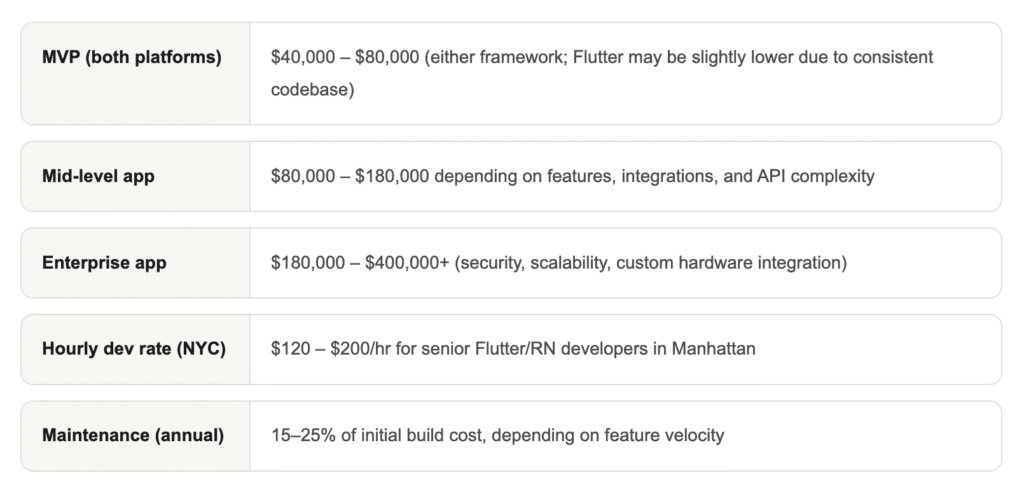
One thing developers often don’t tell you: React Native’s hidden cost tends to be in maintenance. Because it relies on native OS components, OS updates (iOS, Android) can break things. You’ll be chasing compatibility issues more frequently than you might expect — especially on Android, which fragments badly across device manufacturers. Flutter’s self-rendering approach insulates you from most of this.
Trying to figure out what your app might actually cost? Our team at KKRF Group — a mobile app development company in New York — offers free scoping consultations for NY businesses. No pitch, just honest numbers based on your actual requirements.
View Our Cross-Platform App Development Services NYC →
Best Framework for NYC Startups: The Honest Answer
New York’s startup ecosystem — particularly around Flatiron, DUMBO, and Hudson Yards — is driven by speed. You need to validate, ship, iterate, and raise. For most early-stage startups, the question isn’t “which is technically superior?” It’s “which gets us to market faster without painting us into a corner?”
If your founding team or contracted developers already work in React and JavaScript, React Native wins on onboarding speed. You’re not retooling your team or hiring new specialists. And for a pre-revenue startup watching every dollar, that matters enormously.
But if you’re starting from scratch — hiring a specialized team or working with an agency like ours — Flutter is often the smarter bet for MVPs in 2026. The codebase is cleaner, UI bugs are rarer, and your product will look polished from day one. Investors and users notice that.
A few questions to ask yourself as a NYC startup:
- Do we have existing React developers? → Lean React Native
- Is our app visually complex (animations, custom UI)? → Lean Flutter
- Do we need to integrate deeply with device hardware (Bluetooth, NFC, AR)? → React Native has a slight edge
- Are we targeting a quality-sensitive market (fintech, healthtech, luxury)? → Flutter
- Do we expect heavy feature iteration in year one? → Flutter’s hot reload is a genuine time saver
Best Framework for NYC Enterprise Clients
For larger organizations — particularly enterprises operating out of Midtown Manhattan or regulated industries like finance, insurance, or healthcare — the calculus shifts.
Enterprise apps have different requirements: complex state management, strict security protocols, deep third-party integrations (Salesforce, SAP, legacy REST APIs), and long maintenance windows. They also have real QA departments who will put your app through hell before it ships.
Flutter is increasingly winning enterprise deals in New York, and for good reason. Google itself uses Flutter internally. Companies like eBay, BMW, and several Wall Street-adjacent firms have standardized on it for internal tools and customer-facing apps. The long-term architectural story is cleaner.
React Native is still a legitimate enterprise choice — particularly for organizations already standardized on the Microsoft or Meta ecosystem, or those with large JavaScript engineering teams who would otherwise need significant retraining.
We built a field operations app for a mid-sized logistics company based in Long Island City. The app needed Bluetooth scanner integration, real-time GPS tracking, and an enterprise SSO system. We built it in Flutter. The Bluetooth integration required platform channels (Flutter’s way of talking to native code), which added two weeks of development time compared to React Native. But the resulting app was rock-solid across 200+ Android device models — something that would have been far more painful in React Native given Android fragmentation.
Hiring Flutter vs React Native Developers in New York
Talent is the unspoken part of this decision. Building the right app requires finding the right developers — and in New York’s competitive tech hiring market, availability matters. If you’re starting from scratch on this process, our guide on how to hire the right mobile app developers in New York covers vetting frameworks, interview questions, and red flags to watch for.
On LinkedIn and Indeed, React Native developer listings in the NYC metro significantly outnumber Flutter postings — roughly 3:1 in our experience. JavaScript developers are abundant. If you’re hiring in-house, React Native gives you a larger pool to fish from.
But here’s what most job postings don’t show: Flutter developers in New York tend to be more experienced mobile specialists. They chose a framework that required learning a new language, which filters for developers who take mobile seriously. Anecdotally, we’ve found Flutter developer portfolios tend to show more polished, intentional UI work.
If you’re working with a mobile app development agency (like us), this distinction matters less — good agencies maintain teams in both frameworks. When choosing the right development team in NYC, always ask any agency you’re evaluating: “How many Flutter vs React Native apps have you shipped to production, and can I speak to those clients?” That single question separates the real shops from the portfolio-padders.
For salary benchmarking in New York in 2026: senior Flutter engineers typically command $140,000–$190,000 annually. Senior React Native developers are similar at $135,000–$185,000. The gap has narrowed considerably as Flutter demand has risen.
Need to hire experienced mobile app developers in New York without the overhead of a full-time hire? KKRF Group maintains a vetted team of Flutter and React Native specialists serving NYC clients. Whether you need staff augmentation or a full-service build, we move fast without cutting corners.
Read: How to Hire Mobile App Developers in NYC →Decision Guide: When to Choose Flutter vs React Native
Still unsure? Use this as your decision filter.
Choose Flutter if…
- Your app has complex, custom UI
- Visual consistency is business-critical (fintech, healthtech, luxury)
- You’re starting fresh without an existing JS team
- You’re building for multiple platforms (iOS, Android, web, desktop)
- You want lower long-term maintenance costs
- You’re a NY enterprise prioritizing stability over speed
Choose React Native if…
- Your team already knows React / JavaScript
- Speed to MVP is the top priority
- You need deep 3rd-party JS library integration
- Your app needs heavy native module access (AR, Bluetooth, NFC)
- You’re integrating with an existing React web app
- You’re a startup optimizing for fast iteration in year one
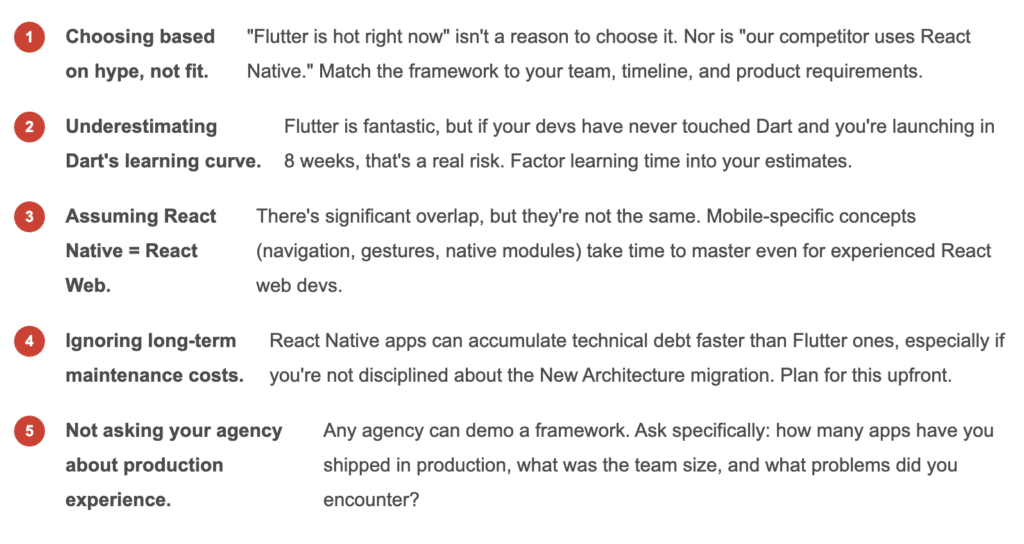
Common Mistakes NYC Businesses Make When Choosing a Framework
Why Your Mobile App Partner Should Know New York
This might sound self-serving coming from a NYC app development company, but it’s genuinely important. New York has specific market characteristics that affect how your app should be built.
The regulatory environment here is more complex than most cities — especially for fintech (NYDFS regulations), healthcare (NY-specific HIPAA implementation guidance), and even certain consumer apps (NYC Local Law 144 for automated employment decisions). Your development team needs to understand these realities, not just build a good UI.
Additionally, New York user expectations are high. Your app will be used on the subway (poor connectivity, brief sessions), in offices (Bluetooth headphone pairing, enterprise Wi-Fi), and on tight time windows. Apps built without understanding the NYC user context tend to ship with the wrong UX assumptions.
A Manhattan or Brooklyn-based development partner — or one that has built specifically for the NY market — brings this context to your project without requiring you to explain it all from scratch.
Work with a Top mobile app Development company in New York
KKRF Group has helped startups, SMBs, and enterprises across NYC ship production-quality Flutter and React Native apps — on time, on budget, and built for the demands of the New York market. Ready to build your app with NYC experts?
See Our NYC Mobile App Development Services →What’s Next: Flutter and React Native Trends in 2026
Both frameworks are actively evolving. Here’s what’s shaping the landscape right now:
Flutter’s Impeller engine is now the default rendering engine on both iOS and Android. It significantly improves frame rates and reduces jank — particularly on Android, which previously lagged behind iOS Flutter performance. This alone has convinced several fence-sitters to move to Flutter.
React Native’s New Architecture is now the default in new projects. JSI (JavaScript Interface) and TurboModules have eliminated the old asynchronous bridge, which was the framework’s biggest performance bottleneck for years. The gap between RN and native has narrowed substantially.
AI-powered development tools are accelerating both ecosystems. If you’re evaluating AI app development in New York for your business, both frameworks have robust integrations with LLM APIs, edge model deployments, and on-device inference libraries. Flutter’s type system tends to make AI feature integration cleaner to maintain — a meaningful advantage as AI features stop being differentiators and start being table stakes.
Multiplatform ambitions are real with Flutter. Google has made clear that Flutter targets iOS, Android, web, macOS, Windows, and Linux from a single codebase. If you’re thinking about a mobile-first app that might expand to desktop — Flutter has a genuine roadmap advantage.
Conclusion: Flutter vs React Native — The KKRF Take
After working on dozens of projects across New York’s startup and enterprise landscape, here’s our genuine recommendation:
For most New York businesses building in 2026 — especially those without an existing JavaScript team — Flutter is the better long-term bet. It’s faster, more visually consistent, cheaper to maintain, and increasingly well-supported for enterprise use cases. The Dart learning curve is real but short, and the payoff compounds over time.
React Native remains a smart, pragmatic choice for teams already embedded in the JavaScript ecosystem, and for startups that genuinely need to move at maximum speed with existing resources.
What we’d caution against: making this decision based on framework popularity rankings or LinkedIn trends alone. The right framework is the one that fits your team, your timeline, your users, and your business — not the one topping a GitHub star count.
If you’d like a candid opinion on what’s right for your specific app, our cross-platform app development services in NYC include a free 30-minute strategy session for New York businesses. We’ll tell you honestly which way to go — even if that means recommending something we don’t prefer. No agenda, no boilerplate pitch.
Ready to build? Work with a top mobile app development company in New York — KKRF Group builds Flutter and React Native apps for NYC startups, SMBs, and enterprises.
Build Your App With NYC Experts →Should I use Flutter or React Native for my business in New York?
Which is better — Flutter or React Native — in 2026?
How much does it cost to build an app in New York?
Is React Native still good in 2026?
Which framework is better for fintech apps in New York?
Planning to Launch a High-Impact News Application?
Our expert team helps you design and build scalable applications tailored to your business goals.
Contact With Us