New York City is not a market that forgives mediocrity. If your business app doesn’t load fast, think smart, and feel intuitive within the first sixty seconds — your user has already opened something else. That’s the reality of competing in one of the most fast-paced, high-expectation cities on the planet.
AI app development in New York has shifted from an emerging trend into a baseline competitive requirement. Whether you’re building a fintech tool for Wall Street traders, a healthcare scheduling platform for Brooklyn clinics, or a food delivery experience for the West Village — the standard for AI app development New York businesses rely on has never been higher, and the gap between average and excellent has never been wider. According to McKinsey, AI-driven companies in dense urban markets see 20–30% higher revenue growth than digital-only competitors who haven’t yet integrated machine learning into their core product.
And yet, most founders approaching their first AI-powered build don’t have a clear picture of which features actually move the needle. There are dozens of AI capabilities available — but only a handful deliver the kind of user retention, operational efficiency, and revenue growth that justify the investment. This guide breaks them down with clarity, real-world context, and zero fluff.
Not sure which AI features your app actually needs?
Investing in the wrong capabilities is the #1 reason AI builds go over budget without delivering ROI. KKRF Group has guided dozens of NYC founders through this exact decision — and we offer free discovery calls to help you prioritize intelligently before you commit a single dollar to development.
Book Your Free Strategy Call with KKRF Group →Why AI App Development in New York Is Different From Everywhere Else
Building an AI-powered app in Austin or Miami is one thing. Building one for New York City is an entirely different challenge — and a significantly greater opportunity.
NYC operates at a density and velocity that no other U.S. market can match. Your users are switching between five apps before they’ve finished their subway commute. Attention windows are shorter, competitive alternatives are more numerous, and user expectations — shaped by the best products from the world’s top tech companies — are genuinely higher than anywhere else in the country.
This changes the calculus of AI mobile app development in several meaningful ways:
- Regulatory complexity is real. NYC fintech and healthcare apps operate under overlapping state, federal, and city-level regulations. AI features — particularly in underwriting, diagnostics, and credit decisioning — need to be designed with explainability and auditability built in from day one. This isn’t an afterthought; it’s architecture.
- Hyper-local context is a genuine differentiator. New York is not one market — it’s hundreds of micro-markets with distinct demographics, transit patterns, income profiles, and cultural preferences. AI that can operate at neighborhood granularity (not just city level) unlocks conversion advantages that no generic platform can replicate.
- Talent costs are higher, so efficiency is non-negotiable. NYC-based teams are expensive. That makes AI automation not just a nice-to-have but a fundamental cost management strategy — especially for startups managing burn through a Series A or beyond.
- The competitive bar moves faster. New York is where global tech companies run their product pilots. What was cutting-edge six months ago is table stakes today. Staying ahead requires a development partner who tracks the market the same way you do.
That’s why the most successful AI app development services companies in New York don’t just build features — they build strategy-first. KKRF Group is built on exactly this premise: that your NYC market context is not a footnote to your product brief, it’s the headline.
The 10 AI Features Every NYC Business App Should Have
AI-Powered Personalization That Actually Knows Your User
Generic apps feel like junk mail — technically delivered, immediately ignored. The best AI powered mobile apps in 2026 do the opposite: they learn from every tap, every scroll, every abandoned session, and use that behavioral data to reshape what each user sees next.
A personalization engine built on machine learning analyzes user patterns in real time and dynamically surfaces the content, products, or services most likely to convert. For a New York real estate app, that might mean automatically prioritizing listings in neighborhoods a user has explored, at the price range they’ve filtered twice before. For an NYC fitness platform, it means knowing which workout type to recommend on a Tuesday morning without the user lifting a finger.
This is one of the most foundational AI features in mobile apps — and one of the highest-leverage investments you can make. Apps implementing intelligent personalization consistently report 30–40% improvements in session duration, a 25% reduction in churn, and measurably higher LTV for activated users.
Conversational AI & Intelligent Chatbot Support
New Yorkers don’t wait. If your app takes more than a few seconds to answer a question, they’re gone — and odds are, they won’t come back. An AI chatbot for mobile apps isn’t just about automating support; it’s about giving users an instant, always-available, genuinely helpful response at any hour.
Modern conversational AI goes far beyond scripted menus and keyword triggers. It understands context, manages multi-step interactions, detects frustration signals, and hands off to human agents at exactly the right moment. For an NYC healthcare app, an AI assistant can answer questions about insurance coverage, suggest available appointment slots, and guide patients through symptom checkers — handling tasks that would otherwise consume hours of staff time every single day.
Think about what that means operationally: one well-trained AI assistant handles the volume of 10 support agents, 24 hours a day, without a single sick day. For startups watching burn rate, that’s not just convenient — it’s transformational. Gartner projects that by 2026, AI-powered virtual assistants will handle 75% of all customer service interactions in high-growth mobile apps.
Predictive Analytics: Stop Reacting, Start Anticipating
Running a business on gut instinct in 2026 is a liability. Predictive analytics in apps uses historical data, behavioral patterns, and machine learning models to forecast what’s going to happen — before it does.
For an NYC restaurant group running a delivery platform, predictive analytics means knowing which menu items will spike on rainy Fridays so you can prep inventory in advance. For a fintech startup in the Financial District, it means identifying which users are most likely to churn in the next 30 days — and triggering retention workflows before they leave. For a logistics company covering all five boroughs, it means routing deliveries more efficiently by predicting traffic congestion by neighborhood and time of day.
The key insight most founders miss: predictive analytics isn’t a reporting feature — it’s a decision-making layer. It doesn’t just tell you what happened last quarter; it tells you exactly what to do next. Businesses using predictive models in their mobile products report up to 18% lower customer acquisition costs and significantly higher reorder rates.
Planning an AI app development New York project? KKRF Group has helped NYC founders prioritize exactly these features — without wasting budget on the wrong ones. Talk to us before you build. →
AI-Driven Push Notifications That Don’t Get Ignored
Every app sends push notifications. Almost nobody opens them. The reason? They’re generic, poorly timed, and irrelevant to the individual. AI automation in apps fixes this by learning when each specific user is most likely to engage — and what message will actually resonate with them.
An AI-powered notification system analyzes individual usage patterns to determine optimal send times, message tone, and offer type per user. If your app knows that a particular customer in Astoria opens their food delivery app at 6:45 PM on weekday evenings, it doesn’t blast them at noon — it reaches them at exactly the moment they’re most receptive, with a message tailored to their ordering history.
This is one of those smart mobile app features that looks simple on the surface but has an outsized business impact. Apps using AI-optimized notification strategies typically see 2–3x the open rates of standard broadcast campaigns — without spending an extra dollar on acquisition. Over a 12-month lifecycle, the revenue differential compounds significantly.
Voice AI & Natural Language Search
People don’t search the way they used to — and your app’s search functionality needs to reflect that. Voice AI mobile apps and natural language processing allow users to interact with your product the way they’d talk to another person: “Show me three-bedroom apartments in the West Village under $5,000” or “Find me an urgent care clinic open near me right now.”
For NYC real estate platforms, NLP-powered search is a genuine differentiator. Instead of forcing users through a maze of dropdowns and filters, they describe what they want in plain language and get results that match their intent. The same logic applies to healthcare apps, retail platforms, and any service with complex inventory or catalog management. Research by PwC found that 65% of adults aged 25–49 speak to their devices at least once per day — that’s not a niche behavior, it’s mainstream.
Are you still making your users think in keywords? That friction costs you conversions every single day. Voice and natural language search removes that barrier entirely — and in a city where users are often multitasking on the subway or walking between meetings, hands-free interaction isn’t a luxury, it’s a usability requirement.
Is AI necessary for mobile apps in 2026?
In high-competition markets like New York, yes — increasingly so. AI isn’t just a feature layer; it’s the mechanism through which modern apps deliver personalization, automation, and predictive intelligence that users now expect as standard. Apps without AI capabilities are losing ground to AI-native competitors every month that passes.
Which AI features matter most for early-stage startups?
For startups with limited budgets, the highest-ROI AI investments are conversational AI (reduces support costs immediately), AI-optimized push notifications (improves retention without new spend), and a lightweight personalization engine (improves activation rates from day one). Build these first; add predictive analytics and recommendation systems as your data volume grows.
How does AI improve user experience in mobile apps?
AI improves UX by eliminating friction at every touchpoint: it anticipates what users need before they ask, surfaces relevant content without manual filtering, reduces support wait times to zero, and adapts the interface dynamically based on individual behavior patterns. The cumulative effect is an app that feels built specifically for that user — which is the highest standard of experience design.
You Need More Than a Dev Shop — You Need a Strategy Partner
KKRF Group is a New York City–based mobile app development company that has spent years building AI-powered applications across fintech, healthcare, real estate, and consumer products. We don’t just wire up features — we architect competitive advantages that compound over time.
Talk to KKRF Group About Your AI Build →AI Recommendation Systems That Drive Revenue
The best moment to sell to a customer is when they’re already engaged with your app. An AI recommendation system capitalizes on exactly that moment — surfacing the next product, service, or action a user is most likely to want, based on their behavior and the patterns of similar users.
This is how Amazon generates approximately 35% of its revenue. It’s how Spotify keeps people listening for hours without manually selecting a single track. And it’s exactly what NYC-based e-commerce apps, food platforms, and subscription services should be building into their mobile experiences from day one.
For a New York specialty grocery delivery app, an AI recommendation engine might learn that customers who order organic produce on Tuesday also tend to add artisan bread by Thursday — and proactively suggest it. For a healthcare platform, it might surface follow-up care options after an appointment is completed. The logic is universal; the implementation is context-specific. Platforms using intelligent recommendation systems report average order value increases of 15–30% within the first 90 days of deployment.
Real-Time Fraud Detection & AI Security
For any app handling payments, medical records, or sensitive financial data in New York — fraud detection isn’t optional. NYC’s fintech and healthcare sectors are under constant regulatory scrutiny, and a single security incident can end a startup faster than any competitor.
AI-powered fraud detection works by analyzing thousands of behavioral signals in real time — device fingerprint, login location, transaction velocity, typing rhythm — and flagging anomalies the moment they deviate from established patterns. This approach is exponentially more effective than static rule-based systems, which sophisticated bad actors have learned to bypass with ease. The global cost of mobile payment fraud exceeded $48 billion in 2023, and that number is climbing.
Here’s the insight most security consultants won’t tell you: AI fraud detection is also a trust signal. When users know your app actively protects them — and when it communicates that clearly — they’re measurably more likely to store payment information, complete high-value transactions, and refer others. Security done right isn’t just risk mitigation; it’s a retention strategy.
Machine Learning-Powered Onboarding Flows
You have roughly 60 seconds to prove your app is worth a user’s time. Machine learning mobile apps use behavioral data to identify exactly where users hesitate, get confused, or abandon the onboarding flow — and then adapt the experience to address those friction points for future users.
This goes beyond A/B testing. Machine learning continuously optimizes the flow based on real behavior, creating a genuinely adaptive onboarding experience that improves itself over time. For a New York-based B2B SaaS tool or a credentialed healthcare platform where onboarding involves complex steps and data collection, this can make the difference between a 30% and a 70% completion rate.
The math matters: if you’re spending $50 to acquire each app install, a 20-point improvement in onboarding completion is equivalent to getting 20 free users for every 100 you paid for. The ROI compounds with every optimization cycle — making this one of the most cost-effective investments in the entire AI in mobile app development toolkit.
Intelligent Automation for Back-End Operations
The AI your users never see is often the most powerful. AI automation in apps handles the manual, repetitive operational tasks that slow your team down — without requiring human attention for each instance.
For a New York restaurant running a delivery platform, this means dynamic menu pricing that adjusts automatically based on ingredient costs, demand patterns, and time of day — no one manually updating it every shift. For a real estate app in Brooklyn, it means AI that categorizes inbound inquiries, routes them to the right agent by neighborhood specialization, and schedules follow-ups automatically.
What makes intelligent back-end automation particularly powerful in the NYC context is scale. New York businesses operate at a density and speed that manual processes simply cannot sustain. An AI operations layer doesn’t just save time — it makes certain types of growth possible that would otherwise require proportionally expanding headcount. According to Deloitte, intelligent automation reduces operational overhead by 25–40% in mobile-first businesses within the first year of deployment.
Hyper-Local AI & Geo-Intelligence
New York City is not one market. It’s hundreds of micro-markets layered on top of each other. A feature that resonates in SoHo might fall completely flat in Flushing. An offer that converts in the Financial District might get ignored in Bay Ridge. Mobile app AI integration with geo-intelligence accounts for this granularity — and uses it as a competitive advantage.
Hyper-local AI layers in real-time location data, neighborhood-level behavioral patterns, and borough-specific demand signals to deliver experiences that feel genuinely relevant to where each user is right now. For food delivery apps, this means surfacing cuisine types that over-index in particular neighborhoods at particular times. For healthcare apps, it means prioritizing providers within realistic transit distance — not just geographic radius.
What would it mean for your conversion rate if every user felt like your app was built for their specific corner of New York? That’s not aspirational — it’s what geo-intelligent apps are delivering today. NYC platforms using neighborhood-level AI personalization report local conversion rate improvements of 28–45% compared to citywide baseline targeting.
Benefits of AI in Mobile Apps for NYC Businesses
The benefits of AI in mobile apps aren’t abstract — for New York businesses operating in dense, competitive markets, they’re direct, measurable, and time-sensitive. Here’s what leading NYC companies are actually seeing after deploying AI-powered mobile products:
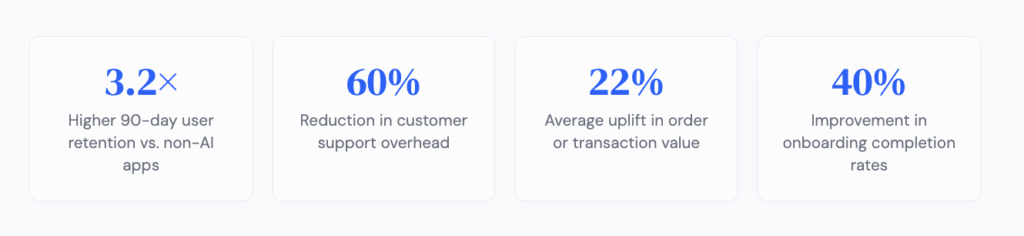
Beyond the numbers, the strategic benefit is compounding: AI apps improve with time and data, while traditional apps deliver roughly the same value on day 365 as they did on day one. That gap — between a learning system and a static one — is what turns a product launch into a durable competitive moat.
For regulated sectors like fintech and healthcare, AI also delivers a compliance advantage. Properly designed explainable AI systems generate audit trails automatically, flag anomalies before they become regulatory incidents, and document decision logic in formats that satisfy both state and federal review standards — saving legal and compliance teams hundreds of hours annually.
AI App Development Cost in New York: What to Actually Expect
One of the most common questions we hear at KKRF Group: “What does this actually cost?” The honest answer is that AI app development cost in New York depends heavily on your feature choices, data readiness, and team structure. But there are practical benchmarks worth knowing before you start any serious scoping conversation.
The smartest approach for most NYC startups: identify your one highest-ROI AI feature, build that first with quality, and scale the AI investment as revenue and data grow. Launching with 8 mediocre AI features is far worse than launching with 2 excellent ones. The compounding value comes from getting the first layer right — not from checking boxes.
One cost factor that’s consistently underestimated: data infrastructure. Before a single model can be trained, your data needs to be clean, structured, and accessible. Founders who skip this step inevitably spend more on rework than they saved by rushing. Budget 15–25% of your AI feature cost for data architecture — it’s the foundation everything else sits on.
AI Apps vs. Traditional Apps: Why NYC Businesses Are Switching
There’s a growing divide in the New York mobile market between apps that use AI as core infrastructure and those still operating on static, rules-based logic. The gap in performance outcomes is no longer marginal — it’s decisive.
The shift from traditional to AI-powered isn’t happening because AI is fashionable. It’s happening because the performance gap has become too large to ignore. In New York’s most competitive verticals — fintech, healthcare, real estate, food delivery — traditional apps are losing users, revenue, and market position to AI-native competitors who launched with intelligence built in.
What AI features should a New York fintech app prioritize?
Real-time fraud detection and explainable AI for credit or underwriting decisions are non-negotiable for NYC fintech compliance. Beyond those, predictive churn modeling and personalized push notifications typically deliver the strongest early ROI for fintech user retention.
How does AI app development differ for healthcare vs. retail in NYC?
Healthcare AI apps in New York require HIPAA-compliant data handling, explainability for any clinical decision support, and careful integration with existing EHR systems. Retail apps can move faster and focus on personalization, recommendation engines, and AI-optimized promotions. The technical foundations overlap; the regulatory and UX constraints diverge significantly.
Best AI Features for Startups in New York
Not every startup has a $200,000 AI budget on day one — and that’s fine. The good news is that some of the most impactful AI features are also among the most accessible, and for early-stage companies, choosing the right two or three capabilities often delivers more ROI than a sprawling feature list that spreads resources too thin.
For NYC startups specifically, AI app development New York companies invest in tends to deliver the fastest returns when founders prioritize in this order:
Conversational AI first. A well-configured AI assistant reduces your support overhead from week one, without requiring proprietary training data. This is the closest thing to free ROI in the AI toolkit.
AI-optimized push notifications second. You already have users — this feature helps you keep them without spending more on acquisition.
A lightweight personalization layer third. Even a simple behavioral model that adapts content ranking based on user history can meaningfully improve retention before you’ve collected millions of data points.
The strategic principle here: build the AI features that pay for themselves first. Scale into prediction, recommendation, and automation as your data compounds. Startups that sequence their AI investments intelligently don’t just survive the build — they arrive at Series A with a product that’s genuinely harder to replicate.
Four Things the Typical Blog Won’t Tell You
Your AI features are only as good as your data pipeline. This is the unsexy truth about AI in mobile app development that rarely gets discussed. Every personalization engine, every predictive model, every recommendation system depends entirely on clean, structured, well-connected data to function correctly. The most common reason AI implementations underperform isn’t the algorithm — it’s that the underlying data is fragmented or unreliable. Before investing in AI features, audit your data infrastructure. Fix that first. Build that second.
In NYC’s regulated sectors, AI explainability is a competitive moat — not just a compliance checkbox. Healthcare and fintech apps operating in New York face increasing regulatory scrutiny around AI decision-making. Apps that can show users why an AI made a recommendation — why this investment suggestion, why this treatment flag — build measurably more trust than black-box systems. Designing for explainability from the start is a strategic advantage that most of your competitors are actively ignoring right now.
The ROI of AI features compounds differently than standard features. A standard feature delivers roughly the same value on day one as it does on day 365. AI features improve over time as they process more data and refine their models. This means the gap between an AI-powered app and a traditional app widens with every month that passes. The businesses that launch AI capabilities early build a compounding advantage that becomes almost impossible to replicate later — which is why waiting for “the right time” is itself a strategic risk.
The most dangerous phase of AI adoption is the second build, not the first. Most NYC founders successfully launch an AI MVP. Where they stall is in the scaling phase — when models need retraining, data pipelines need expansion, and new AI features need to integrate with legacy infrastructure. The partners who succeed long-term design for scalability from the beginning: modular architectures, clean API contracts between AI services, and data governance policies that support model evolution. If your development partner hasn’t discussed model maintenance and retraining cycles before your first sprint, that’s a red flag worth taking seriously.
Before You Build: Three Resources Worth Your Time
The features you choose matter — but the partner you choose to build them matters more. If you’re in the middle of evaluating development companies in New York right now, this guide will save you significant time and costly trial and error: How to Hire the Right Mobile App Developers in New York. It covers the exact questions to ask, the red flags to watch for, and what separates production-grade AI teams from generalist shops that overpromise.
If you’re still early in your budget planning, the most grounded breakdown of what you should actually expect to spend — by feature complexity, team structure, and build phase — is here: How Much Does It Really Cost to Build a Mobile App in New York? This isn’t a generic estimate range — it’s built on real project data from the NYC market.
Finally, if you’re weighing whether to work with a local NYC partner versus a distributed or offshore team, if local market knowledge, regulatory familiarity, and real accountability matter to you — and in AI product development, they absolutely should — here’s why partnering with a mobile app development company New York businesses trust is worth serious consideration before you sign with anyone else.
Frequently Asked Questions
What is the cost of AI app development in New York?
The AI app development cost in New York varies significantly based on scope and complexity. Integrating pre-built AI APIs — a chatbot, NLP search, or basic recommendation layer — typically ranges from $15,000 to $50,000. Building custom machine learning models or full predictive analytics systems generally runs $75,000 to $250,000 and above. The best approach for most startups is to identify your single highest-ROI AI feature, build it well, and scale the investment as data and revenue grow together.
What are the key benefits of AI in mobile apps for NYC businesses?
The benefits of AI in mobile apps for NYC businesses include significantly higher user retention through personalization, reduced operational costs through automation, stronger fraud protection for fintech and healthcare apps, and improved conversion rates through intelligent recommendations and optimized notification timing. Beyond individual features, AI apps compound in effectiveness over time — delivering increasing ROI with every month of data collected. The compounding nature of AI performance is what makes early investment particularly valuable in competitive markets.
How long does AI mobile app development take?
A well-scoped MVP with core AI features typically requires 3 to 6 months for an experienced team. That timeline assumes clear product requirements, access to relevant training data, and a development partner with genuine AI integration experience. Skipping proper data architecture in favor of speed is the most common and costly mistake in AI mobile app development — it creates technical debt that typically doubles the timeline and the cost in later phases.
Which industries in NYC benefit most from AI-powered apps?
Fintech, healthcare, real estate, food delivery, and retail are currently seeing the strongest ROI from AI apps for business in New York. That said, the underlying value drivers — personalization, automation, predictive intelligence — apply across nearly every vertical. If your business involves repeat customers, variable demand, or data-intensive operations, AI will improve your outcomes meaningfully regardless of the specific sector.
Do I need a large dataset to use AI features in my app?
Not necessarily. Many powerful AI features use pre-trained models that don’t require your own proprietary dataset to function — conversational AI, NLP search, and voice interfaces fall into this category. Features like personalization engines and custom predictive models do require data to train effectively, but they can start simple and improve over time as usage grows. A strong AI app development services partner will design a data strategy alongside your feature roadmap — not after the fact.
What are the latest AI trends in mobile apps for 2026?
The most significant AI trends in mobile apps in 2026 include agentic AI (autonomous systems that execute multi-step tasks without human prompting), on-device AI processing for faster and more private inference, explainable AI for regulated industries, and hyper-local geo-intelligence for location-based services. For NYC businesses specifically, explainability in fintech and healthcare AI is moving from a regulatory concern to a genuine competitive differentiator — and teams building for it now are building a moat that will matter more with each passing quarter.
Can KKRF Group help with AI app development in New York?
Yes. KKRF Group is a New York City-based mobile app development company trusted by NYC founders and business leaders for AI-powered, scalable application builds. We work across fintech, healthcare, real estate, and consumer apps — handling everything from product strategy and AI feature prioritization to full-stack development and post-launch optimization. If you’re planning an AI-powered build in New York, talking to us before you commit to a direction costs you nothing and could save you a significant amount.
The Honest Bottom Line
AI app development in New York is no longer about staying on the cutting edge — it’s about staying in the game. The apps winning in NYC’s competitive market aren’t necessarily built by the biggest companies or the largest teams. They’re built by founders who understood early that intelligent features compound in value over time, and who moved decisively while others were still debating whether the timing was right.
Personalization. Conversational AI. Predictive analytics. Intelligent automation. Fraud detection. Voice interfaces. Recommendation systems. Geo-intelligence. These aren’t features you plan for version 3. They’re the features that determine whether your app creates a lasting habit or becomes a forgotten icon on someone’s second screen.
The businesses that win in New York don’t wait for permission. They identify their highest-leverage opportunity, build it with precision, and let the compounding advantages do the rest. The window to build that early-mover advantage is open right now — but it won’t stay open indefinitely.
New York doesn’t reward hesitation. Neither does your market.
Planning to Launch a High-Impact News Application?
Our expert team helps you design and build scalable applications tailored to your business goals.
Contact With Us