
Digital transformation is no longer a board-level buzzword. It is a budget line, a delivery program, and a measurable set of outcomes. Digital transformation services help an organization move from a current-state operating model to a modern, data-driven one, spanning strategy, cloud, application modernization, automation, and change management. At KKRF Group, an enterprise software development company and a trusted digital transformation partner, we treat transformation as engineering work with a business case, not a slide deck.
Key Takeaways
- What they are: Digital transformation services combine strategy, technology delivery, and change management to modernize how a business operates and serves customers.
- Cost: Focused initiatives typically run $150,000–$500,000, while organization-wide programs range from $500,000 to $2 million or more; the largest enterprise transformations can exceed $27 million.
- Consulting rates: Expect $75–$175/hour for small firms and $250–$850/hour for top-tier enterprise consultancies in 2026.
- Why they fail: Industry research consistently finds roughly 70% of transformations miss their goals, usually because of weak roadmaps, poor adoption, and no clear ROI model.
- How to win: Sequence the work in phases, define KPIs before you start, and choose a partner who ships production software, not just recommendations.
On This Page
- Quick Answer
- What Digital Transformation Services Include
- How Much They Cost in 2026
- Consulting Rates by Firm Tier
- The 6-Phase Transformation Roadmap
- Digital Transformation Framework
- Measuring Transformation ROI
- In-House vs Partner vs Hybrid
- Common Mistakes to Avoid
- Security & Compliance
- Decision Framework
- How to Choose a Partner
- Future Trends (2026+)
- FAQs
Quick Answer: What Are Digital Transformation Services?
Digital transformation services are professional engagements that help an organization redesign its operating model using modern technology, data, and automation. A typical scope covers four things: a strategy and roadmap, technology delivery such as cloud migration and application modernization, process automation and integration, and the change management needed for people to actually adopt the new tools. The goal is measurable business outcomes, faster cycle times, lower operating cost, new revenue streams, better customer experience, rather than technology for its own sake.
In 2026, most enterprise programs bundle these services with AI adoption and data engineering, because automation and analytics are where the clearest returns now sit. Pricing scales with scope and legacy complexity, and the difference between success and an expensive stall usually comes down to sequencing and adoption, not the technology itself.
KKRF Group approaches digital transformation the way an engineering company approaches any hard problem: assess the current state honestly, define the target architecture, then deliver in secure, testable increments. We have seen transformations go wrong when a strategy document is handed off to a team that never has to run the result in production. Our model keeps strategy and delivery under one roof, so the roadmap is written by the same people accountable for shipping it.
What Digital Transformation Services Actually Include
“Digital transformation” is a broad label, so it helps to break it into the concrete services that sit underneath it. A credible digital transformation services company will offer most of the following as discrete, scoped workstreams that connect to a single roadmap.
Strategy and Digital Maturity Assessment
A digital maturity assessment measures where an organization stands today across technology, data, process, and culture, and defines the target state. This is the foundation of any digital transformation strategy. Without it, teams buy tools that solve symptoms instead of causes. The deliverable is a prioritized portfolio of initiatives ranked by business impact and feasibility.
Cloud Migration and Infrastructure Modernization
Most transformations require moving workloads off aging infrastructure. Cloud migration re-platforms or re-architects applications onto scalable, secure cloud environments so the business can release faster and pay for what it uses. This workstream also covers DevOps, observability, and cost governance so the cloud bill does not spiral.
Legacy Application Modernization
Legacy systems are where transformation programs most often stall. Legacy application modernization rebuilds or refactors outdated software into maintainable, API-first services. Done well, it removes the bottleneck that blocks every other initiative; done poorly, it becomes an expensive rewrite with no business value. This is engineering work that rewards careful sequencing.
Data Engineering, Automation, and AI Adoption
Modern transformation is data-led. Data engineering builds the pipelines and platforms that make information trustworthy, and process automation removes manual work from high-volume workflows. AI adoption, from document processing to decision support, now sits on top of that data foundation. These are the workstreams where 2026 programs report the fastest returns.
Change Management and Enablement
Technology only creates value when people use it. Change management covers training, communication, and operating-model redesign so new systems are adopted rather than resented. Research is blunt here: adoption, not code, is the most common point of failure. A transformation partner that ignores enablement is selling you shelfware.
Summary: Digital transformation services span strategy, cloud migration, legacy modernization, data and AI, and change management, unified by a single roadmap. The connective tissue between them is what separates a program from a pile of disconnected projects.
How Much Do Digital Transformation Services Cost in 2026?
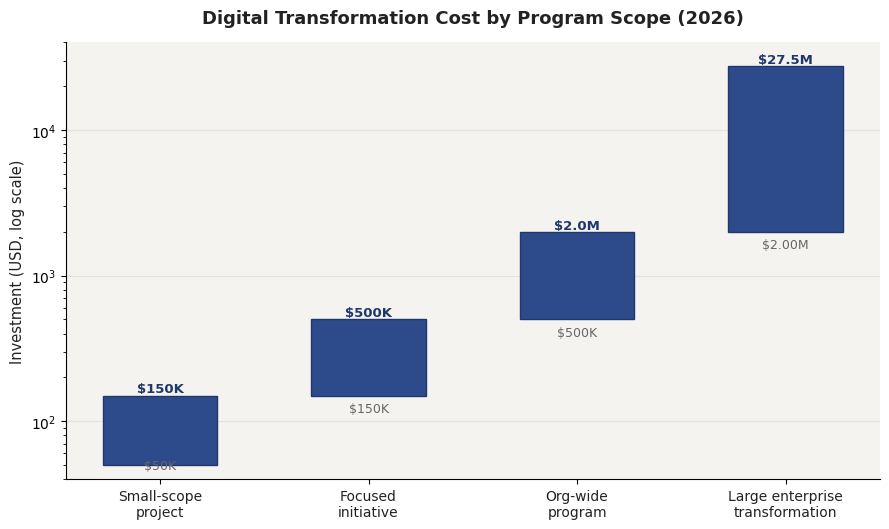
Digital transformation cost is the first question most leaders ask, and the honest answer is that it depends on scope, legacy complexity, and how much of the work is strategy versus build. That said, the market has settled into recognizable ranges in 2026. A focused, single-domain initiative typically costs $150,000 to $500,000. An organization-wide program usually runs from $500,000 to $2 million or more, and the largest multi-year enterprise transformations can exceed $27 million.
Consulting-only engagements, such as strategy, roadmap, and business analysis without full implementation, generally land between $10,000 and $200,000 or more depending on depth. A useful planning heuristic from 2026 industry reporting is that annual transformation budgets now sit at roughly 5% to 15% of revenue, which for many mid-sized companies translates to $250,000 to $5 million per year.
What Drives the Price
Four factors move the number most. Scope determines how many systems and processes are in play. Legacy complexity determines how much has to be untangled before anything new can ship. Technology choices, especially AI and cloud, add capability and cost. And the operating model, whether you buy strategy, delivery, or both, changes the mix of rates you pay. A transparent partner will map each of these to a line item rather than quoting a single opaque figure.
Summary: Budget $150K–$500K for a focused initiative and $500K–$2M+ for an enterprise-wide program in 2026. Scope, legacy complexity, technology, and engagement model are the four levers that set the final price.
Digital Transformation Consulting Rates by Firm Tier
If you engage digital transformation consulting on a time-and-materials basis, hourly rates vary widely by the tier of provider. Small firms typically charge $75 to $175 per hour. Mid-sized firms average $125 to $175. Large providers charge $200 to $300, and top-tier enterprise consultancies can reach $250 to $850 per hour for senior advisory work.
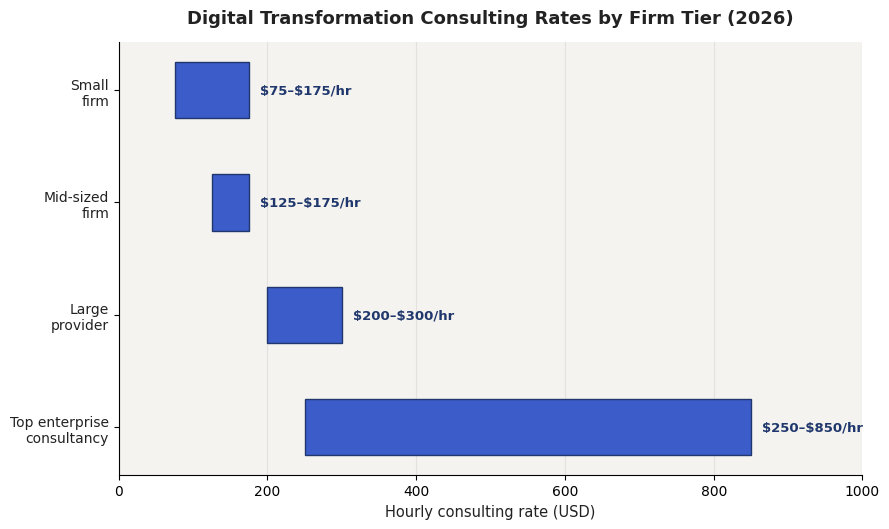
The right tier depends on the work. Board-level strategy for a global enterprise may justify premium advisory rates. But most execution, the actual modernization, integration, and automation, is delivered more cost-effectively by specialized engineering partners than by brand-name consultancies that subcontract the build. A common and expensive mistake is paying advisory rates for work that is really software delivery.
Not sure whether your next investment should be cloud, data, or modernization first? Our team can map your highest-ROI sequence in a short working session. Start with a digital transformation and IT consulting conversation.
Request a Consultation →The Digital Transformation Roadmap: A 6-Phase Process
A digital transformation roadmap turns strategy into sequenced, fundable phases with measurable outcomes at each step. The reason roadmaps matter is simple: roughly 70% of transformations fail, and most of those failures trace back to programs that tried to do everything at once with no clear order. Here is the six-phase process KKRF Group uses to keep programs shippable.
- Assess. Run a digital maturity assessment across technology, data, process, and people. Establish an honest baseline and quantify the cost of the status quo.
- Define the vision. Set a two-to-three-year target state with measurable outcomes. This becomes the yardstick every later decision is checked against.
- Prioritize the portfolio. Rank initiatives by business impact and feasibility. Fund the highest-value, lowest-risk work first to build momentum and free up budget.
- Build the foundation. Deliver the enabling layers, cloud, data pipelines, and modernized core services, that every downstream initiative depends on.
- Scale and automate. Roll out automation, AI, and new customer-facing experiences on top of the foundation. Measure adoption, not just deployment.
- Govern and optimize. Track KPIs, retire legacy, and reinvest savings into the next phase. Transformation is a loop, not a finish line.
Summary: Assess, define, prioritize, build the foundation, scale, then govern. Sequencing the foundation before the flashy work is the single biggest predictor of whether a transformation delivers.
Digital Transformation Framework: The Core Pillars
A digital transformation framework maps the journey from current state to future state across every dimension of the organization, not just technology. These four pillars keep a program balanced. Neglect any one and the others underdeliver.
Technology and Architecture
This pillar covers the modern stack: cloud-native infrastructure, API-first services, data platforms, and security by design. Enterprise-grade architecture is what makes the rest of the transformation scalable and safe. It is the difference between a pilot that works and a platform the whole business can run on.
Data and Intelligence
Data is the fuel for automation and AI. This pillar establishes trustworthy pipelines, governance, and analytics so decisions are made on evidence. In 2026, organizations that treated data as a first-class product, rather than an afterthought, are the ones seeing real AI returns.
Process and Operating Model
Transformation redesigns how work flows, not just which tools are used. This pillar re-engineers processes, removes handoffs, and defines a governance structure that clarifies who decides what. A new system layered on a broken process just automates the dysfunction.
People and Culture
The human pillar covers skills, incentives, and adoption. Inclusive transformations, where the people doing the work help shape it, are markedly more likely to exceed ROI expectations. Culture is not a soft add-on; it is where value is either captured or lost.
How to Measure Digital Transformation ROI
Digital transformation ROI is measured across both tangible and intangible value. Tangible value shows up directly in the numbers: lower operating cost, higher revenue, shorter cycle times, and increased output. Intangible value, employee experience, customer satisfaction, and risk reduction, matters too, but leaders should always anchor the business case in quantifiable metrics.
The practical method is to define KPIs at the start of each phase and track both leading and lagging indicators. Adoption rate, training completion, and engagement are leading signals that predict whether financial returns will follow. Cost savings and revenue lift are the lagging results. Programs that set KPIs before kickoff are far more likely to prove their value, and to secure funding for the next phase.
In-House vs Consulting Partner vs Hybrid Delivery
One of the biggest decisions is who delivers the transformation. Each model has a clear best-fit. The table below compares them on the factors that matter most to enterprise buyers in 2026.
| Factor | In-House Team | Consulting Partner | Hybrid (Partner + In-House) |
|---|---|---|---|
| Speed to start | Slow (hiring first) | Fast | Fast |
| Specialized skills | Limited to current staff | Deep and broad | Deep, plus internal context |
| Cost profile | High fixed cost | High variable cost | Balanced |
| Knowledge retention | Stays in-house | Can leave with vendor | Transferred by design |
| Best for | Ongoing run + small change | One-off strategy or surge | Most enterprise transformations |
For most enterprises, the hybrid model wins. A partner brings specialized delivery capacity and modern engineering practice while the internal team retains context and, crucially, the knowledge to run the result. KKRF Group is built for this model: we deliver production software alongside your team and transfer ownership deliberately, so you are not dependent on us forever.
Common Digital Transformation Mistakes to Avoid
- Buying technology before strategy. Tools purchased to chase a trend rarely map to a real business outcome.
- Trying to transform everything at once. Big-bang programs overwhelm teams and budgets. Sequenced phases win.
- Ignoring change management. The best system is worthless if nobody adopts it. Enablement is not optional.
- Skipping the data foundation. AI and automation built on untrustworthy data produce confident, wrong answers.
- No ROI model. Without KPIs defined up front, you cannot prove value or defend the next round of funding.
- Paying advisory rates for delivery work. Match the provider tier to the task, or the budget evaporates before anything ships.
Security and Compliance in Digital Transformation
Every new integration, cloud workload, and data pipeline expands the attack surface. Security-first transformation bakes controls in from the start rather than bolting them on later. That means zero-trust access, encryption in transit and at rest, and continuous monitoring across the modernized estate. Frameworks from bodies like NIST give a practical baseline for enterprise controls.
Compliance is equally central. Regulated industries, finance, healthcare, and the public sector, carry obligations such as SOC 2, HIPAA, or GDPR that must be designed into the target architecture, not audited in afterward. We have seen programs lose months because compliance was treated as a final checkbox. Building it in from phase one is faster and cheaper than retrofitting.
Decision Framework: When to Invest, and When to Wait
Not every organization should launch a full transformation this quarter. Use this framework to decide.
Invest now when:
- Legacy systems are actively blocking revenue, hiring, or customer experience.
- Manual processes consume significant staff time that automation could return.
- You have executive sponsorship and can fund at least the first two phases.
- Competitors are pulling ahead on speed, data, or digital experience.
Wait or go smaller when:
- There is no clear business outcome, only pressure to “do AI” or “go digital.”
- Leadership alignment or funding is uncertain, start with a scoped pilot instead.
- Your data is too fragmented to support the first initiative, fix that foundation first.
Our recommendation: if you are unsure, do not commit to a multi-year program on day one. Fund a focused, high-ROI initiative with clear KPIs, prove the model, then scale. Limitations are real, transformation demands sustained sponsorship and budget, and pretending otherwise is how programs stall.
How to Choose a Digital Transformation Partner
The market is crowded with firms offering digital transformation services, so evaluate on evidence, not marketing. A strong digital transformation services company should demonstrate real engineering depth, a transparent process, and a track record of transferring ownership rather than creating dependency.
- Do they ship production software? Favor partners who deliver working systems, not just recommendations.
- Is the process transparent? You should see the roadmap, the architecture, and the cost breakdown line by line.
- Do they design for security and scale? Enterprise-grade architecture and security-first delivery should be defaults, not upgrades.
- Will they transfer knowledge? A good partner makes you more capable, not more dependent.
- Can they connect strategy to delivery? The team writing the roadmap should be accountable for building it.
This is the model KKRF Group was built around: a long-term technology partner that pairs strategy with hands-on engineering, so the plan and the product come from the same accountable team.
Planning a modernization or cloud program and want a second set of eyes on the architecture before you commit budget? Book a technical session with our engineers, we will pressure-test your modernization and legacy strategy against your goals.
Request an Architecture Review →Future Trends in Digital Transformation (2026 and Beyond)
Three shifts are defining transformation in 2026. First, AI has moved from experiment to operating layer, agentic automation and intelligent document processing are now standard workstreams, not moonshots. Second, cloud strategy has matured into cost discipline; FinOps and platform engineering are as important as migration itself. Third, data products and governance have become the prerequisite for everything else, because untrustworthy data caps the value of every AI initiative on top of it.
The organizations pulling ahead are not the ones adopting the most tools. They are the ones sequencing well, measuring adoption, and treating transformation as continuous engineering. That is where analyst firms like Gartner and McKinsey consistently point: durable advantage comes from operating-model change, not one-off technology purchases.
What are digital transformation services?
Digital transformation services are engagements that help an organization modernize its operating model using technology, data, and automation. They typically include strategy and roadmap, cloud migration, legacy application modernization, data engineering and AI, process automation, and change management, all aimed at measurable business outcomes.
How much do digital transformation services cost in 2026?
A focused initiative usually costs $150,000 to $500,000, while an organization-wide program ranges from $500,000 to $2 million or more. Consulting-only engagements run roughly $10,000 to $200,000+. Many mid-sized companies budget 5% to 15% of annual revenue for transformation.
How long does a digital transformation take?
A scoped, single-domain initiative can deliver value in 3 to 6 months. Enterprise-wide programs are multi-year efforts delivered in phases. The key is to sequence the work so each phase produces measurable outcomes rather than waiting years for a single big-bang result.
Why do most digital transformations fail?
Industry research consistently finds roughly 70% of transformations miss their goals. The usual causes are a weak or absent roadmap, poor user adoption because change management was skipped, buying technology before defining a business outcome, and no ROI model to prove value or justify continued funding.
What is a digital transformation roadmap?
A digital transformation roadmap is a phased plan that turns strategy into sequenced, fundable initiatives with measurable outcomes at each step. It typically moves through assessment, vision, prioritization, building the technology foundation, scaling automation and AI, and ongoing governance and optimization.
Should we use an in-house team or a transformation partner?
Most enterprises get the best result from a hybrid model. A partner brings specialized delivery capacity and modern engineering practice, while the internal team retains business context and long-term ownership. Choose a partner that ships production software and transfers knowledge rather than creating dependency.
Ready to turn a transformation ambition into a costed, phased plan you can fund? Let us build a roadmap tied to real ROI, then deliver it with you. Talk to KKRF Group’s engineering team about where to start.
Get a Custom Project Estimate →