
New York runs on commerce. From SoHo boutiques and Brooklyn DTC brands to Manhattan enterprise retailers, more of that buying now happens on a phone than anywhere else. A well-built shopping app is no longer a nice-to-have — it is often the single most profitable sales channel a brand owns. At KKRF Group, a top mobile app development company, we help New York businesses turn that channel into real, measurable revenue, and this guide lays out exactly what it takes to build an eCommerce app here in 2026.
Below you will find honest cost ranges, the features that actually move sales, the tech-stack decisions that shape your budget for years, and a clear framework for choosing an eCommerce app development company in New York that fits your goals.
Key Takeaways
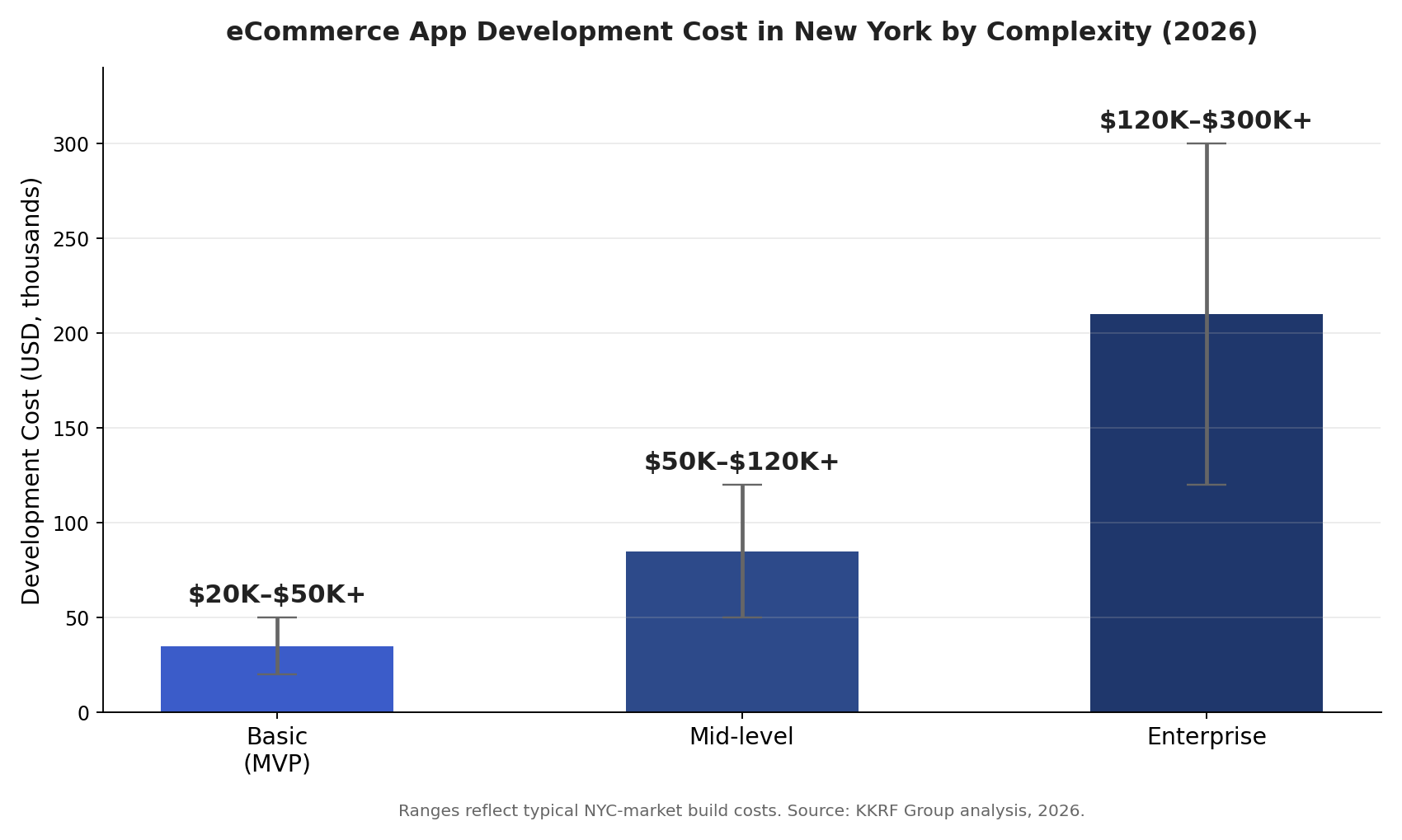
- An eCommerce app in New York typically costs $20K–$50K for an MVP, $50K–$120K for a mid-level build, and $120K–$300K+ for an enterprise-grade platform.
- Most NYC projects run 3 to 9 months, driven by feature depth, integrations, and how ready your brand and data are on day one.
- The tech-stack decision — native, cross-platform (React Native or Flutter), or a Progressive Web App — shapes both budget and long-term performance more than any single feature.
- Payment security and PCI DSS compliance are non-negotiable; they should be designed in from the first sprint, not bolted on before launch.
- Choosing the right eCommerce app development company in New York comes down to proven retail/DTC work, transparent process, and post-launch support — not the lowest quote.
What This Guide Covers
Quick Answer: eCommerce App Development in New York
eCommerce app development in New York is the process of designing, building, and launching a mobile shopping app for iOS and Android that lets customers browse, buy, and track orders. In 2026, a New York eCommerce app costs roughly $20,000 for a basic MVP and $120,000 to $300,000+ for an enterprise build, and typically takes three to nine months. The right scope depends on your catalog size, payment needs, and how much custom experience your brand requires.
KKRF Group builds eCommerce apps as an experienced engineering partner, not a template shop. We approach each project with a custom engineering mindset, enterprise-grade architecture, and a security-first process — the same standards we bring to fintech and healthcare clients. That means your app is designed to scale from your first thousand orders to your millionth without a costly rebuild.
What eCommerce App Development Actually Involves
eCommerce app development is the end-to-end creation of a mobile application that sells products or services directly to customers. It combines user-experience design, front-end mobile engineering, a back-end that manages catalog and orders, secure payment processing, and integrations with tools like inventory, shipping, and analytics. The goal is a fast, trustworthy path from product discovery to a completed purchase.
It helps to separate the storefront a shopper sees from the systems behind it. The front end is the app itself — product pages, search, cart, and checkout. The back end handles inventory, pricing, user accounts, and order state. Between them sit APIs that keep everything in sync, whether your data lives in Shopify, a headless commerce platform, or a fully custom system.
For New York brands, one more layer matters: your app rarely stands alone. It usually connects to a point-of-sale system, an email platform, a loyalty program, and sometimes a warehouse. Getting those connections right is where much of the real engineering effort goes, and where an inexperienced team tends to run over budget.
How Much Does an eCommerce App Cost in New York?
The cost of eCommerce app development in New York in 2026 generally falls into three bands. A basic MVP with core shopping and checkout costs $20,000 to $50,000. A mid-level app with real-time order tracking, multiple payment gateways, and analytics runs $50,000 to $120,000. An enterprise or multi-vendor platform with AI recommendations, loyalty, and automation reaches $120,000 to $300,000 or more. These ranges assume New York-market delivery standards.
Location plays a real role in these numbers. In 2026, US developers typically bill $150 to $250 per hour, and NYC agencies often carry a local premium on top of that. That is why many New York brands use a blended model: senior strategy and architecture handled locally, with parts of the build delivered by a vetted distributed team. Done well, this trims cost without sacrificing quality.
One caution from experience: the cheapest quote is almost never the cheapest project. We have seen New York businesses pay twice — once for a rushed build, and again to fix the security gaps, broken integrations, and untestable code it left behind. A slightly higher upfront investment in clean architecture usually pays for itself within the first year.
Not sure which cost band fits your idea? Our team can map your feature list to a realistic budget and timeline in one working session. See how we build eCommerce apps in New York.
Get a Custom Project Estimate →Where Your Budget Actually Goes
Understanding how a budget breaks down helps you spend it well. On a typical mid-complexity New York eCommerce app, front-end and back-end engineering together consume close to half the total, while design, payments, QA, and post-launch maintenance make up the rest. Maintenance is not optional — plan for roughly 15 to 20 percent of the build cost per year to keep the app secure and current.
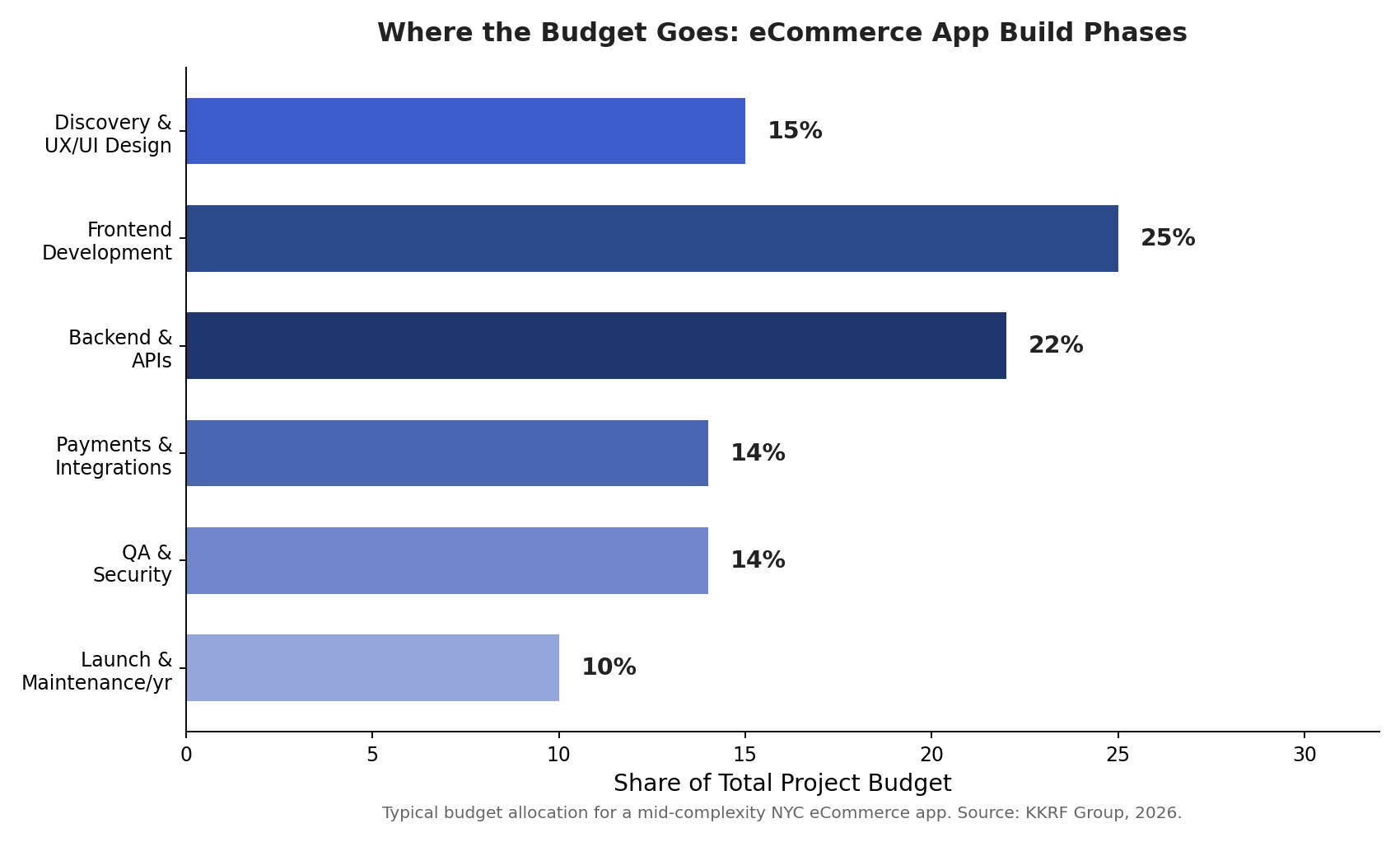
Notice how much weight sits on the back end and integrations. A shopping app lives or dies on whether inventory is accurate, payments clear, and orders sync in real time. Skimping here to spend more on visual polish is one of the most common and expensive mistakes we see brands make.
Must-Have Features for a New York eCommerce App
Features should earn their place by driving sales or retention. A strong 2026 eCommerce app includes a fast product catalog with smart search and filters, a frictionless cart and checkout, saved payment methods and guest checkout, secure user accounts, and reliable order tracking. These form the backbone of nearly every successful shopping app.
Beyond the basics, the features that separate winners from also-rans focus on personalization and re-engagement. The highest-impact additions include:
- Personalized recommendations: AI-driven product suggestions based on browsing and purchase history, which consistently lift average order value.
- Push notifications: timely nudges for abandoned carts, back-in-stock alerts, and location-aware offers — especially effective for New York shoppers on the move.
- Loyalty and rewards: points, tiers, and referrals that turn one-time buyers into repeat customers.
- Multiple payment options: cards, Apple Pay, Google Pay, and buy-now-pay-later, so no sale is lost at the final tap.
- Real-time order and delivery tracking: a single feature that measurably cuts support tickets and builds trust.
- In-app support and chat: quick help that keeps shoppers from bouncing when they hit a question.
A quick reality check on features: more is not better. Each addition increases build cost, testing surface, and long-term maintenance. The disciplined approach is to launch with the features that directly serve your buyer, then expand based on real usage data rather than guesswork.
Choosing a Tech Stack: Native, Cross-Platform, or PWA
A tech stack is the set of programming languages, frameworks, and services used to build and run an app. For eCommerce, the most consequential choice is how you build the front end: fully native, cross-platform, or as a Progressive Web App. This decision affects performance, cost, and how quickly you can ship to both iOS and Android.
Native development uses Swift for iOS and Kotlin for Android, producing the fastest, smoothest experience and the deepest access to device features. The trade-off is cost: you build and maintain two separate codebases. Native is the right call for high-traffic retailers where every millisecond of performance affects conversion.
Cross-platform development with React Native or Flutter builds one codebase that runs on both platforms, cutting cost and time to market significantly. For most New York DTC brands and startups, this is the pragmatic sweet spot — near-native performance with a single team. A Progressive Web App, by contrast, runs in the browser and can be saved to the home screen, offering the widest reach and lowest cost while giving up some native hardware access.
| Approach | Best For | Typical NYC Cost | Trade-off |
|---|---|---|---|
| Native (Swift / Kotlin) | High-traffic retail, complex animations, deep device features | $90K–$300K+ | Two codebases to build and maintain |
| Cross-platform (React Native / Flutter) | Most DTC and startup apps needing iOS + Android fast | $45K–$150K | Occasional native modules still needed |
| Progressive Web App (PWA) | Budget-conscious catalogs, wide reach, no app-store gate | $20K–$70K | Limited access to some native hardware |
On the back end, the parallel decision is whether to build on a platform like Shopify, go headless, or run a fully custom system. Shopify integration is fast and cost-effective when your catalog already lives there. A headless or custom back end — often paired with our custom software and SaaS engineering work — makes sense when you need advanced merchandising, multi-vendor support, or full control over performance and data.
The eCommerce App Development Process, Step by Step
A predictable process is what keeps an eCommerce project on budget. At KKRF Group we follow a transparent, six-stage path, and each stage produces something you can see and approve before the next begins.
- Discovery and strategy. We define your buyer, map the shopping journey, and lock a prioritized feature list tied to business goals. This stage prevents the scope creep that inflates most app budgets.
- UX and UI design. We design the full flow from product discovery to checkout, then prototype it so you can test the experience before a line of production code is written.
- Architecture and setup. We choose the stack, design the data model and APIs, and stand up secure, cloud-native infrastructure built to scale with order volume.
- Development. We build the front end and back end in short sprints, integrating payments, inventory, and third-party tools incrementally so problems surface early.
- Quality assurance and security testing. We test across devices, load-test the checkout, and run security and penetration testing against the payment and account flows before launch.
- Launch and support. We ship to the App Store and Google Play, monitor real-world performance, and provide ongoing maintenance, updates, and iteration based on live data.
The section that most teams underinvest in is the fifth one. A shopping app that fails under a Black Friday traffic spike, or leaks a payment error, can undo months of brand-building in an afternoon. Rigorous QA is cheaper than a bad launch, every time.
Security, Payments, and Compliance
Payment security in an eCommerce app means protecting card and personal data at every step, from entry to storage to transmission. The foundational rule is simple: a well-built app never stores raw card numbers. Instead it uses tokenized, PCI DSS-compliant gateways such as Stripe, Braintree, or Adyen, so sensitive data stays with the processor, not on your servers.
Around that core, a secure New York eCommerce app encrypts data in transit and at rest, enforces strong authentication, and follows the OWASP Mobile Top 10 guidelines. Compliance with the PCI Security Standards Council requirements is mandatory for handling card payments, and for apps serving certain customers, data-privacy rules add further obligations.
Security is not a phase you complete and forget. Threats evolve, dependencies age, and new vulnerabilities appear. That is why our security-first approach includes ongoing monitoring and regular penetration testing after launch — the protection your customers expect only holds if it is maintained.
Security and payments are where eCommerce apps most often go wrong. We can review your architecture and flag risks before they reach production. Explore our mobile app development services.
Request a Technical Assessment →How Long Does It Take to Build?
Most eCommerce apps take three to nine months from kickoff to launch. A focused MVP can ship in three to four months, a mid-complexity app usually needs five to seven, and an enterprise build with heavy integrations runs eight months or longer. The single biggest accelerator is readiness: brands that arrive with clean product data, brand assets, and payment accounts in place routinely save weeks.
Integrations are the most common source of delay. Connecting to a legacy inventory system, a strict ERP, or a third-party logistics provider can add unpredictable time, because you are now dependent on systems and teams outside the project. An experienced partner scopes these dependencies early and builds buffer around them rather than discovering them mid-sprint.
Common Mistakes NYC Businesses Make
After years of building and rescuing shopping apps, the same avoidable mistakes keep surfacing. Watch for these:
- Choosing on price alone. The lowest bid often hides shortcuts in security, testing, or architecture that cost far more to fix later.
- Overloading the MVP. Launching with every imaginable feature delays revenue and buries the features that actually matter under ones that do not.
- Treating checkout as an afterthought. A slow or confusing checkout quietly kills conversions no marketing budget can offset.
- Ignoring maintenance. An app is a living product; brands that budget nothing for updates watch performance and security erode within a year.
- Skipping analytics. Without event tracking from day one, you are optimizing blind and cannot prove what drives sales.
How to Choose an eCommerce App Development Partner in New York
Choosing the right eCommerce app development company in New York is a decision framework, not a coin flip. Weigh a partner against the criteria that predict a successful outcome, and be honest about which ones matter most for your business.
When a partner is the right fit
The strongest signals are directly relevant experience and a transparent process. Look for a team with shipped retail or DTC apps, clear ownership of code and intellectual property, a documented development process, senior engineers who engage with your business goals, and a real plan for post-launch support. A partner who talks as much about your margins and retention as about frameworks is usually the right one.
When to keep looking
Walk away when a partner cannot show working apps, is vague about who owns the code, quotes a firm price before understanding your scope, or has no answer for security and maintenance. Extremely low quotes, pressure to skip discovery, and one-size-fits-all templates are reliable warning signs that the real costs will appear later.
Where KKRF Group fits
KKRF Group positions itself as a long-term technology partner rather than a one-off vendor. We combine custom engineering, enterprise-grade architecture, and a security-first process with transparent communication and genuine post-launch support. For New York brands that want an eCommerce app built to scale and to last, that combination is exactly what this decision framework points toward.
Where eCommerce Apps Are Heading in 2026
Three shifts are reshaping eCommerce apps this year, and each has practical budget implications. First, AI-driven personalization is moving from a premium add-on to a baseline expectation, powering search, recommendations, and support. Second, faster and more flexible checkout — one-tap payments, buy-now-pay-later, and wallet integration — is becoming a competitive necessity.
The third shift is architectural. Headless and composable commerce lets brands swap front-end experiences and back-end services independently, so the app can evolve without a full rebuild. Pairing that with modern cloud infrastructure is how forward-looking New York retailers keep their apps fast during demand spikes and cheap to run the rest of the year. Building with these trends in mind today is what keeps an app relevant three years from now.
Frequently Asked Questions
How much does it cost to build an eCommerce app in New York?
A basic eCommerce app (MVP) in New York usually costs $20,000 to $50,000. A mid-level app with real-time tracking, multiple payment gateways, and analytics runs $50,000 to $120,000, while an enterprise or multi-vendor platform with AI recommendations and automation can reach $120,000 to $300,000 or more. The final figure depends on feature depth, chosen platforms, and integration complexity.
Should my eCommerce app integrate with Shopify or use a custom backend?
If your catalog, inventory, and orders already live in Shopify, integrating your app with the Shopify Storefront API is faster and cheaper, and keeps one source of truth. A custom or headless backend makes sense when you need advanced merchandising logic, multi-vendor support, ERP connections, or full control over performance. Many New York DTC brands start on Shopify and move to headless as order volume grows.
What features actually drive conversions in an eCommerce app?
The features that move revenue are a fast, low-friction checkout, saved payment methods, guest checkout, personalized product recommendations, push notifications for abandoned carts, and reliable order tracking. Speed matters as much as features: a checkout that loads in under two seconds and requires fewer taps consistently outperforms a feature-heavy but sluggish flow.
How long does it take to build an eCommerce app?
Most eCommerce apps take three to nine months. A focused MVP can ship in three to four months, a mid-complexity app usually needs five to seven, and enterprise builds with heavy integrations run eight months or longer. Timelines shorten when brand assets, product data, and payment accounts are ready before development starts.
How do eCommerce apps keep customer payments secure?
Secure eCommerce apps never store raw card data. They use tokenized, PCI DSS-compliant payment gateways such as Stripe, Braintree, or Adyen, encrypt data in transit and at rest, and enforce strong authentication. Following the OWASP Mobile Top 10 and running regular penetration tests keeps the payment flow and user accounts protected after launch.
Will Apple and Google take a commission on my eCommerce sales?
For physical goods and services sold through an app, Apple and Google generally do not take a commission — those transactions run through your own payment processor. Their commission (up to 30%) applies mainly to digital goods and in-app purchases consumed within the app. A New York eCommerce app selling physical products keeps its full margin minus normal processor fees.
Ready to turn your New York eCommerce idea into a shipping product? KKRF Group will help you scope it, cost it, and build it right the first time. Start with our New York mobile app development team.
Discuss Your Project →