
New York runs on on-demand. Late-night dinner arriving in Brooklyn, a courier crossing Manhattan in under an hour, a handyman booked before lunch — the city’s pace turned on-demand apps into an expectation, not a novelty. If you’re planning to build one, the partner you pick matters as much as the idea itself. KKRF Group is a top mobile app development company that builds on-demand platforms for startups and established brands across New York.
This guide covers what it actually takes to ship an on-demand app in NYC in 2026: real cost ranges, the features each side of the marketplace needs, the tech stack that survives real-time load, and how to choose an on-demand app development company in New York without overpaying. The numbers and trade-offs here come from shipping these systems, not from a brochure.
Key Takeaways
- Building an on-demand app in New York typically costs $40,000–$350,000+, with most funded startups landing between $80,000 and $180,000.
- A single-service MVP takes 4–6 months; a full multi-city platform takes 9–12 months.
- Every on-demand app needs at least two or three synchronized sides: a customer app, a provider app, and an admin dashboard.
- Real-time GPS tracking, secure payments, and dispatch logic are the biggest cost drivers.
- Budget 15–20% of the build cost per year for maintenance, scaling, and app-store updates.
What This Guide Covers
- Quick Answer
- What On-Demand App Development Is
- Types of On-Demand Apps
- Cost to Build in New York
- What Drives the Cost
- Must-Have Features
- The Tech Stack
- The Development Process
- How Long It Takes
- White-Label vs Custom
- Security & Compliance
- How They Make Money
- Common Mistakes
- Choosing a Company in NY
- Trends Shaping 2026
- FAQ
Quick Answer: On-Demand App Development in New York
An on-demand app development company in New York builds mobile platforms that connect customers with a service or product in real time — ride-hailing, food delivery, home services, courier, or healthcare-on-demand apps. In 2026, building one in New York typically costs between $40,000 and $350,000 and takes four to twelve months, depending on how many user roles, real-time features, and integrations the platform needs. Most projects ship a customer app, a provider app, and an admin dashboard, plus a backend for matching, payments, and live tracking.
KKRF Group, a top mobile app development company, engineers these systems for New York founders and enterprises. We’ve built two-sided marketplaces, live-dispatch engines, and payment flows that hold up under real usage — and we architect each build to scale from one Manhattan neighborhood to the whole tri-state area without a costly rewrite.
What On-Demand App Development Is
The defining trait is immediacy. A user taps once, and a live system finds the nearest available provider, quotes a price, processes payment, and tracks fulfillment to completion. That real-time coordination — not the app’s screens — is where most of the engineering effort and cost lives.
New York sharpens every one of those requirements. Dense demand, tight delivery windows, and competition from well-funded incumbents mean an NYC on-demand app has to be fast, reliable, and genuinely useful from day one. There’s little tolerance for a laggy map or a payment that fails at checkout.
Types of On-Demand Apps NYC Businesses Build
On-demand covers far more than food delivery. In New York we see demand across several verticals, each with its own workflow, compliance profile, and cost curve. Understanding which category you’re in is the first step to an accurate estimate.
Common On-Demand Categories
- Ride-hailing & mobility — uber-like app development in New York, including taxis, black-car, and micro-mobility.
- Food & grocery delivery — restaurant ordering, grocery, and dark-store fulfillment.
- Home & local services — cleaning, repairs, beauty, and on-demand handyman marketplaces.
- Courier & logistics — same-day parcel, B2B dispatch, and last-mile delivery.
- Healthcare on-demand — telehealth visits, at-home care, and prescription delivery (HIPAA-scoped).
- Retail & eCommerce delivery — quick-commerce and same-hour retail fulfillment.
How Much Does an On-Demand App Cost in New York?
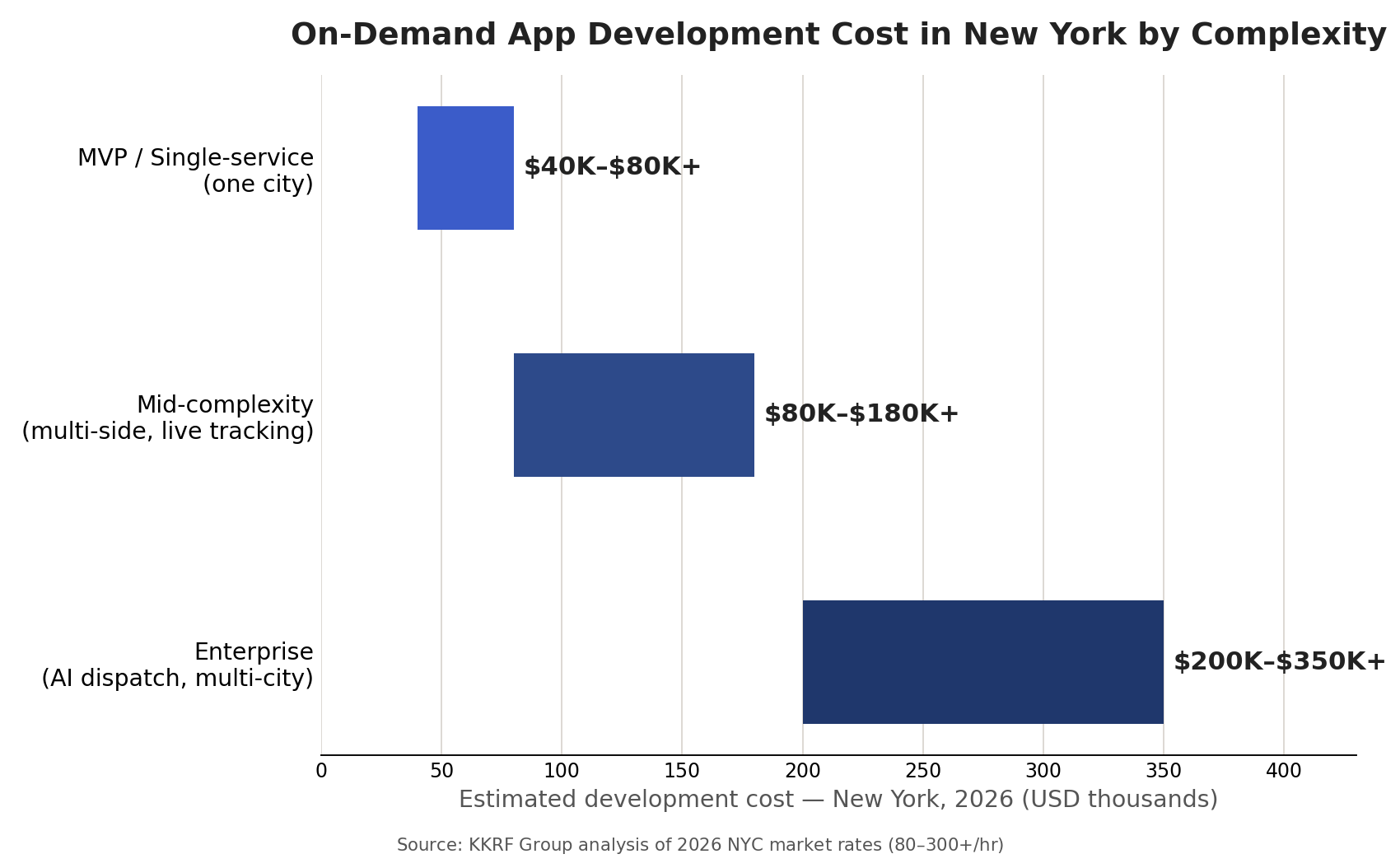
Building an on-demand app in New York costs between $40,000 and $350,000 or more in 2026. A single-service MVP for one borough starts around $40,000–$80,000, while a feature-rich, multi-city platform with AI dispatch can exceed $300,000. Most funded NYC startups spend $80,000–$180,000 for a market-ready product with two or three synchronized apps.
New York rates sit at the top of the U.S. range. Local senior mobile engineers bill roughly $150–$250 per hour, and NYC’s average across top app firms lands near $100+ per hour, which is why the same feature set costs more here than in most other markets. Many teams control this by blending NYC product leadership with distributed engineering.
| App type | Typical NYC cost (2026) | Timeline |
|---|---|---|
| Single-service MVP (one city) | $40,000–$80,000 | 4–6 months |
| Food delivery / courier app | $60,000–$150,000 | 5–8 months |
| Ride-hailing (uber-like) app | $80,000–$250,000 | 6–10 months |
| Home services marketplace | $60,000–$180,000 | 5–9 months |
| Enterprise multi-city platform | $200,000–$350,000+ | 9–12+ months |
What Drives On-Demand App Development Costs
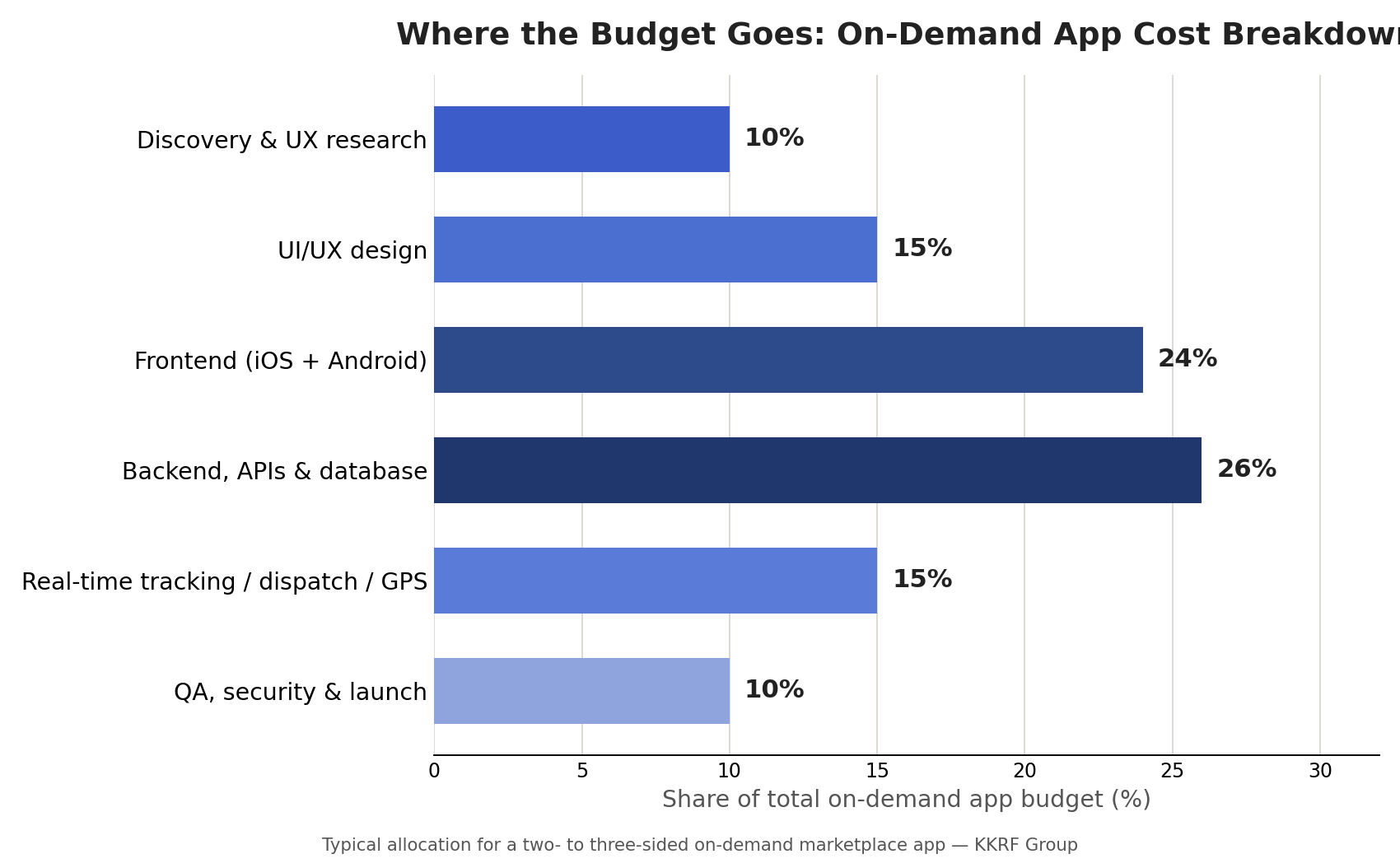
The single biggest cost driver is the number of “sides” the platform coordinates. A customer-only app is cheap; a customer app plus a provider app plus an admin panel plus a live matching engine is a different animal. Real-time features multiply the backend and QA effort behind the scenes.
The Main Cost Drivers
- Number of sides — each additional role (customer, provider, admin) adds design, code, and testing.
- Real-time tracking & dispatch — GPS, geofencing, and matching logic are engineering-heavy.
- Payments & payouts — split payments, provider payouts, and PCI-DSS scope add integration work.
- Platforms — iOS + Android + web admin costs more than a single platform.
- Third-party integrations — maps, SMS, identity checks, and analytics each carry setup and license cost.
- Compliance — HIPAA (health) or heavy data-privacy requirements raise the security bill.
Must-Have Features for an On-Demand App
Most on-demand platforms are two- or three-sided, and each side needs its own dedicated app or interface. A feature that’s optional for the customer is often mandatory for the provider, so scoping all sides up front prevents the most expensive kind of rework.
Customer App
- Quick registration and social or phone login
- Search, filters, and service or restaurant discovery
- Real-time GPS tracking of the provider or order
- In-app payments, tipping, and saved cards
- Ratings, reviews, and order history
- Push notifications and in-app support chat
Provider / Driver App
- Availability toggle and job requests with accept or reject
- Turn-by-turn navigation and optimized routing
- Earnings dashboard and in-app payouts
- Status updates and proof of delivery or completion
Admin Dashboard
- Live dispatch and order monitoring
- User, provider, and content management
- Commission, pricing, and promotion controls
- Analytics, reporting, and dispute resolution
The admin panel is the part first-time founders most often underestimate. It’s where you set commissions, resolve disputes, and watch the marketplace breathe in real time. Skimp on it, and you’ll be running your business through database queries within a month of launch.
The Tech Stack Behind On-Demand Apps
A Proven On-Demand Stack
- Frontend: React Native or Flutter for cross-platform apps; native Swift or Kotlin where performance is critical.
- Backend: Node.js or Python, with PostgreSQL for core data and Redis for real-time state.
- Real-time & maps: WebSockets for live updates; Google Maps or Mapbox for geolocation, routing, and geofencing.
- Payments: Stripe, Braintree, or PayPal, scoped for PCI-DSS compliance.
- Infrastructure: AWS or Google Cloud, containerized with Docker and Kubernetes for elastic scaling.
- Notifications: Firebase Cloud Messaging for push, plus SMS fallback.
We usually recommend React Native or Flutter for on-demand builds because a shared codebase cuts both cost and time-to-market without giving up the native feel users expect. Where a specific feature — say, high-frequency background location — demands it, we drop to native modules for that slice only.
Have an on-demand concept and want a realistic number before you commit? Our team will map your features to a clear budget and timeline. Talk to our New York app team about your build.
Get a Custom Project Estimate →The On-Demand App Development Process, Step by Step
A disciplined process is what keeps an on-demand build on budget. At KKRF Group, an on-demand app development company in New York, we run the same six-phase approach whether the client is a two-person startup or an enterprise, adjusting depth rather than skipping steps.
Six Phases From Idea to Launch
- 1. Discovery & scoping — We define the sides, core flows, and success metrics, then lock a prioritized feature list for the MVP.
- 2. UX/UI design & prototyping — We design each side’s screens and validate the flows with a clickable prototype before any code is written.
- 3. Architecture & backend — We stand up the database, APIs, matching engine, and real-time infrastructure the apps will depend on.
- 4. App development — We build the customer app, provider app, and admin dashboard in parallel sprints with regular demos.
- 5. QA, security & compliance — We test real-time flows under load, run security checks, and confirm payment and privacy compliance.
- 6. Launch & scaling — We ship to the App Store and Google Play, monitor live performance, and expand capacity as demand grows.
How Long Does It Take to Build an On-Demand App?
An on-demand app MVP takes four to six months to build and launch in New York. A full-featured, multi-city platform with advanced dispatch and analytics typically takes nine to twelve months or more. The timeline scales with the number of sides, the complexity of the matching logic, and how many integrations need testing.
The fastest path to market is a focused MVP: one city, one core service, the essential features on each side, and nothing else. We’ve seen this go wrong when founders try to launch every borough and every feature at once — the scope balloons, the launch slips, and the burn climbs. Start narrow, prove the loop, then expand.
White-Label vs Custom On-Demand App Development
One of the first real decisions is whether to buy a white-label solution or build custom. A white-label app is a pre-built platform you rebrand and launch quickly; a custom app is engineered specifically for your business model and owned outright. Each fits a different stage and strategy.
| Factor | White-label | Custom development |
|---|---|---|
| Upfront cost | $15,000–$40,000 | $60,000–$350,000+ |
| Time to launch | 2–6 weeks | 4–12 months |
| Differentiation | Low — shared feature set | High — built to your model |
| Scalability | Limited by the platform | Architected to scale |
| Code ownership | Usually licensed | Full ownership |
| Best for | Fast, low-cost market test | Long-term, fundable product |
Choose white-label when you need to validate demand cheaply and speed matters more than differentiation. Choose custom when the marketplace is your core business, you expect to raise capital, or your model needs mechanics a generic platform can’t support. Many NYC founders start white-label to test, then rebuild custom once the demand is real.
Security, Compliance & Scalability in New York
On-demand apps handle location, payment, and personal data continuously, which makes security a first-order requirement rather than a finishing touch. In New York, that also means meeting specific regulatory expectations depending on your vertical.
What Secure On-Demand Apps Get Right
- Payment security — PCI-DSS-compliant handling of cards and payouts, with no raw card data on your servers.
- Data privacy — encryption in transit and at rest, aligned with the New York SHIELD Act and modern privacy norms.
- Healthcare compliance — HIPAA-scoped architecture for any telehealth or at-home care app.
- Secure authentication — token-based auth, role-based access, and protection against account takeover.
- Scalability — auto-scaling infrastructure that absorbs rush-hour and weather-driven demand spikes.
Security-first architecture is part of how KKRF Group approaches every build. We align mobile security with the OWASP Mobile Top 10 and design encryption, access control, and audit logging into the foundation rather than bolting them on before launch — retrofitting security is slower, riskier, and more expensive every time.
How On-Demand Apps Make Money
On-demand platforms earn revenue from the transactions they enable. Most successful apps combine two or three of these models rather than relying on a single stream, which smooths income and reduces dependence on volume alone.
Common Revenue Models
- Commission — a percentage of each completed transaction, the most common on-demand model.
- Delivery or service fees — a flat or dynamic fee charged to the customer per order.
- Subscriptions — memberships that waive fees or unlock perks (think DashPass-style plans).
- Surge or dynamic pricing — higher prices during peak demand, shared with providers.
- Featured listings & ads — providers pay for visibility within the app.
When we model revenue with clients, commission plus a modest customer fee is usually the durable core, with subscriptions layered on once there’s a loyal base. Chasing surge pricing too early tends to annoy users before the marketplace is dense enough to justify it.
Common On-Demand App Mistakes to Avoid
Most on-demand projects that stall don’t fail on the idea — they fail on execution choices that were avoidable. These are the patterns we see most often, and each one is fixable with better scoping up front.
Mistakes That Sink On-Demand Builds
- Neglecting the provider side — if drivers or providers have a poor experience, supply dries up and the app dies.
- Underbuilding the admin panel — you can’t run a live marketplace without real operational controls.
- Launching everywhere at once — spreading thin across cities before proving one market burns cash fast.
- Skipping real-time load testing — tracking and dispatch break exactly when demand peaks.
- No dispute or refund flow — disputes are inevitable; handling them manually doesn’t scale.
- Picking the cheapest team — real-time marketplaces punish inexperience, and rebuilds cost more than doing it right once.
How to Choose an On-Demand App Development Company in New York
Choosing an on-demand app development company in New York comes down to proven marketplace experience, not just a portfolio of pretty screens. The right partner has shipped real-time, multi-sided systems before and can show you how they handled dispatch, payments, and scale under pressure.
Evaluate a Partner On
- Marketplace track record — have they built two- or three-sided apps with live matching, not just single-user apps?
- Real-time engineering depth — can they speak concretely about GPS, WebSockets, and dispatch logic?
- NYC market understanding — do they grasp local density, competition, and compliance?
- Transparent process — clear scope, milestones, and a fixed or capped budget with regular demos.
- Security-first approach — compliance and data protection designed in from the start.
- Post-launch support — a real plan for maintenance, monitoring, and scaling after go-live.
Whether you need on-demand app development services in New York for a delivery app, a ride-hailing platform, or a home-services marketplace, one rule holds: hire on-demand app developers who’ve shipped live marketplaces before. Founders comparing the best on-demand app development company options should weigh proven launches over the lowest bid. That’s the standard on-demand app development New York businesses deserve, and it’s why experienced on-demand app development NYC teams price for the complexity involved.
As an on-demand app development company in New York, KKRF Group fits the custom end of that framework: NYC founders and enterprises that need an on-demand product built to scale, own, and defend. We pair New York product leadership with senior engineering and a transparent, milestone-based process.
On-Demand App Trends Shaping 2026
The on-demand model keeps evolving, and a few shifts are worth designing for now rather than retrofitting later. Building with these in mind protects your app from feeling dated a year after launch.
What’s Changing in 2026
- AI-driven matching & pricing — smarter dispatch and dynamic pricing that adapt to real-time demand.
- Hyperlocal & quick commerce — sub-30-minute delivery from micro-fulfillment hubs.
- Greener logistics — EV and bike-based fleets, increasingly relevant in New York.
- Super-app bundling — multiple services under one login to raise lifetime value.
- Voice and AI assistants — conversational ordering and support baked into the customer app.
Our take: AI-driven dispatch is the trend with the clearest near-term ROI for New York apps, because better matching directly cuts wait times and idle provider time. The rest matter, but they pay off later in a platform’s life.
Ready to turn your on-demand idea into a working product? We’ll review your model, flag the real risks, and outline an architecture built to scale in the New York market. See how we build on-demand apps in NY.
Book a Discovery Call →Frequently Asked Questions
How much does it cost to build an on-demand app in New York?
In 2026, an on-demand app in New York typically costs $40,000 to $350,000 or more. A single-service MVP runs $40,000–$80,000, most funded startups spend $80,000–$180,000, and enterprise multi-city platforms exceed $200,000. NYC developer rates of $150–$250 per hour are the main reason costs sit at the top of the U.S. range.
How long does it take to develop an on-demand app?
An on-demand app MVP takes four to six months to build and launch. A full multi-city platform with advanced dispatch and analytics takes nine to twelve months or more. The timeline scales with the number of user roles, the complexity of the matching logic, and the number of integrations that need testing.
What features does an on-demand app need?
An on-demand app needs three coordinated interfaces: a customer app with search, real-time tracking, and payments; a provider app with job requests, navigation, and earnings; and an admin dashboard for dispatch, pricing, and dispute resolution. Real-time GPS tracking, secure payments, and push notifications are essential across all sides.
Should I build a white-label or custom on-demand app?
Choose a white-label app to validate demand quickly for $15,000–$40,000 in two to six weeks. Choose custom development when the marketplace is your core business, you plan to raise capital, or your model needs mechanics off-the-shelf software cannot support. Many New York founders start white-label, then rebuild custom once demand is proven.
Which tech stack is best for on-demand apps?
A proven on-demand stack uses React Native or Flutter for the apps, Node.js or Python with PostgreSQL and Redis on the backend, WebSockets and Google Maps or Mapbox for real-time tracking, Stripe or Braintree for payments, and AWS or Google Cloud for scalable infrastructure. The stack is chosen for reliability under real-time load, not just build speed.
How do on-demand apps make money?
On-demand apps earn revenue mainly through commissions on each transaction, delivery or service fees charged to customers, subscription memberships, dynamic surge pricing during peak demand, and paid featured listings for providers. Most successful platforms combine two or three of these models to stabilize revenue.
Whether you’re validating a concept or scaling an existing platform, KKRF Group builds on-demand apps engineered for the New York market. Let’s put real numbers and a real plan behind your idea. Start the conversation today.
Request a Consultation →