
Web application development costs between $8,000 and $400,000+ in 2026, with most business-grade builds landing in the $40,000–$150,000 range. The exact figure depends on complexity, the number of features, third-party integrations, and where your team sits. At KKRF Group — an experienced custom software development company that ships web platforms for startups, scale-ups, and enterprises — we’ve scoped hundreds of these projects, and the same truth holds every time: price is set by decisions you make before a single line of code is written. This guide breaks down real 2026 cost ranges, shows where the budget actually goes phase by phase, and explains how to keep spend under control without gutting quality.
Key Takeaways
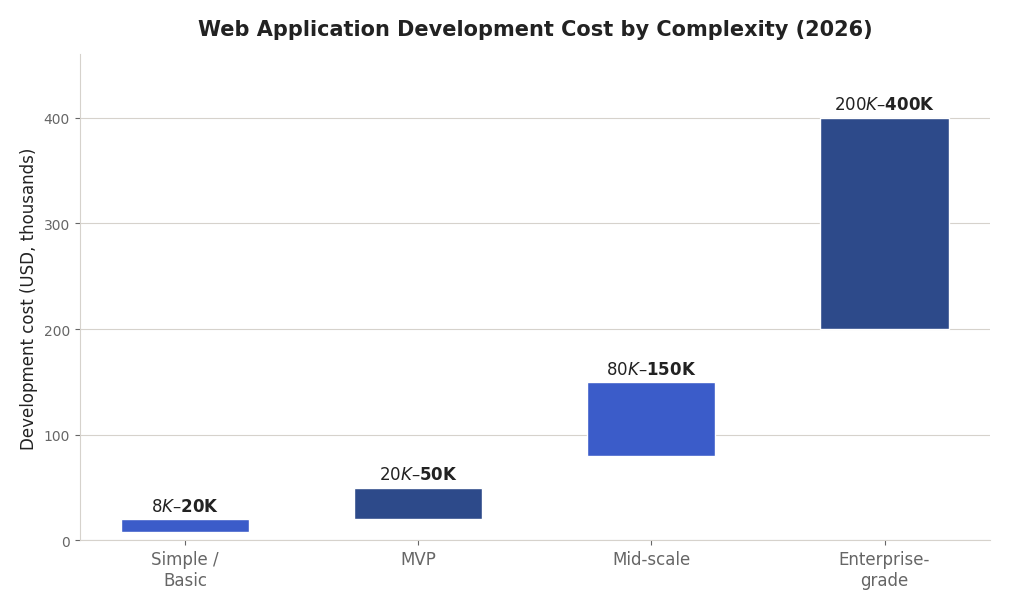
- Typical 2026 range: $8K for a simple app, $20K–$50K for an MVP, $80K–$150K for mid-scale, and $200K–$400K+ for enterprise-grade web applications.
- Biggest cost drivers: feature complexity, custom UI/UX, third-party and payment integrations, security and compliance needs, and developer location.
- Where the money goes: engineering is usually ~45% of a build; discovery, design, QA, and DevOps make up the rest.
- Ongoing cost: plan for annual maintenance of roughly 15–20% of the initial build price, plus hosting and third-party subscriptions.
- How to save: ship a focused MVP first, reuse proven frameworks, and fix scope before development instead of mid-project.
What This Guide Covers
- Quick answer: 2026 cost
- What web app development is
- Cost by complexity
- 9 factors that shape cost
- Cost breakdown by phase
- Pricing models compared
- Hidden & ongoing costs
- How your tech stack affects cost
- Developer rates by region
- How to reduce cost
- Costing mistakes to avoid
- Is a custom web app worth it?
- Choosing a development partner
- What is changing in 2026
- FAQ
Quick Answer: How Much Does Web Application Development Cost in 2026?
A web application costs $8,000 to $400,000+ to build in 2026. A simple internal tool starts around $8,000–$20,000. A market-ready MVP runs $20,000–$50,000. A mid-scale product with custom workflows and integrations lands at $80,000–$150,000. A large enterprise-grade platform — with strict security, heavy integrations, and high traffic — frequently exceeds $200,000 and can reach $400,000 or more. The single largest variables are feature complexity, design depth, and the hourly rate of the team building it.
What Is Web Application Development?
Web application development is the process of designing, building, testing, and deploying software that runs in a web browser rather than as an installed desktop or mobile app. Unlike a static website, a web application is interactive: users log in, enter data, and complete real tasks such as banking, booking, project management, or online shopping. Common examples include tools like Gmail, Trello, and Shopify dashboards. A web app combines a frontend (what users see), a backend (business logic and databases), and infrastructure (hosting, security, and scaling).
The cost of a web application reflects everything required to make that system reliable, secure, and usable at scale — not just writing code. You pay for product discovery, interface design, engineering, quality assurance, deployment automation, security hardening, and post-launch support. Understanding those components is the first step to reading any quote accurately.
Web Application Development Cost by Complexity
The clearest way to estimate a web app budget is by complexity tier. Each tier maps to a predictable range of features, engineering hours, and timelines. The table below shows the typical web application development cost for each, based on prevailing market rates across specialist development firms.
| App type | Typical 2026 cost | Timeline | Best for |
|---|---|---|---|
| Simple / basic app | $8,000 – $20,000 | 1–3 months | Internal tools, single-purpose utilities |
| MVP (market-ready) | $20,000 – $50,000 | 3–5 months | Startups validating an idea with real users |
| Mid-scale application | $80,000 – $150,000 | 5–9 months | Growing products with custom workflows |
| Enterprise-grade platform | $200,000 – $400,000+ | 9–18+ months | High-traffic, compliance-heavy systems |
A quick note from experience: the jump between tiers is rarely linear. Adding real-time features, an admin panel, role-based permissions, or a second user type can push an MVP into mid-scale territory faster than most founders expect. Scope discipline early is what keeps a build inside its tier.
9 Factors That Shape Your Web App Development Cost
Two apps that look similar on the surface can differ in price by six figures. These nine factors explain almost every gap between quotes. Weigh each one against your actual business need before signing off on a budget.
1. Feature scope and complexity
Every feature carries a design, engineering, and testing cost. A login form is cheap; real-time collaboration, custom dashboards, and workflow automation are not. Feature scope is the number-one driver of web application development cost, and unmanaged scope creep is the number-one reason budgets overrun.
2. Custom UI/UX design
A templated interface keeps costs down, while pixel-crafted, branded, animation-rich design adds significant hours. Good UX pays for itself in adoption, but every custom screen, state, and interaction is billable work. Expect design to consume roughly 10–15% of the total build.
3. Third-party and payment integrations
Each external system — payment gateways, CRMs, ERPs, mapping, analytics, or messaging APIs — adds integration and testing effort. Payment and financial integrations cost more because they demand extra security review and edge-case handling. A single complex integration can add several thousand dollars on its own.
4. Security and compliance requirements
Applications handling health, financial, or personal data must meet standards such as HIPAA, PCI DSS, GDPR, or SOC 2. Meeting them means encryption, audit logging, access controls, and formal testing — real engineering hours, not a checkbox. Compliance can add 15–30% to a project’s cost, and skipping it is far more expensive later.
5. Technology stack
The frameworks and infrastructure you choose affect both build speed and long-term maintenance cost. Mature, well-supported stacks reduce risk and hiring difficulty; niche technologies can raise rates and slow delivery. Stack choice is covered in detail below.
6. Team size, seniority, and location
A developer’s hourly rate varies from roughly $25 in parts of Asia to $150+ in North America. Rate is not the same as value: an experienced senior who ships clean, tested code often costs less per outcome than a cheap team that needs constant rework. Location and seniority together can double or halve a quote.
7. Number of user roles and platforms
Supporting one user type is simpler than supporting admins, customers, and vendors, each with different permissions and screens. Responsive design for phones, tablets, and desktops adds testing surface. More roles and more devices mean more to build and verify.
8. Data volume, performance, and scalability
An app for 100 users is architected differently than one for 1,000,000. Caching, load balancing, database optimization, and cloud-native design add upfront cost but prevent expensive rebuilds. If you expect rapid growth, paying for scalable architecture early is cheaper than retrofitting it.
9. Timeline and urgency
Compressing a nine-month build into five months usually means adding people, which raises cost and coordination overhead. Rushed timelines also increase the risk of technical debt that must be repaid later. A realistic schedule is one of the cheapest ways to protect a budget.
Where the Budget Goes: Cost Breakdown by Project Phase
Understanding how a build is split across phases helps you judge whether a quote is realistic. A proposal that spends nothing on discovery or QA is a warning sign, not a bargain. The chart below shows a typical distribution for a well-run web application project.
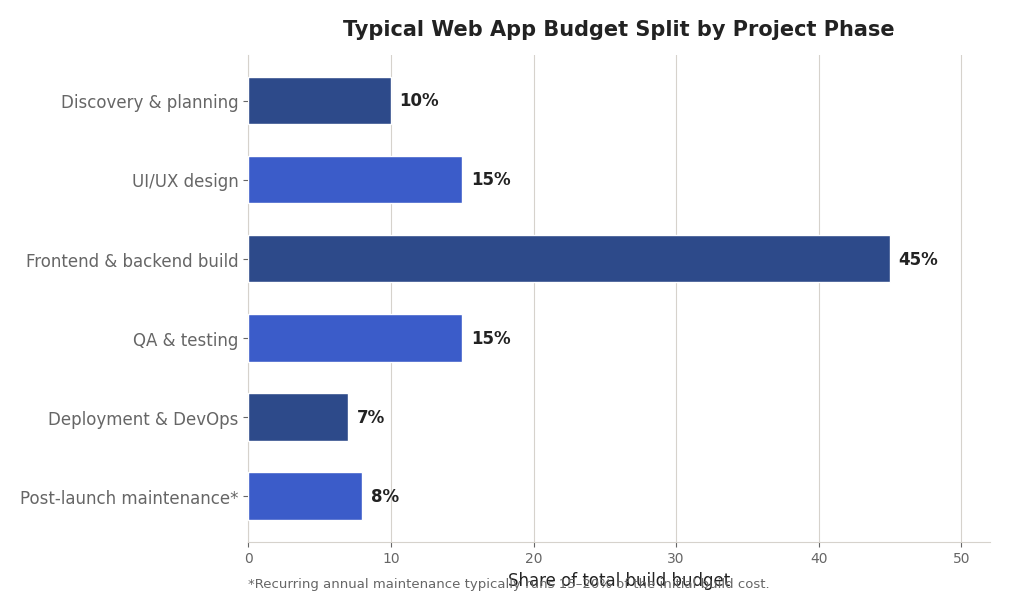
Discovery and planning (~10%): Requirements, user stories, architecture, and a project roadmap. Getting this right prevents the most expensive class of mistake — building the wrong thing.
UI/UX design (~15%): Wireframes, prototypes, and a design system that defines how the product looks and behaves. Strong design directly improves adoption and reduces costly rework.
Frontend and backend development (~45%): The core engineering effort — building interfaces, business logic, databases, and APIs. This is where most hours and most cost concentrate.
QA and testing (~15%): Manual and automated testing to catch defects before users do. Cutting QA is a false economy; production bugs cost far more to fix.
Deployment and DevOps (~7%): Setting up hosting, CI/CD pipelines, monitoring, and release automation so the app ships safely and updates smoothly.
Post-launch maintenance (~8% shown, plus ongoing): The initial launch is the start, not the finish. Budget for recurring maintenance of roughly 15–20% of the build cost every year.
Web App Development Pricing Models Compared
How you pay matters as much as how much you pay. The three common engagement models suit different levels of scope certainty. Choosing the wrong one is a frequent source of budget friction.
| Pricing model | How you pay | Best for | Main trade-off |
|---|---|---|---|
| Fixed price | One agreed sum for a defined scope | Small, well-defined projects with stable requirements | Little flexibility; changes require renegotiation |
| Time & materials | Hourly or per-sprint billing for actual work | Evolving products where scope will change | Requires trust and active budget tracking |
| Dedicated team | Monthly rate for a committed team | Long-term products and ongoing development | Higher commitment; best value over time |
Fixed price gives budget certainty but punishes change — every new idea becomes a change request. Time and materials fits products that will evolve, which describes most real software. A dedicated development team is usually the most cost-effective model for anything you plan to grow over years, because it removes repeated re-scoping overhead. As an experienced custom software development company, KKRF Group typically recommends time-and-materials or dedicated-team models for products expected to change after launch.
Not sure which tier or pricing model fits your product? Our engineers will map your requirements to a realistic budget and timeline — no obligation. See how we work before you commit.
Get a Custom Project Estimate →Hidden and Ongoing Costs of Web Applications
The build price is only part of the total cost of ownership. Teams that budget only for development are the ones caught out three months after launch. Plan for these recurring and easily missed expenses from day one.
- Maintenance and updates: Roughly 15–20% of the build cost per year for bug fixes, security patches, dependency upgrades, and small improvements.
- Hosting and infrastructure: Cloud costs on AWS, Azure, or Google Cloud scale with traffic and data — from tens to thousands of dollars monthly.
- Third-party subscriptions: Payment processors, email, analytics, monitoring, and API access often carry monthly or usage-based fees.
- Security and compliance: Ongoing audits, penetration testing, and certifications renew on a schedule and are not one-time costs.
- Scaling and performance: Growth eventually demands architecture work, database tuning, or infrastructure upgrades.
- Support and monitoring: Uptime monitoring, incident response, and user support all require budget or staff time.
A useful rule: over a three-year horizon, ongoing costs often match or exceed the original build price. Factoring that in early leads to smarter architecture decisions and fewer unpleasant surprises.
How Your Technology Stack Affects Cost
The technology stack is the set of programming languages, frameworks, and tools used to build an application. Stack choice affects development speed, hiring cost, performance, and long-term maintenance — so it has a direct financial impact on web application development cost well beyond launch.
Frontend: Frameworks like React, Vue, and Angular are mature and widely supported, which keeps hiring easy and rates stable. A progressive web app (PWA) can deliver app-like experiences without separate native builds, often reducing total cost for reaching mobile users.
Backend: Node.js, Python (Django), Ruby on Rails, Java, and .NET each suit different needs. Node and Python speed up early development; Java and .NET are common in enterprise systems with heavy compliance and integration demands.
Database and infrastructure: The choice between SQL and NoSQL, and between managed cloud services (for example, AWS) and self-hosting, shapes both performance and running cost. Cloud-native, containerized architecture costs more upfront but scales more cheaply as usage grows.
Our guidance is simple: choose proven, well-supported technologies unless a specific requirement demands otherwise. Exotic stacks can look impressive but raise rates, shrink the hiring pool, and inflate maintenance cost for years. You can review the engineering approach behind these decisions on our software engineering page.
Web Developer Rates by Region and Engagement
Developer location is one of the biggest reasons web application development cost differs. The same feature can cost three times more depending on where the team sits. The table below shows typical 2026 hourly rates for web development talent by region.
| Region | Typical 2026 hourly rate | Notes |
|---|---|---|
| North America | $100 – $180+ | Highest rates; deep senior talent and time-zone alignment for US clients |
| Western Europe | $80 – $150 | Strong engineering quality; GDPR familiarity |
| Eastern Europe | $40 – $75 | Popular for balance of quality and cost |
| Latin America | $40 – $70 | Growing hub; overlaps US working hours |
| South & Southeast Asia | $25 – $50 | Lowest rates; quality varies widely by vendor |
Lower rates do not automatically mean lower total cost. A cheaper team that produces rework, misses requirements, or writes fragile code can cost more per delivered outcome than a higher-rate team that gets it right the first time. Judge vendors on delivered value and code quality, not the headline hourly figure.
How to Reduce Web App Development Cost Without Cutting Quality
Cutting cost is not about paying less per hour — it is about wasting fewer hours, because most of your web application development cost is labour. These strategies reliably lower spend while protecting the product.
- Start with an MVP: Build the smallest version that delivers real value, launch, learn, then invest in what users actually want.
- Fix scope before you build: A clear specification prevents mid-project changes, which are the most expensive kind.
- Reuse proven frameworks and components: Do not rebuild authentication, payments, or dashboards from scratch when reliable building blocks exist.
- Prioritize ruthlessly: Separate must-have features from nice-to-haves and defer the rest to later phases.
- Invest in QA early: Catching defects during development is far cheaper than fixing them in production.
- Choose the right engagement model: Match fixed-price, time-and-materials, or dedicated-team billing to how much your scope will change.
The most expensive web application is the one you have to rebuild because it was rushed or under-specified. Spending a little more on discovery and design almost always lowers the total cost of the project.
Common Costing Mistakes That Blow Budgets
Most budget overruns trace back to a handful of avoidable errors that quietly inflate the total web application development cost. Recognizing them early is the cheapest insurance you can buy.
- Chasing the lowest quote: An unusually cheap bid often hides missing scope, junior staffing, or change-order surprises.
- Ignoring maintenance: Budgeting only for the build and nothing for the years of operation that follow.
- Vague requirements: Starting development without a clear specification guarantees costly rework.
- Over-building the first version: Loading an MVP with features users have not validated wastes capital.
- Skipping security and QA: Deferring these creates technical debt that is expensive and risky to repay later.
- No contingency buffer: Real projects change; a 10–20% reserve prevents small surprises from derailing delivery.
Decision Framework: Is a Custom Web App Worth It?
Custom web application development is not always the right answer. This framework helps you decide before you spend.
Choose a custom web app when
- Your workflow is unique and off-the-shelf tools force awkward compromises.
- You need to own your data, integrations, and roadmap rather than rent them.
- The application is core to your business model or a direct revenue driver.
- You expect to scale and need architecture that grows with you.
Reconsider or delay when
- A configurable SaaS product already covers 90% of your needs at a fraction of the cost.
- You have not validated demand and could test the idea with a no-code tool first.
- Budget is tight and the app is a supporting convenience rather than a core function.
Limitations to weigh: A custom build takes months, requires ongoing maintenance, and ties up capital that a startup might deploy elsewhere. Our recommendation: if the application is central to how you make money and existing tools genuinely fall short, custom development pays back through efficiency, differentiation, and control. If it is peripheral or unvalidated, start smaller. For products headed toward a subscription model, our SaaS development approach can stage the investment sensibly.
How to Evaluate a Web Development Partner
The team you hire affects cost more than any framework or feature list. A strong partner prevents the rework, delays, and rebuilds that quietly double a budget. Use these criteria to evaluate any vendor.
- Relevant portfolio: Shipped web applications similar in complexity to yours, ideally in your industry.
- Transparent process: A clear methodology for discovery, estimation, and delivery, with regular demos.
- Technical depth: Genuine expertise in modern frontend, backend, cloud, and security — not just one layer.
- Communication: Responsive, plain-spoken updates and honesty about trade-offs and risk.
- Post-launch support: A real plan for maintenance, monitoring, and future development.
- Code ownership: Clear contracts confirming you own the source code and intellectual property.
KKRF Group approaches web application projects as a long-term technology partner: enterprise-grade architecture, security-first development, transparent estimation, and a stack chosen for maintainability rather than novelty. That combination is what keeps total cost of ownership predictable well beyond launch day.
What Is Changing Web App Costs in 2026 and Beyond
The economics of web development are shifting. A few trends are worth factoring into any 2026 budget.
AI-assisted development is speeding up routine coding, testing, and documentation, which can trim engineering hours on well-scoped work. It does not replace senior judgment on architecture and security, so it compresses cost rather than eliminating it.
Cloud-native and serverless architecture is lowering the barrier to building scalable apps, shifting spend from upfront infrastructure toward usage-based operating cost. That makes early-stage launches cheaper but demands careful cost monitoring as you grow.
Rising security and privacy expectations mean compliance is becoming a baseline requirement, not a premium add-on. Budgeting for security from the start is now the cheaper long-term path. For infrastructure planning, a cloud consulting review early in the project often reduces running costs later.
Ready to turn a rough idea into a costed plan? We will scope your web application, recommend a stack, and give you a transparent estimate you can build a budget around.
Discuss Your Project →Frequently Asked Questions
How much does it cost to build a web application in 2026?
Web application development costs $8,000 to $400,000+ in 2026. A simple app runs $8,000–$20,000, a market-ready MVP $20,000–$50,000, a mid-scale product $80,000–$150,000, and an enterprise-grade platform $200,000–$400,000 or more. The final price depends on feature complexity, design, integrations, security needs, and the team’s hourly rate.
How much does it cost to build an MVP web application?
A minimum viable product typically costs $20,000 to $50,000 and takes three to five months. Cost rises toward the top of that range once you add cybersecurity requirements, external integrations, or advanced UX. An MVP deliberately ships only the core features needed to validate demand with real users.
What is the ongoing cost of maintaining a web application?
Annual maintenance usually runs 15–20% of the initial build cost. That covers bug fixes, security patches, dependency upgrades, and small improvements. On top of maintenance, budget for cloud hosting, third-party subscriptions, and monitoring, all of which scale with usage.
Why do web application development quotes vary so much?
Quotes vary because feature scope, design depth, integrations, security requirements, and developer location differ enormously between projects. Hourly rates alone range from about $25 in parts of Asia to $180+ in North America. Two apps that look similar can differ by six figures once scope and quality expectations are compared.
Is it cheaper to build a custom web app or use an off-the-shelf SaaS product?
Off-the-shelf SaaS is cheaper upfront and best when it covers most of your needs. A custom web application costs more initially but pays back when your workflow is unique, the app is core to your revenue, or you need to own your data and roadmap. The right choice depends on how central the application is to your business.
How can I reduce web application development cost without losing quality?
Start with a focused MVP, fix scope before development begins, reuse proven frameworks instead of rebuilding common features, and invest in QA early to avoid expensive production fixes. Matching the right pricing model to your project also prevents wasted spend. Cutting hourly rate is far less effective than cutting wasted hours.
You now know what a web application should cost — the next step is a number tailored to your project. Talk to KKRF Group’s engineering team for a transparent estimate, architecture guidance, and a realistic timeline. Start on our contact page.
Talk to Our Engineering Team →