
Most New York founders don’t need a finished product to raise a seed round or land their first hundred users. They need the right MVP. At KKRF Group, a top mobile app development company, we help NYC teams scope a lean first build that ships in weeks instead of quarters — then grows on real user feedback. This guide breaks down what MVP app development in New York actually costs, how long it takes, and how to build one without burning your runway.
Key Takeaways
- An MVP app in New York typically costs $15,000–$150,000 and ships in 8–20 weeks, depending on complexity.
- Scope is the biggest cost lever. A focused feature set beats a long wishlist every time.
- Consumer MVPs usually launch in 8–16 weeks; marketplaces and regulated FinTech or healthtech apps take longer.
- React Native and Flutter let early teams launch on iOS and Android from one codebase, saving budget.
- The goal isn’t a small product — it’s a fast, honest test of whether people want what you’re building.
- KKRF Group builds MVPs for NYC startups on an enterprise-grade foundation, so the app scales after product-market fit.
What This Guide Covers
- Quick Answer: MVP Development in New York
- What Is an MVP in App Development?
- Why New York Startups Build an MVP First
- MVP App Development Cost in New York (2026)
- How Long Does It Take to Build an MVP in NYC?
- The MVP Development Process: 7 Steps
- Choosing the Right Tech Stack for Your MVP
- MVP vs. Prototype vs. Proof of Concept
- In-House vs. Agency vs. Offshore Development
- Common MVP Mistakes That Sink NYC Startups
- How to Choose an MVP Company in New York
- MVP Trends Shaping NYC Startups in 2026
- Frequently Asked Questions
Quick Answer: MVP Development in New York
MVP app development in New York typically costs between $15,000 and $150,000 and takes 8 to 20 weeks, depending on how many features the app needs, how many platforms it targets, and whether it handles regulated data. A basic single-platform MVP sits at the low end. A two-sided marketplace or a FinTech app with compliance requirements sits at the top. For most NYC startups, the smartest move is to cut scope to the one workflow that proves demand, launch it fast, and expand only after real users respond.
KKRF Group is a top mobile app development company that partners with New York startups and enterprises to build mobile products end to end. We’ve shipped iOS, Android, and cross-platform apps across FinTech, healthcare, and SaaS, and we bring the same enterprise-grade engineering discipline to a scrappy MVP as we do to a production platform. The sections below reflect how we actually scope, price, and build minimum viable products for NYC founders.
What Is an MVP in App Development?
The word “minimum” trips people up. An MVP is not a low-quality app or a half-finished one. It’s a complete experience around a single, sharp use case. Instagram launched as photo sharing with filters, not a social network. That focus is the point: build the one thing that proves people want what you’re offering, and leave the rest for later.
Why New York Startups Build an MVP First
New York’s funding market is competitive and fast. The average pre-seed check in New York runs around $2.58 million, and investors expect traction, not slide decks. An MVP turns a pitch into evidence — real users, real retention, real conversion. That evidence is what moves a seed conversation forward.
Runway is the other reason. Every week spent building features nobody asked for is runway you can’t get back. Building an MVP first forces a hard question: what is the one thing this product must do to be worth using? Answer that, ship it, and let returning users tell you what comes next.
MVP App Development Cost in New York (2026)
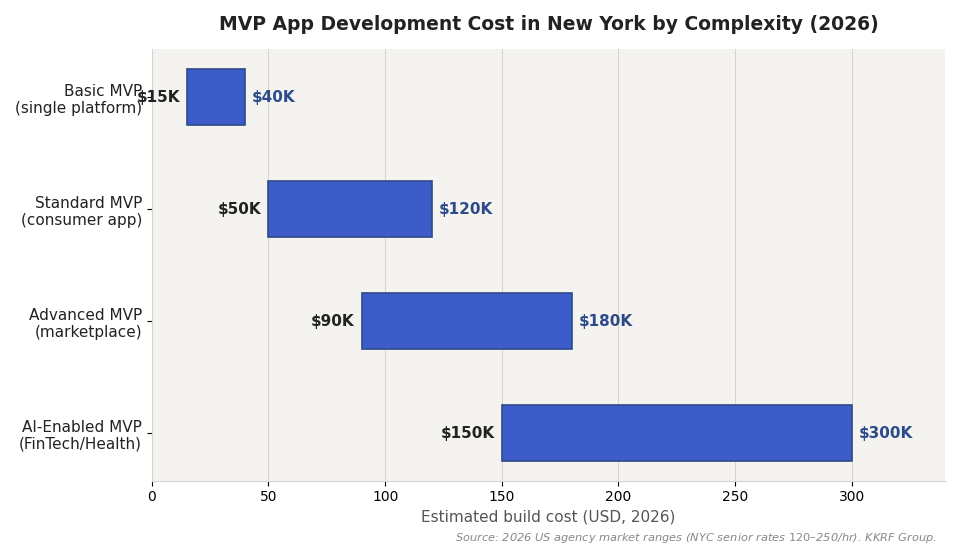
MVP app development cost in New York in 2026 ranges from about $15,000 for a basic single-platform build to $300,000 for an AI-enabled FinTech or healthcare MVP. Most funded startups land between $50,000 and $150,000 for a production-ready consumer app. The range is wide because “MVP” means very different things depending on the product.
| App type | Typical NYC cost (2026) | Timeline |
|---|---|---|
| Basic MVP (single platform) | $15K–$40K | 4–8 weeks |
| Standard consumer MVP (iOS + Android) | $50K–$120K | 8–16 weeks |
| Marketplace / two-sided MVP | $90K–$180K | 14–24 weeks |
| FinTech / healthtech MVP (compliance) | $150K–$300K | 14–28 weeks |
Three things move MVP cost more than anything else: the number of features, the number of platforms, and how much regulated data the app touches. NYC senior mobile engineers bill roughly $120–$250 per hour, so every extra screen has a real price. Design complexity, third-party integrations like Stripe, and ongoing maintenance — budget 15–20% of build cost per year — round out the total.
Not sure where your idea lands on this range? We’ll map it to a realistic scope, cost, and timeline — talk to our team and get a straight answer, not a sales pitch.
Get a Custom Project Estimate →How Long Does It Take to Build an MVP in NYC?
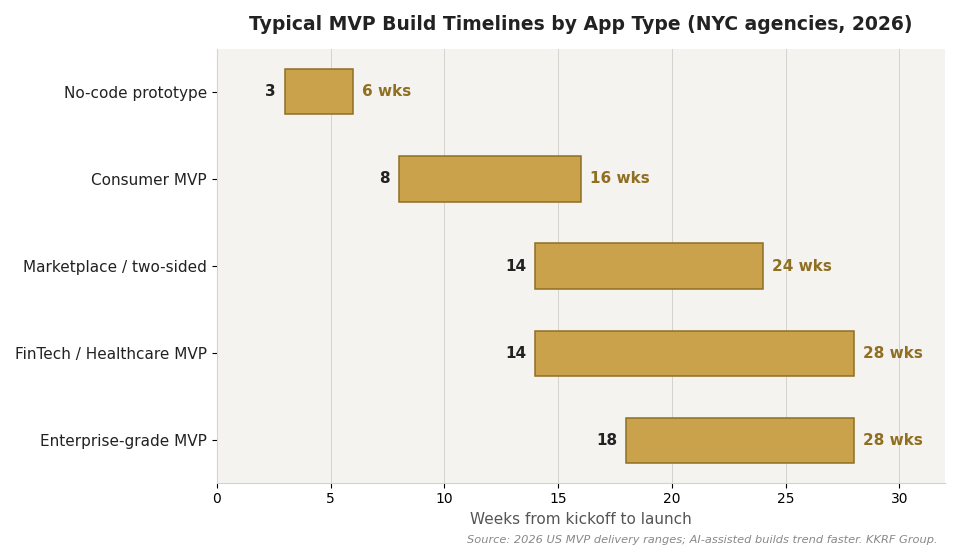
How long it takes to build an MVP in NYC depends on the app type. A no-code prototype can go live in 3 to 6 weeks. A polished consumer MVP for iOS and Android typically ships in 8 to 16 weeks. Two-sided marketplaces and regulated FinTech or healthcare MVPs run 14 to 28 weeks because they carry more moving parts and compliance work.
AI-assisted engineering is compressing these timelines. Work that once took three to six months can now land in a fraction of that when experienced engineers use AI tooling under proper review. Speed still depends on decisions, not just code — the fastest MVPs come from teams that lock scope early and resist mid-build additions.
The MVP Development Process: 7 Steps
A good MVP process is less about writing code and more about deciding what not to build. Here’s the seven-step approach we use with New York startups, structured so each step has a clear output before the next begins.
- Define the core problem. Pin down the single problem your app must solve and the one user it serves first. Everything else waits.
- Prioritize features (MoSCoW). Sort every idea into Must-have, Should-have, Could-have, and Won’t-have. Only Must-haves go in the MVP.
- Design the core flow. Map the shortest path a user takes to get value, then design just those screens. Keep the rest for the roadmap.
- Choose the tech stack. Pick tools that let you launch fast and scale later, usually React Native or Flutter for cross-platform reach.
- Build in short iterations. Ship the core workflow in two-week sprints, reviewing working software at the end of each one.
- Test with real users. Release to a small group via TestFlight and Google Play internal testing, then watch what people actually do.
- Measure, learn, and iterate. Track activation, retention, and conversion, then decide what to build, cut, or fix next.
Choosing the Right Tech Stack for Your MVP
For most New York MVPs, cross-platform frameworks are the practical choice. A React Native MVP or a Flutter MVP lets a small team ship one codebase to both iOS and Android, which cuts cost and shortens the timeline. Native iOS in Swift or Android in Kotlin still makes sense when the app leans heavily on device hardware or demands the smoothest possible performance. If you’re weighing the two, our breakdown of Flutter vs. React Native for New York apps goes deeper, and our iOS app development guide for New York covers the native path.
On the back end, managed services keep early teams lean. Firebase or AWS handle authentication, databases, and hosting without a large infrastructure team. Stripe covers payments. The right stack for an MVP is the one that ships fast today and won’t force a rewrite the week after product-market fit.
MVP vs. Prototype vs. Proof of Concept
Founders often use these three terms interchangeably, but they answer different questions. A proof of concept tests feasibility. A prototype tests the experience. An MVP tests demand. The table below shows how they compare.
| Proof of Concept | Prototype | MVP | |
|---|---|---|---|
| Goal | Prove a feature is technically possible | Show how the app looks and flows | Test real demand with real users |
| Audience | Internal team | Stakeholders, investors | Actual users / early customers |
| Fidelity | Throwaway code | Clickable design, no real backend | Working, shippable product |
| Timeline | Days to 2 weeks | 1–3 weeks | 8–20 weeks |
| Outcome | Go / no-go on tech | Feedback on UX | Validated learning + traction |
In-House vs. Agency vs. Offshore Development
Once your scope is clear, you have to decide who builds it. Each option trades cost against speed, control, and product judgment. There’s no universally right answer — only the right fit for your stage and budget.
| In-house team | NYC agency (e.g. KKRF Group) | Offshore team | |
|---|---|---|---|
| Speed to start | Slow (hiring first) | Fast | Fast |
| Cost | High (salaries + equity) | Medium–high | Low |
| Time-zone overlap | Full | Full | Partial |
| Product / strategy input | Depends on hires | Strong | Limited |
| Best for | Funded teams building for years | Startups needing to ship fast with senior guidance | Tight budgets with fixed, clear scope |
Choose an in-house team when you’re funded and the app is your core product for years. Choose a New York agency when you need senior engineers and product judgment fast, with full time-zone overlap for the daily decisions an MVP demands. Choose an offshore team when budget is the hard constraint and your scope is already crystal clear. Many NYC founders start with a Manhattan or Brooklyn agency for the MVP, then hire in-house once traction justifies it.
Common MVP Mistakes That Sink NYC Startups
We’ve seen the same handful of mistakes stall promising products. Most are about discipline, not talent. Avoid these and you’re ahead of most first-time founders.
- Building too much. The most common MVP killer is a feature list that looks like a finished product. Cut it in half, then cut again.
- Chasing perfection. A polished app nobody wants is still a failure. Ship the rough version that answers the real question.
- Skipping user testing. Opinions from the founding team aren’t validation. Put the app in front of strangers early.
- Ignoring the data. If you’re not tracking activation and retention from day one, you can’t tell learning from noise.
- Picking the wrong build partner. A cheap team that needs constant re-specs costs more than a senior team that gets it right once.
- No plan for after launch. An MVP is the start of a roadmap, not the end. Budget time and money for the iterations that follow.
How to Choose an MVP Company in New York
Choosing an MVP development company in New York comes down to a few honest questions. Do they push back on your scope, or just take the order? Can they show shipped apps, not just mockups? Will the senior engineers you meet in the pitch be the ones writing your code? Our guide to the best mobile app development companies in New York covers how to compare firms, but the checklist below is where to start.
- Relevant shipped work — real apps in your category, ideally FinTech, healthtech, SaaS, or marketplace MVPs.
- Senior ownership — the people who scope your MVP should be the ones building it.
- Product judgment — a partner who trims scope to protect your budget, not one who pads it.
- Transparent process — clear sprints, working software every two weeks, and honest status updates.
- A path to scale — an architecture that survives success instead of forcing a rewrite.
- Verifiable reputation — references and public reviews on platforms like Clutch.
Choose an agency partner when you want speed and senior guidance without building a team first. It’s the wrong fit if your scope is genuinely trivial — a weekend no-code tool doesn’t need one. As a decision rule: if the app is central to a venture you intend to fund and grow, work with a senior New York mobile app development partner who can take it from MVP through scale. KKRF Group builds MVPs on an enterprise-grade, security-first foundation, so the same codebase that tests your idea can carry it to thousands of users.
MVP Trends Shaping NYC Startups in 2026
AI-assisted development is the biggest shift in MVP building for 2026. Experienced NYC teams now use AI tooling to scaffold code, generate tests, and compress timelines — turning a three-month build into weeks without cutting quality, as long as the work stays under senior review. For founders, that means a validated product in front of users sooner and less capital spent before the first signal.
Two other trends matter for New York founders. No-code and low-code tools are now viable for the earliest validation, though most funded startups still move to custom code before scaling — the no-code vs. custom MVP decision is really about how far you need to go. And investors increasingly expect an MVP with real usage data before a seed round, which makes a fast, measurable first launch more valuable than ever.
Ready to turn your idea into a working MVP that NYC users can try? Talk to our engineering team about scope, stack, and a realistic launch date.
Book a Discovery Call →Frequently Asked Questions
How much does MVP app development cost in New York?
MVP app development in New York typically costs between $15,000 and $150,000 in 2026. A basic single-platform MVP runs $15,000–$40,000, a production-ready consumer app for iOS and Android runs $50,000–$120,000, and a regulated FinTech or healthcare MVP can reach $300,000.
How long does it take to build an MVP?
Most MVPs take 8 to 20 weeks to build. A no-code prototype can launch in 3–6 weeks, a consumer MVP in 8–16 weeks, and a marketplace or regulated FinTech/healthcare MVP in 14–28 weeks. Locking scope early is the single biggest factor in shipping on time.
What is the difference between an MVP and a prototype?
A prototype is a clickable design that shows how an app looks and flows, usually with no working backend. An MVP is a real, shippable product released to actual users to test genuine demand and gather usage data. A prototype tests the experience; an MVP tests whether people want it.
Should a startup build an MVP or a full app first?
Almost always an MVP first. Building a full app before validating demand risks spending your entire budget on features nobody wants. An MVP tests the core idea quickly, protects runway, and gives investors real traction data before a seed round.
Which tech stack is best for an MVP?
Cross-platform frameworks like React Native and Flutter are the most cost-effective choice for most MVPs, launching on iOS and Android from one codebase. Native Swift or Kotlin suits hardware-heavy or performance-critical apps. Firebase or AWS with Stripe covers a typical MVP back end.
Can KKRF Group build an MVP for my New York startup?
Yes. KKRF Group is a top mobile app development company that builds MVPs for New York startups on an enterprise-grade, security-first foundation. We scope a lean first release, ship it in weeks, and design the architecture to scale after product-market fit.
KKRF Group helps New York founders ship MVPs that raise rounds and win users. Tell us about your idea and we’ll scope your build — realistic cost, timeline, and stack included.
Request a Consultation →