
Most enterprise breaches in 2026 don’t begin with a cinematic hack. They begin with one stolen credential, one over-permissioned account, one flat network where an attacker can move sideways for weeks before anyone notices. Zero trust architecture exists to close exactly that gap.
The idea is blunt: never trust, always verify. No user, device, or workload gets access just because it sits inside the corporate network. Every request is authenticated, authorized, and inspected — every time. At KKRF Group, a trusted IT consulting and cybersecurity partner, we help enterprises turn that principle into a working architecture without grinding the business to a halt.
Below we cover what zero trust architecture really is, the five pillars that structure it, what it costs in 2026, how to roll it out in phases, and how to tell a serious implementation partner from a reseller with a slide deck.
Key Takeaways
- Zero trust architecture assumes no implicit trust. Every access request is verified continuously against identity, device health, and context, in line with NIST SP 800-207.
- CISA’s Zero Trust Maturity Model 2.0 structures the work around five pillars: identity, devices, networks, applications and workloads, and data.
- First-year cost typically runs from about $30k for small teams to $5M+ for large enterprises. Identity modernization alone is usually 30–40% of the budget.
- IBM’s 2025 data shows mature zero trust saves roughly $1.76M per breach and cuts breach costs by about 43%.
- It succeeds as a phased program, not a one-time product purchase. Start with identity, prove value, then expand pillar by pillar.
In This Article
- What Is Zero Trust Architecture?
- The Five Pillars of Zero Trust
- How It Works: PDP, PEP and PIP
- What Zero Trust Costs in 2026
- The Business Case and ROI
- A Step-by-Step Implementation Roadmap
- Zero Trust vs Perimeter Security
- Common Mistakes to Avoid
- Zero Trust for AI and What’s Next
- Is Your Enterprise Ready?
- Choosing an Implementation Partner
- Frequently Asked Questions
We have built and hardened zero trust programs across regulated industries, from fintech platforms in New York to distributed SaaS teams across the USA. The pattern that works is consistent. Tie access to verified identity first, instrument everything, and automate policy enforcement so security scales without punishing legitimate users. Our cybersecurity consulting and IT consulting teams treat zero trust as an operating model, not a checkbox.
What Is Zero Trust Architecture?
For two decades, enterprise security ran on a castle-and-moat model. Build a strong perimeter, and treat everything inside it as trusted. That assumption broke the moment work went remote, apps moved to the cloud, and attackers learned that one phished login gets them inside the walls.
The zero trust model flips the default. Trust is never granted by location; it is earned per request and revoked the instant conditions change. A finance analyst logging in from a managed laptop at 9 a.m. is evaluated differently from the same account hitting a payroll API from an unrecognized device at 3 a.m. Same credentials, very different risk, very different decision.
Two principles anchor zero trust security. Continuous verification means every request is re-checked rather than trusted for a whole session. Least privilege means each identity gets the minimum access required, so a single compromised account cannot open the whole estate. Everything else in a zero trust architecture is engineering in service of those two ideas.
The Five Pillars of Zero Trust
NIST defines the philosophy. CISA turned it into something you can actually plan against. The CISA Zero Trust Maturity Model 2.0 organizes zero trust into five pillars, each of which you mature independently from a traditional starting point toward a fully automated one.
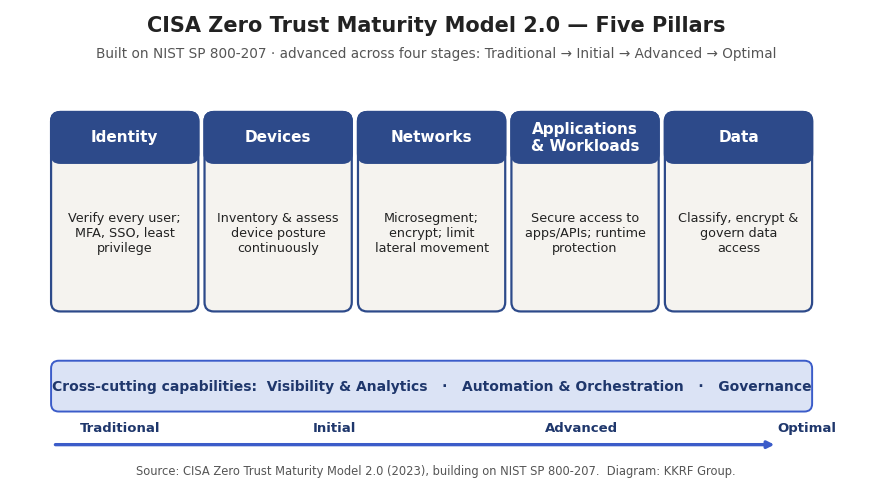
- Identity — verify every user and service account with strong authentication. This is where passwordless authentication, MFA, SSO, and least-privilege access policies live. It is the pillar most programs start with.
- Devices — maintain a live inventory and continuously assess the health and posture of every endpoint requesting access, from laptops to servers to mobile.
- Networks — segment aggressively. Microsegmentation and encrypted traffic limit an attacker’s ability to move laterally once they are in.
- Applications and workloads — secure access to apps, APIs, and cloud workloads at runtime, not just at the front door.
- Data — classify, encrypt, and govern who can touch what. This pillar ties directly into compliance work such as SOC 2.
Three capabilities cut across all five pillars: visibility and analytics, automation and orchestration, and governance. They are what turn a pile of point tools into a coordinated system. CISA’s four maturity stages — traditional, initial, advanced, and optimal — give you an honest way to measure where each pillar stands today and where the next investment should go. Most enterprises are strong in one or two pillars and traditional in the rest, which is exactly the map a zero trust maturity model is meant to expose.
How Zero Trust Works: PDP, PEP and PIP
Underneath the strategy sits a simple control loop. NIST SP 800-207 names three logical components, and once you see them, every zero trust product on the market slots into place.
- Policy Decision Point (PDP) — the brain. It evaluates each request and decides allow, deny, or step up.
- Policy Enforcement Point (PEP) — the gate. It sits in front of the resource and enforces whatever the PDP decides.
- Policy Information Points (PIP) — the senses. Identity providers, endpoint detection, and threat intelligence feed the signals the PDP reasons over.
Here is the request lifecycle in practice:
- A user or workload requests access to a resource, and the request hits a Policy Enforcement Point instead of the resource directly.
- The Policy Decision Point pulls context from the Policy Information Points: who is this identity, is the device healthy, where is the request coming from, is anything anomalous.
- The PDP scores the request against policy and grants the least access required, or challenges with step-up authentication, or blocks it outright.
- Access is time-boxed and continuously re-evaluated. If device posture drops or behavior turns suspicious mid-session, the session is cut.
Zero trust network access (ZTNA) is the most visible product category built on this loop. It brokers per-application access based on identity and context rather than dropping users onto a broad network segment the way a legacy VPN does. We will compare ZTNA and VPN in depth in a dedicated guide; for now, treat ZTNA as the access layer of a zero trust architecture, not the whole thing.
How Much Does Zero Trust Architecture Cost in 2026?
Budgets are the first question every executive asks, and the honest answer is that zero trust architecture cost scales with your starting point, not just your headcount. A cloud-native company with modern identity already in place spends far less than a hybrid enterprise dragging twenty years of legacy access along.
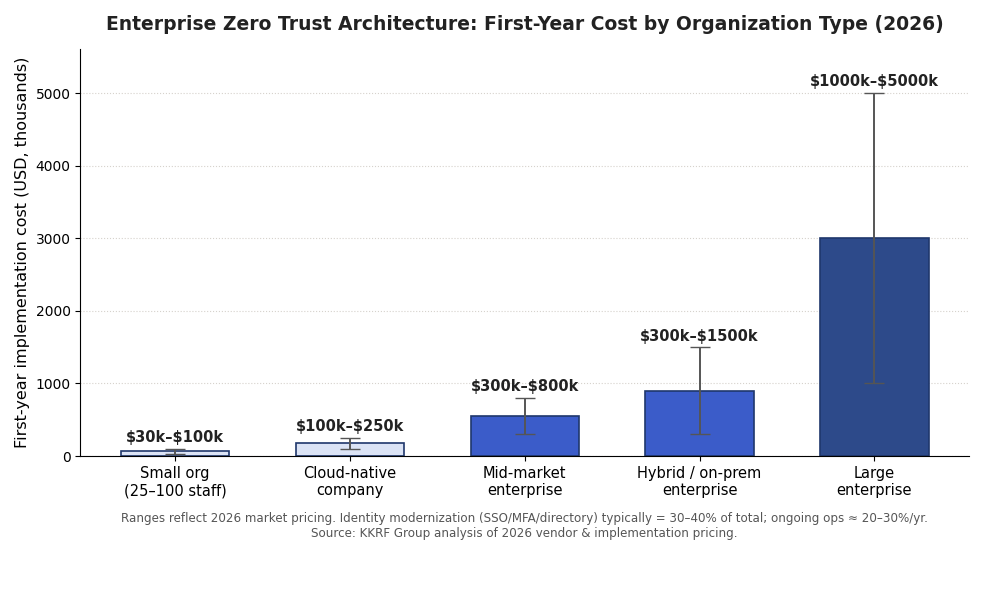
Based on 2026 market pricing, first-year zero trust implementation cost tends to fall into these bands: roughly $30k–$100k for a 25–100 person organization taking a phased approach, $100k–$250k for a cloud-native company, and $300k–$1.5M for hybrid or on-prem-heavy enterprises where integration is the real expense. Large, complex enterprises routinely land between $1M and $5M+ across a multi-year rollout.
One practical note from the field: phasing is a cost-control lever, not just a delivery tactic. Enterprises that try to buy every pillar at once overspend on shelfware. Those that sequence identity first, then devices and network, consistently get more security per dollar because each phase reduces the attack surface the next phase has to cover.
Not sure where your budget should go first? A short zero trust assessment maps your five pillars against the CISA maturity model and turns a vague mandate into a costed, phased plan.
Get a Zero Trust Assessment →The Business Case: ROI and Breach Reduction
Security spending gets approved when it maps to money, not fear. Zero trust maps cleanly. According to IBM’s 2025 Cost of a Data Breach research, organizations with mature zero trust save roughly $1.76M per breach compared with peers that lack it, and they cut breach costs by about 43%.
The math gets easier the bigger you are. The average U.S. breach now costs about $10.22M. For a mid-market enterprise, preventing a single serious incident recovers the entire annual zero trust investment several times over. Mature programs also see around 50% fewer breaches and detect intrusions roughly 61% faster, which shrinks both the blast radius and the cleanup bill.
Adoption is still early enough to be a differentiator. Gartner projects that by the end of 2026, only about 10% of large enterprises will have a mature, measurable zero trust program in place, up from under 1% in 2023. Getting there ahead of your peers is not just risk reduction; it is a procurement and insurance advantage when customers and underwriters start asking hard questions.
How to Implement Zero Trust: A Step-by-Step Roadmap
Where do you actually start? Not with a rip-and-replace. Every successful zero trust implementation roadmap we have delivered follows a phased sequence, each phase shipping value before the next begins. Treat this as your zero trust architecture roadmap — the exact sequence our engineers use.
- Assess and map. Run a zero trust assessment against the CISA maturity model. Inventory identities, devices, applications, and data flows, and rank your crown-jewel systems. You cannot protect what you have not mapped.
- Build the identity foundation. Consolidate directories, enforce MFA and SSO everywhere, and cut standing privileges down to least privilege. This phase alone eliminates the majority of credential-based attack paths.
- Establish device trust. Require healthy, known devices for access. Feed endpoint posture into your policy decisions so a compromised laptop cannot quietly reach sensitive systems.
- Microsegment the network. Replace broad network access with per-application access through ZTNA, and segment east-west traffic so lateral movement stops being trivial.
- Protect applications and workloads. Secure APIs, enforce authorization at the workload level, and extend the model to cloud-native and legacy apps alike.
- Govern the data. Classify and encrypt sensitive data, and tie access back to identity and purpose. This is where compliance frameworks and future-proofing such as post-quantum cryptography intersect.
- Automate and monitor. Wire in visibility, analytics, and automated response so policy enforcement scales without a growing army of analysts. Maturity is measured here.
Zero Trust vs Traditional Perimeter Security
The clearest way to understand zero trust security is to line it up against the perimeter model it replaces. The difference is not a single feature; it is a different default for how trust is granted.
| Dimension | Traditional Perimeter | Zero Trust Architecture |
|---|---|---|
| Trust default | Trusted once inside the network | Never trusted; verified per request |
| Access model | Broad network access (VPN) | Least-privilege, per-app access (ZTNA) |
| Identity role | Checked at login, then assumed | Continuously verified with context |
| Lateral movement | Easy once perimeter is breached | Contained by microsegmentation |
| Best fit | Static, on-prem environments | Cloud, hybrid, and remote work |
| Breach impact | Often estate-wide | Limited to a small blast radius |
A recurring question is ZTNA vs VPN. The short version: a VPN grants network-level trust, while ZTNA grants application-level access based on identity and posture. We break that comparison down fully in a separate guide, because it deserves more than a table row.
Common Zero Trust Mistakes to Avoid
We have been called in to fix as many stalled zero trust programs as we have built from scratch. The failure modes rhyme.
- Buying tools before mapping. Teams purchase a ZTNA product, deploy it to one app, and call it zero trust. Without an identity foundation and a maturity plan, it is a point solution wearing a strategy’s name.
- Skipping identity hygiene. Rolling out microsegmentation while standing admin privileges still litter the directory is like locking the windows and leaving the master key under the mat.
- Big-bang rollouts. Trying to reach optimal maturity across all five pillars at once burns budget and goodwill. Phase it.
- Ignoring the user experience. If verification adds friction to every routine task, people route around it. Good zero trust is mostly invisible to legitimate users.
- Treating it as a project, not a program. Zero trust is continuously tuned, not shipped once. The governance and automation pillar is what keeps it alive.
Zero Trust for AI and What’s Next
The next frontier is not human. As enterprises deploy AI agents and automated workloads, the number of non-human identities is exploding, and each one needs the same never-trust-always-verify treatment as a person. Zero trust for AI means authenticating machine identities, scoping agent permissions tightly, and monitoring their behavior in real time.
Major platforms are already reframing zero trust around this shift, extending continuous verification to AI services and the data they touch. Enterprises that built a clean identity foundation for humans are now finding it is the same foundation that governs their AI agents. That is the payoff of getting the fundamentals right early.
A Decision Framework: Is Your Enterprise Ready?
Not every organization needs to start at the same pillar. Use this quick framework to decide where your first dollar should go.
Prioritize network and devices if: your identity is modern but your network is flat and any breached endpoint can reach critical systems.
Focus on data and workloads if: you operate in a regulated industry, handle sensitive customer data, or face SOC 2, HIPAA, or similar obligations.
Invest in automation and governance if: your pillars are maturing but security operations cannot keep up with alerts and manual policy changes.
If more than two of these describe you, a structured zero trust roadmap will pay for itself faster than a scattered set of tool purchases. The framework is deliberately simple. Complexity belongs in execution, not in deciding to begin.
How to Choose a Zero Trust Implementation Partner
Plenty of vendors will sell you a product. Far fewer will own the architecture, the integration, and the messy legacy cleanup that decides whether a zero trust program actually works. When you evaluate a zero trust consulting or implementation partner, look past the logo wall.
- Architecture-first, not product-first. They should design against NIST SP 800-207 and the CISA pillars, then recommend tools, not the reverse.
- Phased delivery with measurable milestones. Ask how they sequence pillars and how they prove value at each stage.
- Identity and integration depth. Since identity is 30–40% of the work, their IAM and directory experience matters more than any single feature.
- Transparent process and knowledge transfer. You want a long-term technology partner that leaves your team stronger, not dependent.
KKRF Group approaches zero trust the way we approach all enterprise engineering work: security-first, architecture-led, and built to scale across cloud and hybrid environments. As a trusted IT consulting and cybersecurity partner, we help startups, SMEs, and enterprises move up the maturity model at a pace their business can absorb.
Ready to turn zero trust from a mandate into a plan? Our engineers will review your current architecture and map a phased, costed roadmap to a measurable zero trust program.
Request an Architecture Review →Frequently Asked Questions
What is zero trust architecture in simple terms?
Zero trust architecture is a security model that stops automatically trusting anyone based on network location. Every user, device, and workload must prove who they are and that they are healthy on every request, and they only get the minimum access they need. It is summarized as never trust, always verify, and it is formally defined in NIST SP 800-207.
What are the five pillars of zero trust?
The CISA Zero Trust Maturity Model 2.0 defines five pillars: identity, devices, networks, applications and workloads, and data. Three capabilities cut across all of them: visibility and analytics, automation and orchestration, and governance. You mature each pillar independently from a traditional to an optimal state.
How much does zero trust architecture cost in 2026?
First-year zero trust implementation cost typically ranges from about $30k for a small organization taking a phased approach to $5M or more for a large, complex enterprise. Cloud-native companies often spend $100k–$250k, while hybrid enterprises land between $300k and $1.5M. Identity modernization alone is usually 30–40% of the budget, and ongoing operations run about 20–30% of the initial cost each year.
How long does it take to implement zero trust?
For most enterprises it is a multi-quarter to multi-year journey rather than a single project, because it is phased across five pillars. A focused first phase around identity can show results within a few months, while reaching advanced or optimal maturity across every pillar generally takes one to three years depending on legacy complexity.
Is ZTNA the same as zero trust?
No. Zero trust network access (ZTNA) is one product category that delivers identity-based, per-application access, and it is an important access layer of a zero trust architecture. But zero trust is the broader strategy spanning identity, devices, networks, applications, and data. ZTNA is a component, not the whole model.
What is the difference between zero trust and a VPN?
A VPN grants broad, network-level trust once a user connects, which lets an attacker who steals those credentials move laterally. ZTNA, the zero trust approach, grants access to specific applications based on continuously verified identity and device posture, so a compromised account reaches far less. This ZTNA vs VPN comparison is one we cover in more detail in a dedicated guide.
The Bottom Line
Zero trust architecture is no longer a forward-looking bet. It is the baseline enterprise security strategy for 2026, backed by NIST, structured by CISA, and validated by hard numbers on breach cost and detection speed. The organizations that win with it treat it as a phased program grounded in identity, measured against a maturity model, and automated so it scales.
You do not have to solve every pillar at once, and you should not try. Start where your risk is highest, prove value, and build from there. If you want a partner who designs the architecture before selling the tools, KKRF Group is ready to help you plan and deliver a zero trust program that holds up under real-world pressure.
Wherever you are on the maturity model, we can help you get to the next stage. Talk to our engineering team about a pragmatic, business-aware zero trust roadmap built for your environment.
Talk to Our Engineering Team →