
SOC 2 compliance for SaaS has quietly become the price of admission for selling software to serious organizations. Enterprise buyers no longer take security on trust: when a mid-market or Fortune 500 customer evaluates a SaaS vendor, one of the first questions their procurement and security teams ask is simple — “Can we see your SOC 2 report?” Without one, deals stall in security review, or never reach it at all.
SOC 2 has quietly become the price of admission for selling software to serious organizations. Yet for most SaaS founders and engineering leaders, it arrives as a fog of acronyms, five- and six-figure quotes, and a timeline that somehow always collides with a big prospect’s deadline. This guide cuts through that. As a security-first software engineering company, KKRF Tech has helped product teams design and implement the controls that SOC 2 examines, and we’ve written this from the builder’s side of the table — what it costs, how long it takes, and how to engineer your product so the audit becomes routine rather than a fire drill.
Key Takeaways
- SOC 2 is a trust attestation, not a certification. A licensed CPA firm independently reports on whether your SaaS actually operates the controls it claims to, measured against the AICPA Trust Service Criteria.
- Budget realistically. A first-year SOC 2 Type 2 for a ~60-person SaaS typically runs $68k–$130k all-in across platform, readiness work, the CPA audit, and a penetration test; leaner startups can land closer to $20k–$35k.
- Type 2 takes months, not weeks. Plan for roughly 8–12 months in year one because of the observation window; a Type 1 point-in-time report is reachable in ~2–4 months.
- The cheapest path is building controls in early. Access control, audit logging, encryption, and evidence automation cost far less to engineer into a codebase than to retrofit under audit pressure.
- Platforms automate evidence; engineers implement controls. You need both a compliance tool and a team that can build the underlying controls into your product and cloud.
What This Guide Covers
- What SOC 2 compliance actually is
- Which SaaS companies need it
- The five Trust Service Criteria
- SOC 2 Type 1 vs Type 2
- How much SOC 2 costs for SaaS
- A realistic SOC 2 timeline
- Engineering SOC 2-ready software
- Build controls in vs retrofit
- Common SOC 2 mistakes
- SOC 2 vs ISO 27001 and others
- Choosing an implementation partner
- Where SOC 2 is heading
Quick Answer
SOC 2 compliance is an independent audit, performed by a licensed CPA firm, that reports on how well a SaaS company’s controls protect customer data against the AICPA’s five Trust Service Criteria. For a typical growing SaaS, a first-year Type 2 report costs roughly $68,000–$130,000 all-in and takes 8–12 months, most of which is the observation window during which your controls must operate continuously. The single biggest lever on both cost and stress is engineering the required controls — access management, audit logging, encryption, and evidence collection — into your software before the audit begins.
Throughout this guide we focus on the decisions that actually move the needle for a SaaS team: which report to pursue, what to budget, where costs hide, and which controls belong in your codebase versus your policies. The goal is not to help you “pass a test,” but to build a product that is genuinely trustworthy — because that is what turns a SOC 2 report into a durable competitive advantage.
What SOC 2 Compliance Actually Is
SOC 2 — System and Organization Controls 2 — is an auditing framework created by the American Institute of Certified Public Accountants (AICPA). It evaluates how a service organization manages customer data across five areas known as the Trust Service Criteria. Unlike a checklist certification, a SOC 2 engagement produces an attestation report: a licensed CPA firm examines your controls and issues an independent opinion on whether they are suitably designed and, for Type 2, operating effectively over time.
SOC 2 report: An independent CPA attestation describing a service organization’s controls relevant to security, availability, processing integrity, confidentiality, and privacy. It is shared under NDA with customers and prospects as evidence that your security claims are real.
A crucial nuance trips up many first-timers: there is no such thing as being “SOC 2 certified.” You cannot frame a certificate on the wall. What you can do is obtain a clean report — ideally with no exceptions — that your sales and security teams share with buyers. The report names the auditor, the period covered, the controls tested, and any exceptions found. That transparency is precisely why enterprise buyers trust it more than a vendor’s self-assessment.
SOC 2 also differs from its siblings. SOC 1 concerns controls over financial reporting; SOC 3 is a public, marketing-friendly summary with far less detail. For a SaaS company protecting customer data, SOC 2 is almost always the report that matters.
Which SaaS Companies Need SOC 2
SOC 2 compliance for SaaS is driven by your sales pipeline, not by regulators. If your software stores, processes, or transmits data on behalf of other businesses, you will eventually be asked for a SOC 2 report. The moment you move upmarket from small customers to mid-market and enterprise accounts, security questionnaires and vendor risk reviews become gatekeepers, and a SOC 2 report is the fastest way through them.
In practice, these situations push SaaS teams toward SOC 2:
- Enterprise deals are stalling in security review. Prospects ask for a report you don’t have, and procurement won’t proceed without it.
- You handle sensitive or regulated data — financial records, health information, or personal data — where customers must prove due diligence on their vendors.
- You’re raising or being acquired. Investors and acquirers increasingly treat a SOC 2 report as a signal of operational maturity.
- A competitor already has one. When buyers can choose between two similar products and only one is audited, the report becomes a tiebreaker.
- You resell or integrate with platforms that require their vendors to be independently audited.
In short: SOC 2 is driven by revenue, not regulation. If enterprise customers are on your roadmap, plan for it before a specific deal forces your hand on an impossible timeline.
The Five Trust Service Criteria
Every SOC 2 report is built on the Trust Service Criteria (TSC). Security — often called the Common Criteria — is mandatory in every engagement. The other four are optional and included only if they are relevant to the promises you make to customers. Most SaaS companies start with Security and Availability, then add others as their contracts demand.
| Criterion | What it covers | Typical SaaS relevance |
|---|---|---|
| Security (Common Criteria) | Protection against unauthorized access, disclosure, and system damage | Always required — the foundation of every SOC 2 report |
| Availability | The system is available for operation and use as committed (uptime, DR, monitoring) | Common — expected wherever you make uptime or SLA commitments |
| Processing Integrity | System processing is complete, valid, accurate, timely, and authorized | Relevant for payments, analytics, or transaction-heavy platforms |
| Confidentiality | Information designated confidential is protected as committed | Common when handling proprietary customer data or IP |
| Privacy | Personal information is collected, used, retained, and disposed of properly | Relevant when you process consumer personal data (often paired with privacy law) |
Choosing your scope is a strategic decision, not a formality. Each added criterion expands the controls you must implement and evidence, which raises both cost and effort. A disciplined scope — Security plus only what your customers genuinely require — keeps your first audit achievable while still satisfying buyers.
SOC 2 Type 1 vs Type 2
SOC 2 comes in two report types, and the difference is about time. A Type 1 report assesses whether your controls are suitably designed at a single point in time. A Type 2 report goes further: it tests whether those controls actually operated effectively over a period — usually three to twelve months.
| Dimension | Type 1 | Type 2 |
|---|---|---|
| What it proves | Controls are designed correctly today | Controls worked consistently over time |
| Observation period | Point in time | Typically 3–12 months |
| Time to first report | ~2–4 months | ~8–12 months (year one) |
| Buyer confidence | Moderate — a snapshot | High — the enterprise standard |
| Best used as | A fast interim signal | Your durable, renewable report |
A common and pragmatic path is to start with Type 1 to unblock a deal quickly, then roll straight into a Type 2 observation window. But be realistic with prospects: sophisticated buyers know a Type 1 is only a snapshot and will ask when your Type 2 lands. If you have the runway, many teams now skip Type 1 entirely and go directly to a Type 2 with a shorter three-month initial window.
How Much SOC 2 Costs for SaaS
The cost of SOC 2 compliance for SaaS causes sticker shock because quotes vary wildly depending on company size, scope, and how audit-ready your systems already are. The number that matters is the all-in first-year cost, not just the auditor’s fee — which is usually only 30–40% of what you actually spend. For a growing SaaS of roughly 60 people pursuing a Type 2, a realistic all-in range is $68,000 to $130,000 in year one. Leaner startups with modern infrastructure and a tight scope can complete a first audit closer to $20,000–$35,000.
| Cost component | Typical first-year range | What drives it |
|---|---|---|
| Compliance/GRC platform | $12,000–$28,000 | Automates evidence collection and control monitoring |
| Readiness & implementation | $5,000–$15,000+ | Gap assessment, policy work, control build-out |
| SOC 2 Type 2 audit (CPA firm) | $18,000–$35,000 | Auditor fees; scales with scope and criteria |
| Penetration testing | $8,000–$15,000 | Often expected as supporting evidence |
| Internal engineering time | Varies (often the largest hidden cost) | Building and operating controls in your product |
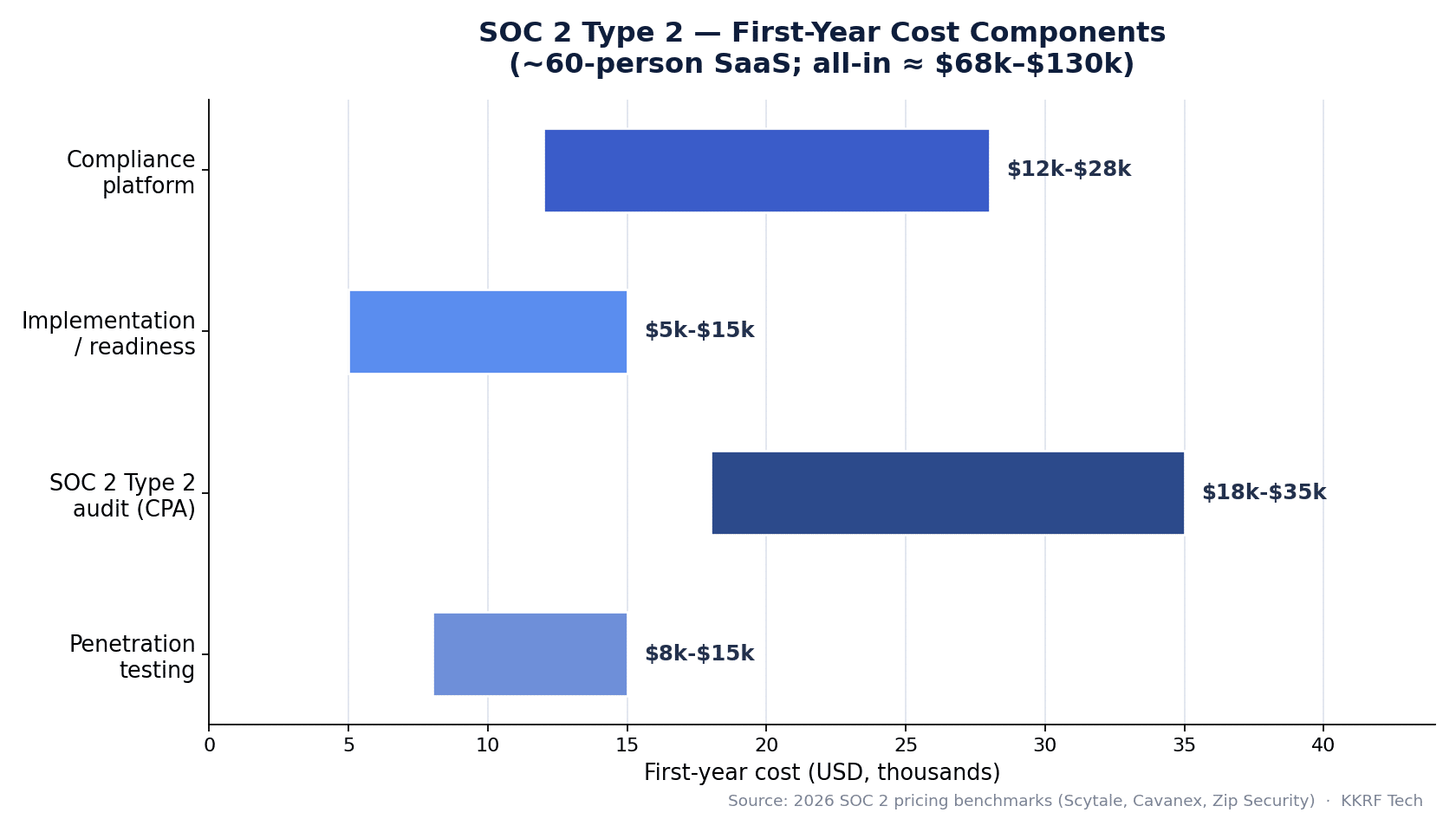
The hidden line item is the last one. Engineering hours spent implementing access controls, logging, and evidence automation rarely appear in a vendor quote, yet they frequently dwarf it — especially when controls are bolted on late. This is exactly why when you build the controls matters as much as what you spend. Costs cited here reflect 2026 market benchmarks; treat them as planning ranges, not quotes.
In short: Budget for the whole program — platform, readiness, audit, pen test, and engineering time — not just the auditor’s invoice. The audit fee is typically the smallest piece of the puzzle.
Not sure where your product stands against the Trust Service Criteria? KKRF Tech runs a focused SOC 2 readiness assessment that maps your current architecture to the controls an auditor will test — and shows what to fix first. Explore our cybersecurity consulting services.
Get a SOC 2 Readiness Assessment →A Realistic SOC 2 Timeline
The most common planning mistake is assuming SOC 2 can be compressed into the weeks before a big deal closes. It cannot. A Type 2 report requires an observation window during which your controls must demonstrably operate, and no amount of budget shortens that window below its minimum. Here is how a first-year program typically unfolds.
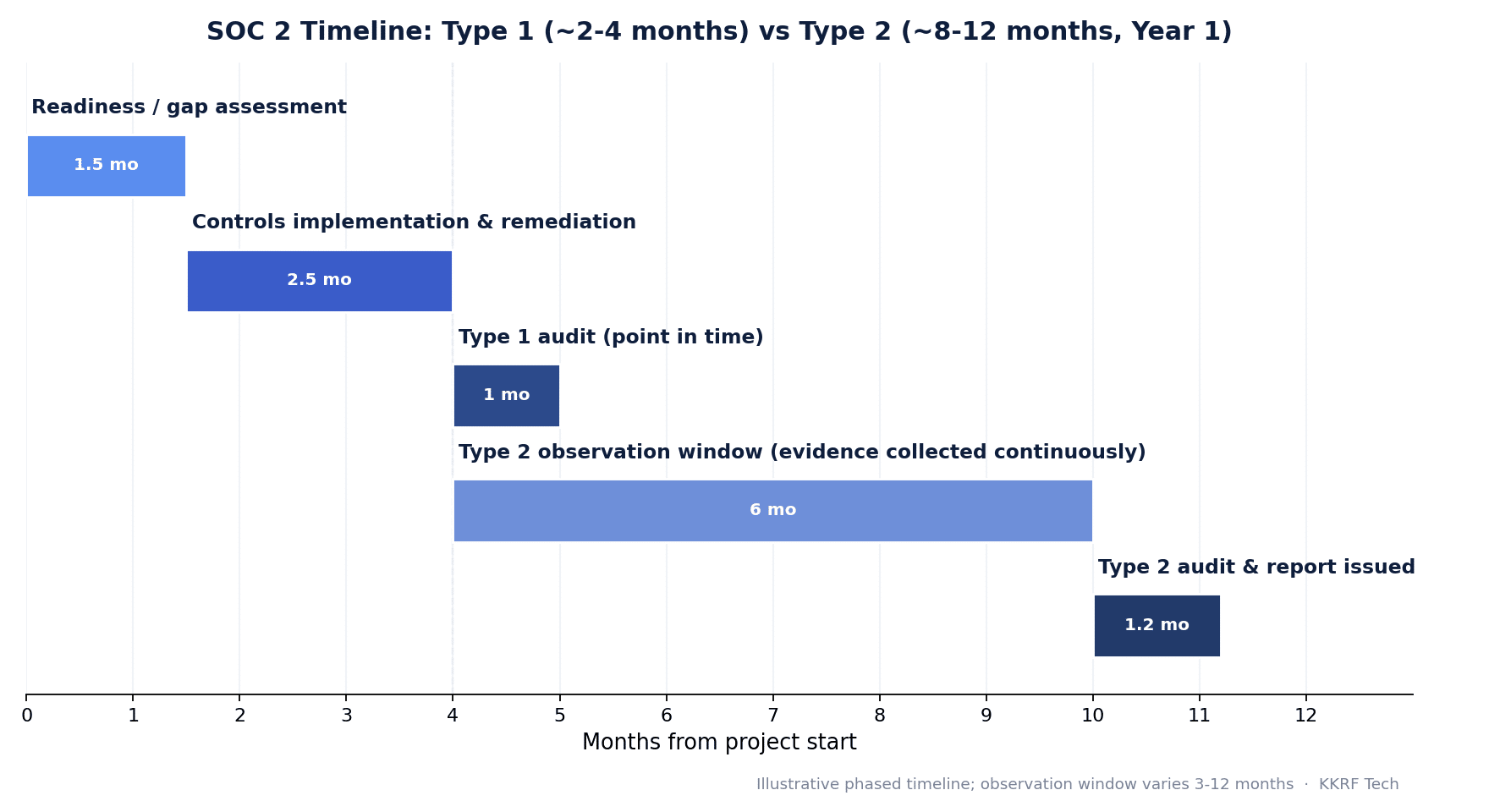
- Readiness & gap assessment (weeks 0–6): Map your current state to the chosen criteria and identify what’s missing.
- Controls implementation & remediation (weeks 2–16): Build and configure the technical and administrative controls, and write the policies that govern them.
- Type 1 audit, optional (month ~4): A point-in-time report to unblock deals while the clock runs on Type 2.
- Type 2 observation window (3–12 months): Evidence is collected continuously as controls operate in production.
- Type 2 audit & report (final month): The CPA firm tests your evidence and issues the report.
Because the observation window dominates the schedule, the highest-leverage move is to start early and let controls “bake” while you keep building your product. Teams that engineer controls in from the start often shorten the remediation phase to near zero, which is where most delays — and most stress — actually live.
Engineering SOC 2-Ready Software
Most SOC 2 content is written by compliance platforms and focuses on evidence collection and auditor logistics. That’s only half the story. The controls an auditor tests live in your software and cloud, and building them well is an engineering discipline. Here is what an audit-ready SaaS looks like under the hood — the areas KKRF Tech prioritizes when we design a product for security from day one.
1. Identity and access control (RBAC and least privilege)
Auditors want proof that only the right people and services can reach sensitive data. That means enforced single sign-on, mandatory multi-factor authentication, role-based access control implemented in the application itself, and a repeatable process for provisioning and deprovisioning access. Least-privilege defaults in both your app and your cloud IAM policies are the backbone of the Security criterion.
2. Audit logging and monitoring
If it isn’t logged, it didn’t happen — at least as far as an auditor is concerned. Comprehensive, tamper-resistant audit trails for authentication, data access, and administrative actions, feeding a centralized monitoring and alerting pipeline, satisfy multiple criteria at once and make incident response credible.
3. Encryption everywhere
Encrypt data in transit with modern TLS and at rest using managed keys, with a clear key-management and rotation approach. This is table stakes, and it is far easier to enforce as an architectural default than to add later across a sprawling codebase.
4. Secure SDLC and CI/CD guardrails
Controls should be enforced by your pipeline, not by memory. Code review requirements, automated dependency and secret scanning, infrastructure-as-code with policy checks, and separated production access turn “we follow secure practices” into evidence a machine generates on every commit. The OWASP secure-development guidance is a solid reference point here.
5. Continuous evidence architecture
The difference between a smooth audit and a painful one is whether evidence is produced automatically. Wiring your cloud, identity provider, and code pipeline into a GRC platform so that control status is captured continuously means your Type 2 window collects itself — instead of a scramble to reconstruct nine months of screenshots the week before the auditor arrives.
In short: SOC 2 is ultimately an engineering outcome. Access control, logging, encryption, pipeline guardrails, and automated evidence are product features — and they are cheapest to build before your first audit, not during it.
Build the Controls In vs Retrofit Later
The costliest SOC 2 programs are the ones that start after a product is already live and sprawling. Retrofitting controls into an architecture that never anticipated them means touching authentication, data access, and logging across the whole surface area — often under deal pressure. Building them in early is a fraction of the effort. Use this simple decision framework.
| Your situation | Recommended approach | Why |
|---|---|---|
| Pre-launch or early MVP | Design controls into the architecture now | Near-zero marginal cost; avoids expensive rework |
| Live product, first enterprise deals appearing | Run a readiness assessment, then remediate deliberately | Fix highest-risk gaps first; sequence work around the sales pipeline |
| Mature product, deals actively blocked | Prioritize a Type 1 to unblock, then Type 2 | Buys time while the observation window runs |
| Multiple frameworks likely (SOC 2 + ISO/HIPAA) | Build a common control set once | Overlapping frameworks are 30–40% cheaper done together |
The through-line is sequencing. A partner who understands both the audit and the codebase can order the work so that each control you build satisfies the maximum number of criteria — and so that engineering effort tracks your revenue priorities rather than an arbitrary checklist.
Common SOC 2 Mistakes to Avoid
- Starting too late. Waiting until a deal demands a report leaves no room for the observation window. Begin before the pipeline forces the issue.
- Over-scoping the first audit. Including every Trust Service Criterion at once multiplies effort. Start with Security plus what customers actually require.
- Treating it as a policy exercise. Well-written policies with no technical controls behind them produce exceptions. Auditors test what your systems actually do.
- Manual evidence collection. Reconstructing months of screenshots by hand is error-prone and exhausting. Automate evidence from day one.
- Confusing a platform with a program. A GRC tool automates monitoring, but it cannot implement controls in your product — that still requires engineering.
- Ignoring vendor risk. Your subprocessors are in scope. Track their security posture, not just your own.
SOC 2 vs ISO 27001 and Other Frameworks
SOC 2 is not the only security framework buyers ask about, and choosing the right one — or combining several efficiently — saves real money. The most common comparison is SOC 2 versus ISO 27001.
| Framework | Nature | Best fit |
|---|---|---|
| SOC 2 | Attestation report (AICPA) | US-centric SaaS selling to enterprise buyers |
| ISO 27001 | Certification of an information security management system | Global sales, especially Europe and enterprise procurement worldwide |
| HIPAA | US regulation | Handling protected health information |
| PCI DSS | Industry standard | Storing or processing cardholder data |
These frameworks share a large common core of controls — access management, encryption, logging, risk assessment. Implementing that core once and mapping it across frameworks is far cheaper than running each program in isolation; pairing SOC 2 with HIPAA or ISO 27001, for example, commonly saves 30–40% versus doing them separately. Government and enterprise control catalogs such as the NIST Cybersecurity Framework can serve as a useful backbone for that unified control set. The AICPA maintains the authoritative SOC 2 criteria themselves.
Choosing a SOC 2 Implementation Partner
Compliance automation platforms are excellent at what they do — monitoring controls and collecting evidence. What they don’t do is implement the controls inside your product and cloud. That gap is where many SaaS teams stall, and it’s where an engineering partner earns its keep. When evaluating who should help, weigh these factors.
- Engineering depth, not just checklists. Can they implement RBAC, logging, encryption, and CI/CD guardrails in your actual stack — or only tell you they’re missing?
- Architecture-first thinking. Do they design controls that scale with your product, rather than bolt-ons that create technical debt?
- Audit fluency. Do they understand what auditors test, so remediation targets real evidence rather than theater?
- A transparent process. Clear scope, sequencing tied to your revenue priorities, and honest trade-offs — not a black box.
- Long-term fit. SOC 2 renews every year; you want a partner who strengthens your product, not one you re-hire in a panic each cycle.
This is the model KKRF Tech works in. As a security-first engineering company, we treat SOC 2 as a product outcome: we map your architecture to the criteria, build the controls into the software and cloud, and wire up continuous evidence so each renewal is calmer than the last. The result is not just a report — it is a genuinely more trustworthy product, which is what enterprise buyers are really paying for.
Where SOC 2 Is Heading
Two shifts are reshaping how SaaS teams approach SOC 2. The first is continuous compliance: rather than an annual scramble, controls are monitored in real time and evidence is always audit-ready, blurring the line between “compliant” and “operating normally.” The second is the rise of AI in the product itself, which expands the security surface — model access, data handling, and third-party AI services all become things auditors and customers scrutinize.
Buyers are also getting more sophisticated. Static PDF reports are increasingly supplemented by real-time trust portals, and questionnaires probe deeper into how controls are actually engineered. The teams that will navigate this comfortably are the ones treating security as a core product capability — exactly the posture that makes SOC 2 a byproduct of good engineering rather than a special project.
Building a new SaaS product or scaling an existing one? Engineering the controls in from the first sprint is dramatically cheaper than retrofitting them later. Talk to the team behind our SaaS development practice about audit-ready architecture.
Book a Discovery Call →Frequently Asked Questions
What is SOC 2 compliance?
SOC 2 is an auditing framework from the AICPA under which a licensed CPA firm independently examines a service organization’s controls across five Trust Service Criteria — security, availability, processing integrity, confidentiality, and privacy. The result is an attestation report shared with customers as evidence that your security claims are real. There is no “certificate”; the report itself is the deliverable.
Who needs SOC 2 compliance?
Any SaaS or service company that stores, processes, or transmits data for other businesses will eventually be asked for a SOC 2 report — usually the moment it starts selling to mid-market and enterprise customers whose procurement teams require it. It is driven by sales and vendor-risk reviews rather than by regulation.
What are the five Trust Service Criteria?
They are Security (the mandatory Common Criteria), Availability, Processing Integrity, Confidentiality, and Privacy. Security is required in every SOC 2 engagement; the other four are included only when they are relevant to the commitments you make to customers.
How much does SOC 2 compliance cost for a SaaS company?
For a growing SaaS of around 60 people, a first-year Type 2 typically costs $68,000–$130,000 all-in, covering a compliance platform, readiness and implementation work, the CPA audit, and a penetration test. Lean startups with modern infrastructure and a tight scope can complete a first audit closer to $20,000–$35,000. The auditor’s fee is usually only 30–40% of the total.
How long does SOC 2 compliance take?
A Type 1 point-in-time report can be reached in roughly 2–4 months. A first Type 2 usually takes 8–12 months because of the observation window, during which controls must operate continuously — typically 3 to 12 months depending on the scope you choose.
What is the difference between SOC 2 Type 1 and Type 2?
Type 1 assesses whether controls are suitably designed at a single point in time; Type 2 tests whether those controls actually operated effectively over a period of months. Type 2 carries far more weight with enterprise buyers and is the report most SaaS companies ultimately need.
Turning SOC 2 into an Advantage
SOC 2 feels like a tax when it arrives unexpectedly and a strength when you plan for it. The companies that experience it as a strength share one habit: they treat the controls auditors examine as ordinary parts of building good software, engineered in early and evidenced automatically. That mindset turns each annual renewal into a formality and each buyer’s security review into a fast yes.
Whether you are pre-launch and want to build it right the first time, or live and racing to unblock enterprise deals, the smartest first step is a clear-eyed assessment of where your architecture stands against the criteria — and a sequenced plan to close the gaps.
SOC 2 is the gateway to enterprise revenue — and it is far smoother when your software is engineered for it. As a trusted security-first engineering partner, KKRF Tech helps SaaS teams design, implement, and evidence the controls auditors expect. Start with a conversation about your security roadmap.
Talk to Our Engineering Team →