
Multi-tenant SaaS architecture is the design decision that quietly determines whether your product scales profitably or collapses under its own success. Get it right and thousands of customers share infrastructure cheaply and securely. Get it wrong and you inherit a rewrite that stalls the roadmap for months. This guide breaks down the isolation models, real costs, security trade-offs, and the enterprise decisions that actually matter in 2026.
Quick Answer
Multi-tenant SaaS architecture is a model in which a single application instance and shared infrastructure serve many customer organizations, called tenants, while keeping each tenant data logically or physically separated. The three canonical isolation approaches are the pool model (shared resources), the silo model (dedicated resources per tenant), and the bridge model (a hybrid of both). Most production platforms in 2026 run a bridge model: standard customers on pooled infrastructure, enterprise and regulated customers on dedicated resources. The right choice depends on your compliance requirements, tenant-size distribution, and cost targets, not on which pattern is fashionable.
Key Takeaways
- Multi-tenancy trades per-tenant isolation for economies of scale; the craft is deciding where on that spectrum each part of your system should sit.
- Three isolation models map to AWS SaaS Lens terminology: silo (dedicated), pool (shared), and bridge (hybrid), which in turn map to database-per-tenant, shared-schema, and schema-per-tenant strategies.
- The database decision made in week two is the one teams most regret; re-architecting isolation after roughly 500 customers can cost six to twelve months.
- Building a production multi-tenant platform typically ranges from about $60K for a lean MVP to $99K to $299K or more for enterprise-grade platforms.
- The noisy neighbor problem is the defining operational risk of pooled tenancy and is managed with rate limits, quotas, and query governance.
- Compliance standards such as SOC 2, HIPAA, and GDPR frequently force a bridge model whether or not you planned for one.
What This Guide Covers
At KKRF Tech, an experienced custom software development company, we have architected and shipped multi-tenant platforms across regulated and high-growth verticals, and the same lesson repeats: tenancy is an architecture problem first and a coding problem second. The teams that succeed model their isolation requirements before they write a single schema, then choose a default model with a clear path to stronger isolation. This guide distills that hard-won perspective into decisions you can act on, and you can see the range of work involved in our SaaS development services.
What Is Multi-Tenant SaaS Architecture?
Multi-tenant SaaS architecture is a software delivery model in which one running application and a shared pool of infrastructure serve many independent customers, called tenants, while guaranteeing that no tenant can see or affect another tenant data. Each tenant experiences the product as if it were theirs alone, yet underneath they share code and often databases, compute, and networking. This shared foundation is what makes the software-as-a-service economic model work.
The alternative, single-tenancy, gives every customer their own isolated stack. It is simpler to reason about but expensive to operate at scale, because cost grows almost linearly with every new customer. Multi-tenancy flips that curve: adding the thousandth tenant costs a fraction of adding the first. The engineering challenge is preserving strict isolation and predictable performance while everyone shares the same walls.
Multi-Tenant vs Single-Tenant SaaS: Key Differences
The short answer: choose multi-tenant when you sell a standardized product to many customers and need efficient scaling, and choose single-tenant when a handful of large customers demand hard isolation or heavy customization. Most SaaS companies use multi-tenancy for the core product and carve out single-tenant deployments for their largest enterprise accounts. The table below summarizes where each approach wins.
| Dimension | Multi-Tenant | Single-Tenant |
|---|---|---|
| Infrastructure cost | Low and shared; marginal cost per tenant falls with scale | High; every customer carries a full stack |
| Data isolation | Logical or partial physical; enforced in software and database | Complete physical isolation by default |
| Scalability | Excellent for many similar customers | Poor beyond a modest number of large accounts |
| Maintenance and updates | One codebase to patch and deploy | Every instance updated separately |
| Customization | Limited to configuration and feature flags | Deep, per-customer customization possible |
| Best for | High-growth products with many customers | Few large, regulated, or highly bespoke clients |
The Three Tenant Isolation Models: Silo, Pool, and Bridge
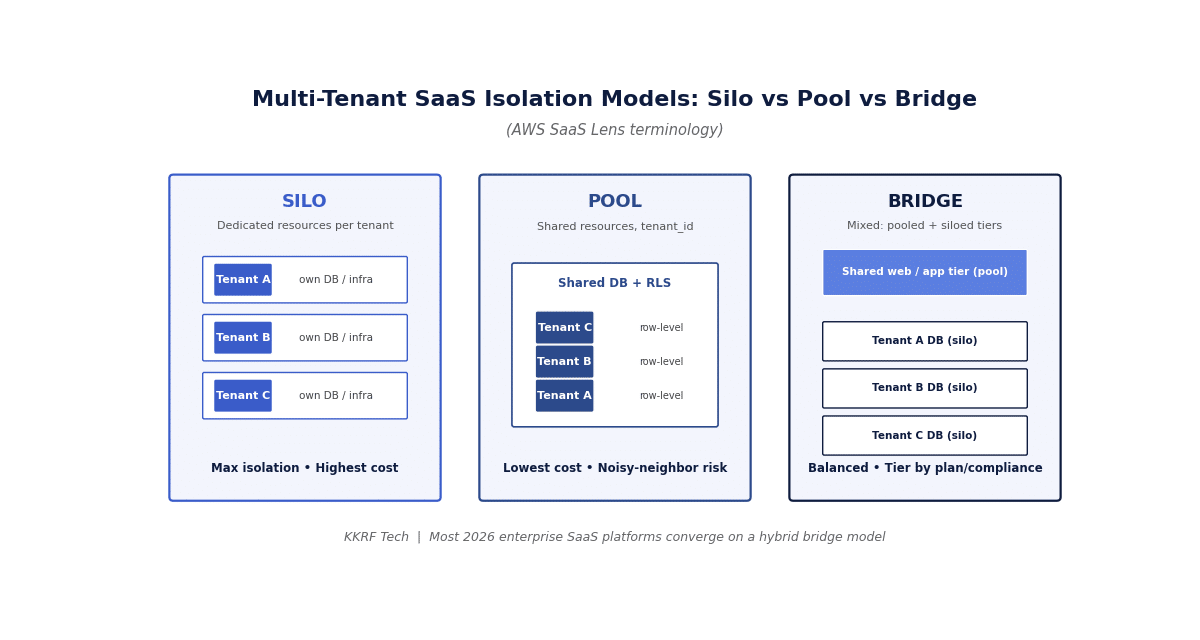
There are three canonical ways to isolate tenants, and the vocabulary comes straight from the AWS SaaS Lens: silo, pool, and bridge. The silo model gives each tenant dedicated resources, the pool model shares resources across all tenants, and the bridge model mixes the two within a single system. Importantly, these are not just database choices; they apply independently to compute, storage, networking, and identity.
The Silo Model
Silo model: each tenant is provisioned dedicated resources, often a dedicated database or even a dedicated application stack, while still being managed through shared onboarding, identity, and operations. It delivers the strongest isolation and the cleanest compliance story, because one tenant data never physically commingles with another. The trade-off is cost and operational overhead, since every silo carries its own baseline infrastructure charges plus its own patching, monitoring, and backups.
The Pool Model
Pool model: all tenants share the same infrastructure and the same tables, with every row tagged by a tenant identifier and every query filtered by it. This is the classic notion of multi-tenancy and it maximizes economies of scale, because the marginal cost of a new tenant approaches zero. The risks are concentration risks: a single query bug can leak data across tenants, and one heavy tenant can degrade performance for everyone, the noisy neighbor problem covered below.
The Bridge Model
Bridge model: a pragmatic hybrid where some tiers are pooled and others are siloed. A common pattern runs a shared, pooled web and application tier while giving each tenant a dedicated database, or keeps standard-plan customers in a pool and moves enterprise customers into silos. The bridge model is the emerging default in 2026 because real customer bases are heterogeneous, mixing a few large regulated accounts with a long tail of small ones.
| Model | Isolation | Cost efficiency | Noisy-neighbor risk | Compliance fit | Typical use |
|---|---|---|---|---|---|
| Silo | Highest (dedicated) | Lowest | None | Excellent | Few large or regulated tenants |
| Pool | Lowest (shared) | Highest | High | Weakest | Many small, similar tenants |
| Bridge | Mixed by tier | Balanced | Contained | Strong | Heterogeneous enterprise SaaS |
Summary: silo optimizes for isolation, pool optimizes for cost, and bridge lets you apply each where it fits. You rarely pick one model forever; you pick a sensible default and a clear path to promote demanding tenants into stronger isolation.
How to Build a Multi-Tenant SaaS Architecture: Step by Step
Building multi-tenancy is less about a single framework and more about a sequence of deliberate decisions made in the right order. The sequence below is the one that avoids expensive rewrites.
- Model your tenants first. Map expected tenant count, size distribution, and growth, and identify which tenants will demand dedicated isolation for regulatory reasons.
- Choose an isolation strategy per layer. Decide independently for database, compute, and storage; pooled compute with a bridged database is a common, safe starting point.
- Establish tenant context everywhere. Every request must carry a verified tenant identifier propagated from authentication down to the data layer, so isolation is enforced by default rather than by convention.
- Enforce data isolation at the lowest possible layer. Use database-native controls such as PostgreSQL row-level security instead of trusting application code to always remember the tenant filter.
- Separate a control plane from an application plane. Keep the shared services that onboard, meter, and manage tenants distinct from the runtime that serves their workloads.
- Add per-tenant observability and metering from day one. You cannot manage noisy neighbors or bill usage-based plans if you cannot attribute resource consumption to a tenant.
- Design the promotion path. Decide in advance how a pooled tenant graduates to a dedicated silo, because your largest customers will eventually ask.
Planning a multi-tenant build and still unsure whether to pool, silo, or bridge? KKRF Tech’s engineers pressure-test your isolation strategy before a line of schema is written, so you avoid the rewrite most teams hit at scale. Explore our SaaS development services to see how we approach it.
Get a Multi-Tenant Architecture Review →How Much Does Multi-Tenant SaaS Architecture Cost?
A disciplined multi-tenant MVP generally starts around $60K, mid-scale commercial platforms run roughly $60K to $150K, and enterprise-grade multi-tenant platforms with advanced security and compliance commonly land between $99K and $299K or more, according to aggregated 2026 industry estimates. First-year totals, including operations and maintenance, frequently reach $100K to $250K. These are ranges, not quotes: scope, compliance, and tenant isolation requirements move the number more than any feature list.
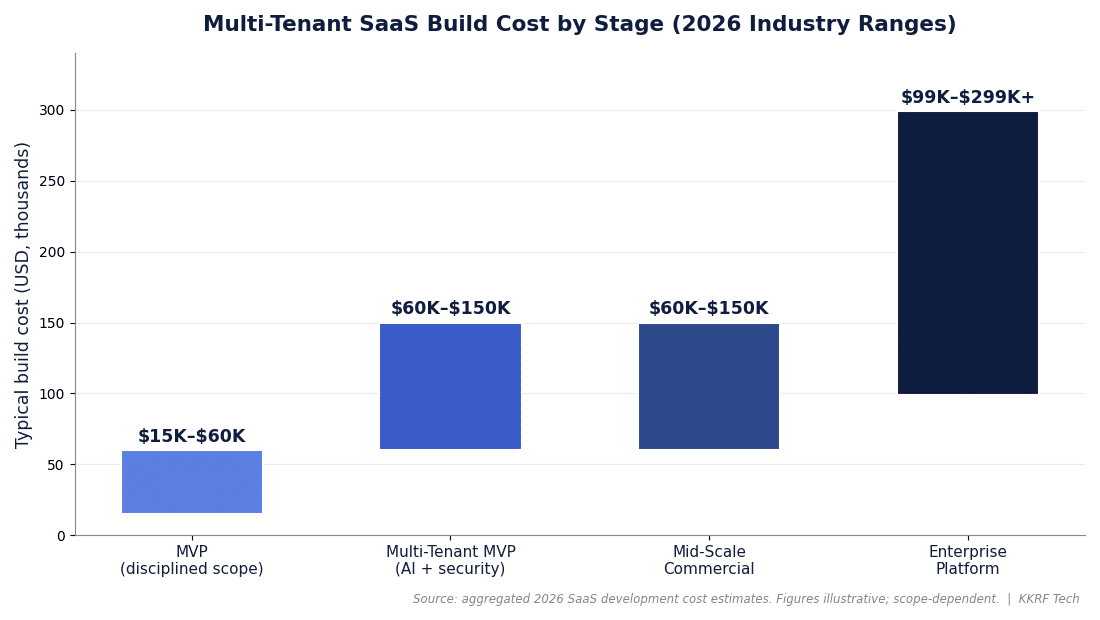
The biggest cost drivers are tenant isolation depth, billing complexity, and compliance. Database-per-tenant designs raise baseline infrastructure spend because every instance carries fixed charges even when idle. Usage-based and multi-tenant billing alone can add weeks of engineering. And picking a database model before you understand isolation requirements is the single decision that most often triggers a six-to-twelve-month re-architecture once a platform passes a few hundred paying customers.
Summary: the cheapest architecture on day one is often the most expensive over three years. Budget for the isolation your future enterprise customers will require, not only the tenants you have today.
Security and Compliance Considerations
Security in multi-tenancy comes down to one guarantee: no tenant can ever access another tenant data, under any code path. That guarantee must be enforced structurally, at the data layer, rather than left to developer discipline in every query.
- Enforce isolation at the data layer using row-level security, schema separation, or dedicated databases rather than application-only filters.
- Scope every credential, token, and cache key to a tenant to prevent cross-tenant leakage through shared caches or sessions.
- Encrypt data in transit and at rest, and consider per-tenant encryption keys for regulated tenants.
- Map your tenancy model to compliance obligations early: SOC 2 for enterprise trust, HIPAA for protected health data, and GDPR for EU data residency and deletion rights.
- Log and audit every cross-tenant administrative action so access is provable during an audit.
Compliance frequently dictates architecture. HIPAA and many financial and government requirements push regulated tenants toward a silo, which is precisely why the bridge model dominates: it lets you satisfy strict tenants without siloing everyone. If your platform touches infrastructure decisions like this, our cloud consulting team can help align isolation with your compliance scope.
The Noisy Neighbor Problem in Multi-Tenant SaaS
The noisy neighbor problem occurs when one tenant heavy workload, such as a large import, an expensive query, or a batch job, consumes a disproportionate share of shared CPU, memory, or I/O and degrades performance for every other tenant on the same infrastructure. Microsoft documents it as a classic multi-tenant antipattern, and it is a fairness problem as much as a capacity problem. It is the defining operational risk of the pool model.
- Enforce per-tenant API rate limits at the edge, returning a 429 response before excess requests consume server capacity.
- Cap query cost with maximum row counts and query-time limits so no single tenant can lock shared tables.
- Apply per-tenant storage and compute quotas tied to plan tier.
- Isolate or throttle known heavy workloads such as reporting and bulk exports.
- Monitor per-tenant resource consumption and promote chronic heavy tenants to a dedicated silo.
ROI and the Business Case for Multi-Tenancy
The business case is straightforward: multi-tenancy decouples revenue growth from infrastructure growth. When tenants share resources, gross margins improve with scale instead of eroding, which is why public markets reward the model. Gartner projects worldwide software spending will grow 14.7% in 2026 to more than $1.4 trillion, with public cloud services growing 21.3%, a market expanding fast enough that operational efficiency, not just features, decides who wins.
Summary: the architecture that keeps marginal cost per tenant low is the architecture that funds your roadmap. Multi-tenancy done well is a margin strategy, not merely a technical one, and it compounds as your customer base grows.
Common Multi-Tenant SaaS Mistakes to Avoid
- Choosing a database model before defining isolation and compliance requirements, the single most expensive early mistake.
- Relying on application code to filter by tenant identifier instead of enforcing isolation in the database.
- Assuming a pure pool model will serve every customer forever, then scrambling when the first enterprise deal demands dedicated data.
- Ignoring per-tenant observability until a noisy neighbor incident forces the issue.
- Treating tenant onboarding, billing, and metering as afterthoughts rather than first-class control-plane capabilities.
- Hard-coding a single region, then discovering data-residency requirements only after signing an EU customer.
Future Trends in Multi-Tenant SaaS Architecture
Four shifts are reshaping multi-tenant SaaS architecture as platforms mature and AI features become table stakes.
- Bridge-by-default: teams increasingly start with a hybrid model rather than migrating to one under duress.
- Cell-based architecture: partitioning tenants into isolated cells to contain blast radius and simplify horizontal scaling.
- AI-per-tenant: isolating retrieval data and model context per tenant as AI features spread, adding a new isolation dimension.
- Data residency as a product feature: region-pinned tenants offered as a paid tier to meet sovereignty and localization rules.
Decision Framework: Choosing the Right Tenancy Model
As an experienced custom software development company, KKRF Tech guides teams toward a default-plus-promotion strategy rather than a single rigid model. Choose the pool model when you serve many small, similar tenants and cost efficiency is paramount. Choose the silo model when tenants are few, large, or regulated and demand hard isolation. Choose the bridge model, the right answer for most enterprise SaaS, when your customer base mixes both profiles.
- Avoid a pure pool model when you have hard data-residency rules or single-tenant compliance mandates you cannot meet with shared storage.
- Avoid a pure silo model when you expect thousands of small tenants, because per-instance baseline costs will not scale.
- Remember every model has limits: pool concentrates risk, silo concentrates cost, and bridge adds operational complexity you must staff for.
Enterprise recommendation: default to a bridge model with a pooled application tier and a database strategy that can promote demanding tenants into dedicated isolation, and design that promotion path before launch. This preserves margin on the long tail while keeping your largest, most valuable accounts satisfiable. In short, architect for the customers you want to win, not only the ones you have.
How to Evaluate a SaaS Development Partner
If you are hiring help, judge a partner by how they reason about tenancy, not by the length of their framework checklist. The right questions surface real experience quickly.
- Do they model tenant isolation and compliance requirements before proposing a schema?
- Can they show production experience with pool, silo, and bridge models, not just theory?
- Do they design per-tenant observability, metering, and a promotion path from day one?
- Do they treat security isolation as a structural guarantee enforced at the data layer?
- Do they document trade-offs honestly, including where their recommended model will hurt?
Weighing build-versus-rearchitect costs for your platform? A short scoping call can save the six-to-twelve-month rewrite that catches teams after their first few hundred customers. See how we handle custom software development end to end.
Talk to Our SaaS Architects →Frequently Asked Questions
What is multi-tenant SaaS architecture?
Multi-tenant SaaS architecture is a model where one application instance and shared infrastructure serve many customer organizations (tenants) while keeping each tenant data isolated. It underpins the SaaS economic model because a provider can add customers without adding a proportional amount of infrastructure.
What are the three multi-tenancy isolation models?
The three models are silo (each tenant gets dedicated resources), pool (all tenants share resources, separated by a tenant identifier), and bridge (a hybrid that pools some tiers and silos others). The terminology comes from the AWS SaaS Lens, and most 2026 platforms adopt a bridge model.
What is the noisy neighbor problem and how do you prevent it?
The noisy neighbor problem is when one tenant heavy workload consumes shared resources and degrades performance for other tenants. It is prevented with per-tenant rate limits, query-cost caps, storage and compute quotas, per-tenant monitoring, and promoting chronic heavy tenants to a dedicated silo.
Which multi-tenancy model is best for enterprise and regulated customers?
Regulated and large enterprise customers usually need the silo model dedicated isolation to satisfy standards such as HIPAA and SOC 2. Most providers deliver this through a bridge model, pooling small customers while siloing enterprise and regulated tenants, rather than siloing everyone.
How much does it cost to build a multi-tenant SaaS platform?
Aggregated 2026 estimates put a disciplined multi-tenant MVP around $60K, mid-scale platforms at roughly $60K to $150K, and enterprise-grade platforms at $99K to $299K or more, with first-year totals often reaching $100K to $250K. Isolation depth, billing complexity, and compliance drive the number more than feature count.
Should I choose single-tenant or multi-tenant architecture?
Choose multi-tenant when selling a standardized product to many customers where efficient scaling matters; choose single-tenant when a few large customers require hard isolation or deep customization. Many teams use multi-tenancy for the core product and offer single-tenant deployments to their largest accounts.
Ready to turn a tenancy decision into a shipped platform? Tell us about your product and we will outline an isolation model, a realistic cost range, and a delivery roadmap tailored to your compliance needs.
Get a Custom Project Estimate →