
Post-quantum cryptography migration is now a board-level cybersecurity priority, not a research-lab curiosity. In 2024, NIST finalized the first quantum-resistant encryption standards, and in 2026 the compliance clock is running: federal mandates, vendor deadlines, and the very real threat of “harvest now, decrypt later” attacks are pushing enterprises to replace RSA and ECC before quantum computers can break them.
This guide explains what the transition actually involves — the NIST standards, the deadlines, the technical trade-offs, the real cost drivers, and a phased roadmap — so you can move from awareness to a scoped, defensible program.
Quick Answer: What Is Post-Quantum Cryptography Migration?
Post-quantum cryptography migration is the process of replacing today’s quantum-vulnerable public-key algorithms — RSA, elliptic-curve cryptography (ECC), and Diffie-Hellman — with new, NIST-standardized algorithms built to resist attacks from large-scale quantum computers. For most enterprises it is a multi-year program resting on four pillars: a complete cryptographic inventory, a risk-based prioritization plan, hybrid or drop-in algorithm replacement, and lasting crypto-agility so the next transition is far easier than this one.
Key Takeaways
- NIST finalized three post-quantum standards in 2024 — FIPS 203 (ML-KEM), FIPS 204 (ML-DSA), and FIPS 205 (SLH-DSA) — and these are the algorithms enterprises must adopt.
- The urgency is “harvest now, decrypt later”: data captured today can be decrypted once a cryptographically relevant quantum computer exists.
- NSA’s CNSA 2.0 sets firm deadlines, with software and firmware signing expected to be quantum-safe from 2027 and most systems exclusive to post-quantum algorithms by 2030–2033.
- A credible post-quantum cryptography migration starts with a cryptographic inventory — you cannot protect algorithms you cannot see.
- Hybrid cryptography (classical and post-quantum together) is the recommended bridge during the transition.
- Crypto-agility — the ability to change algorithms without re-architecting systems — is the real long-term goal.
What This Guide Covers
KKRF Tech is a trusted IT consulting and cybersecurity partner that helps enterprises inventory, prioritize, and execute quantum-safe transitions across cloud, application, and PKI estates. We have guided organizations through complex cryptographic modernization work, and this guide distills the practical lessons — the discovery blind spots, the interoperability traps, and the governance decisions — that separate a smooth post-quantum cryptography migration from a stalled one.
Why Post-Quantum Cryptography Migration Can’t Wait
The short answer: because the threat is retroactive. Encrypted data you transmit or store today can be captured now and decrypted later, the moment a powerful enough quantum computer arrives. Any information that must stay confidential beyond roughly 2030 is therefore already exposed.
Harvest now, decrypt later (HNDL) is an attack strategy in which an adversary collects encrypted traffic or data today and stores it, waiting for future quantum computers to break the encryption. It means the effective shelf life of your secrets — not the arrival date of quantum hardware — determines how urgent your migration is.
A simple way to frame the risk: if the years your data must remain confidential, plus the years your migration will take, exceed the time until a cryptographically relevant quantum computer exists, you are already behind. Recent research has sharpened the concern — published estimates of the quantum resources needed to break RSA-2048 have fallen dramatically, from around 20 million qubits in earlier analyses to well under one million in newer work, according to reporting collated by industry analysts.
Most credible projections still place a cryptographically relevant quantum computer somewhere in the 2030–2035 window or later, but the exact date is the wrong thing to fixate on. Long-lived secrets — health records, financial data, state secrets, intellectual property, and the root keys inside your PKI — need protection that outlasts any single forecast.
Bottom line: the deadline that matters is set by your data’s confidentiality lifespan, not by vendor hype about quantum timelines.
The NIST Post-Quantum Standards: FIPS 203, 204 and 205
NIST’s three finalized standards define the algorithms your post-quantum cryptography migration will standardize on. FIPS 203 handles key establishment; FIPS 204 and 205 handle digital signatures. Understanding what each does tells you where in your stack it will land.
FIPS 203 — ML-KEM specifies the Module-Lattice-Based Key-Encapsulation Mechanism, derived from CRYSTALS-Kyber. It replaces RSA and elliptic-curve key exchange for establishing shared secrets — the mechanism that protects TLS sessions, VPN tunnels, and encrypted messaging.
FIPS 204 — ML-DSA specifies the Module-Lattice-Based Digital Signature Algorithm, derived from CRYSTALS-Dilithium. It is NIST’s primary recommendation for digital signatures used in code signing, TLS certificates, and authentication.
FIPS 205 — SLH-DSA specifies the Stateless Hash-Based Digital Signature Algorithm, derived from SPHINCS+. It is a conservative, hash-based backup whose security rests on well-understood hash functions rather than lattice mathematics — valuable diversity if a weakness is ever found in the lattice-based schemes.
NIST’s National Cybersecurity Center of Excellence (NCCoE) runs a dedicated Migration to Post-Quantum Cryptography project that publishes practice guides and interoperability testing. It is the most authoritative reference to anchor an enterprise program to, alongside the standards bodies and vendor documentation for your specific platforms.
| Classical algorithm (retiring) | Post-quantum replacement | NIST standard | Primary purpose |
|---|---|---|---|
| RSA / ECDH key exchange | ML-KEM (Kyber) | FIPS 203 | Key establishment / encryption |
| RSA / ECDSA signatures | ML-DSA (Dilithium) | FIPS 204 | Digital signatures (primary) |
| — | SLH-DSA (SPHINCS+) | FIPS 205 | Hash-based signatures (backup) |
| AES-128 | AES-256 | FIPS 197 | Symmetric encryption (increase key size) |
Bottom line: standardize key exchange on ML-KEM and signatures on ML-DSA, keep SLH-DSA as a hedge, and move symmetric encryption to 256-bit keys.
Compliance Deadlines: CNSA 2.0 and the Regulatory Clock
If you sell to government or operate in a regulated sector, your timeline is not optional. NSA’s Commercial National Security Algorithm Suite 2.0 (CNSA 2.0) sets staged deadlines that effectively pull the entire vendor ecosystem toward quantum-safe defaults.
CNSA 2.0 is the NSA’s mandated set of quantum-resistant algorithms and adoption timelines for national security systems. It names ML-KEM and ML-DSA as required algorithms and assigns different deadlines to different system categories, from software signing to networking gear to operating systems.
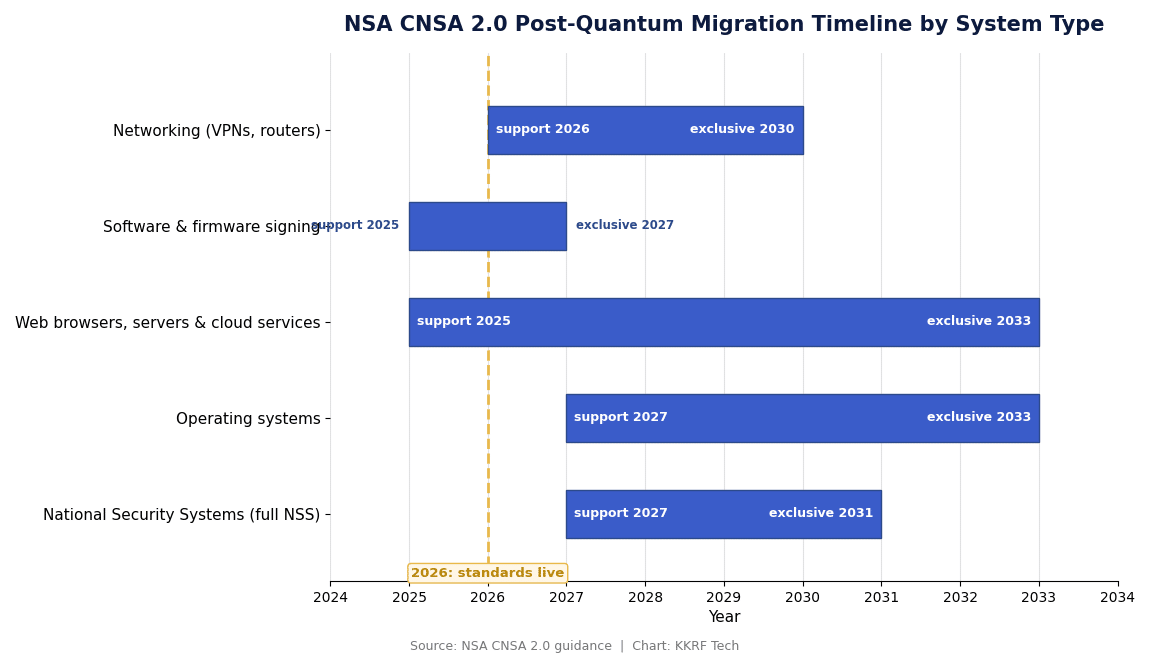
The staggered schedule matters for planning. Software and firmware signing faces exclusive-use requirements from 2027; traditional networking equipment such as VPNs and routers should prefer post-quantum algorithms by 2026 and use them exclusively by 2030; web browsers, servers, cloud services, and operating systems have until 2033 for exclusive use, with full enforcement across national security systems expected by 2031. In parallel, the 2026 U.S. executive order on post-quantum cryptography reinforced these directions, as Cloudflare and other infrastructure providers documented in detail.
Even if you never touch a government contract, these dates shape your world: the operating systems, browsers, HSMs, and cloud services you depend on are being re-engineered to hit them, and their defaults will change under you. Aligning your own roadmap to CNSA 2.0 keeps you compatible with the ecosystem rather than fighting it.
Bottom line: treat CNSA 2.0 as the de facto industry clock — software signing and networking gear come due first, browsers and operating systems last.
The Cryptographic Footprint: What Changes Technically
Post-quantum algorithms are not drop-in, same-size replacements. They generally have larger keys, larger signatures, and different performance profiles — which is why testing and integration, not just swapping a library, dominate the engineering effort.
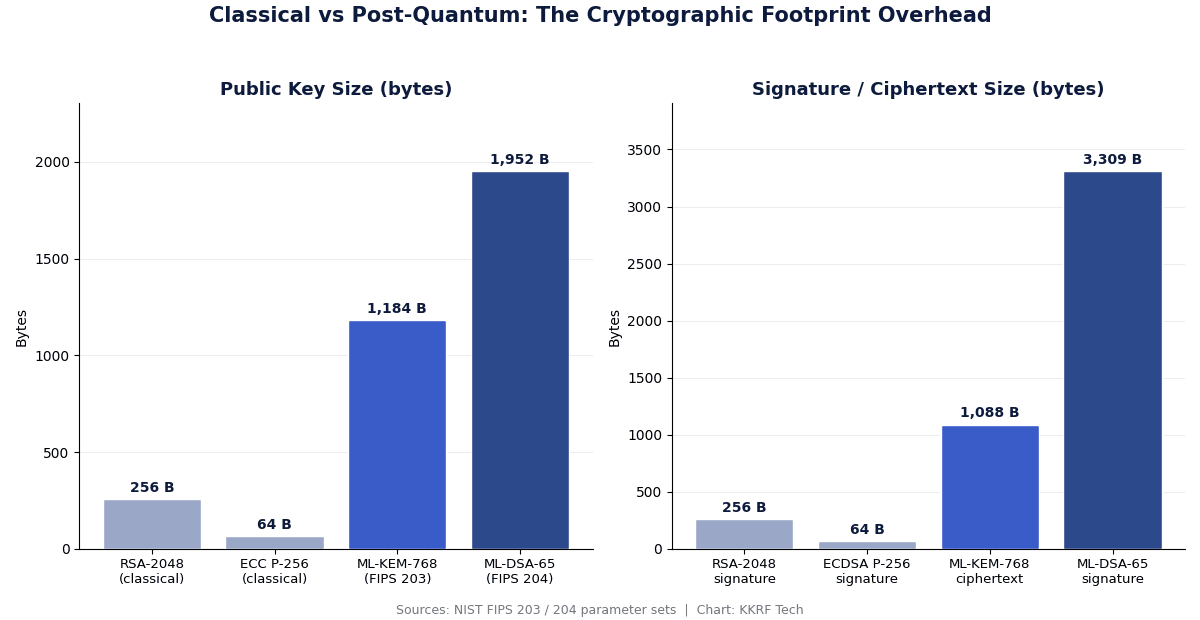
The size difference is real and has downstream effects. An ML-DSA-65 signature is roughly 3.3 KB versus about 64 bytes for an ECDSA P-256 signature, and ML-KEM public keys and ciphertexts run to well over a kilobyte. That inflates TLS handshakes, enlarges certificate chains, and pressures bandwidth-constrained and memory-constrained environments — IoT devices, embedded firmware, and high-volume connection termination in particular.
Hybrid cryptography combines a classical algorithm and a post-quantum algorithm in the same handshake or signature, so the connection stays secure as long as either one holds. NIST and major browsers expect hybrid modes to be the practical bridge during the transition, because they preserve interoperability with systems that have not yet migrated while still defending against harvest-now-decrypt-later attacks.
Bottom line: budget for performance testing and certificate/handshake sizing, and plan to run hybrid modes rather than flipping a single switch.
Not sure where your quantum-vulnerable algorithms are hiding? A cryptographic inventory is the fastest way to turn an abstract threat into a concrete, prioritized plan. Our cybersecurity consulting team can scope a discovery engagement for your cloud, application, and PKI estate.
Map Your Cryptographic Exposure →A Step-by-Step Post-Quantum Cryptography Migration Roadmap
Every credible roadmap follows the same arc: see it, rank it, plan it, replace it, verify it. NIST and the NCCoE describe a phased approach; here is the practical six-phase version that works for enterprise environments.
- Cryptographic inventory. Discover every place cryptography lives — applications, libraries, TLS endpoints, certificates, VPNs, databases, cloud services, code-signing pipelines, and third-party integrations. The output is a Cryptographic Bill of Materials (CBOM). You cannot migrate what you cannot see.
- Risk and data-lifetime assessment. Classify assets by the confidentiality lifespan of the data they protect and by harvest-now-decrypt-later exposure. Long-lived secrets rise to the top.
- Prioritization. Sequence the work: externally exposed systems, root and intermediate PKI, code signing, and anything guarding decade-long secrets go first; low-sensitivity, short-lived data can wait.
- Architecture and crypto-agility planning. Abstract cryptography behind well-defined interfaces so algorithms can be swapped without rewriting business logic, and choose your hybrid strategy for each protocol.
- Migration and hybrid deployment. Replace in waves, starting with pilots and non-critical systems, deploying hybrid classical-plus-PQC modes to preserve interoperability, then expanding.
- Validation and continuous monitoring. Test interoperability and performance, bake cryptographic scanning into CI/CD, and monitor for configuration drift so newly deployed systems do not quietly reintroduce quantum-vulnerable algorithms.
Bottom line: inventory first, prioritize by data lifespan, deploy in hybrid waves, and make discovery a permanent part of your pipeline.
Post-Quantum Cryptography Migration Cost: What Drives the Budget
There is no single price tag, and any vendor quoting one without seeing your estate is guessing. Cost scales with the size, age, and complexity of your cryptographic footprint — not with headcount alone. Published enterprise estimates vary widely and span multiple years, so budget by cost driver rather than by a headline number.
- Discovery and inventory — tooling plus the labor to catalog legacy, embedded, and undocumented cryptography.
- Remediation of hard-coded crypto — applications where cryptographic calls are entangled with business logic are the costliest category to fix.
- Hardware and PKI upgrades — HSMs, certificate authorities, and key-management systems that must support the new algorithms.
- Third-party and supply-chain dependencies — components you cannot patch yourself and must schedule around vendor roadmaps, sometimes 18–24 months ahead.
- Testing and parallel operation — interoperability validation and the overhead of running hybrid systems during transition.
Timelines scale the same way. Industry estimates commonly suggest smaller organizations may complete core migration in a few years, while large enterprises with sprawling legacy estates plan on the better part of a decade — a range consistent with NIST’s assumption of a roughly ten-year transition and with how long previous cryptographic migrations (such as SHA-1 to SHA-2) actually took.
| Migration approach | Best for | Advantages | Trade-offs |
|---|---|---|---|
| Rip-and-replace | Small, modern, well-inventoried estates | Simplest end state; no long-term hybrid overhead | Breaks interoperability with un-migrated partners; risky for large estates |
| Hybrid transition | Most enterprises | Maintains compatibility; defends against HNDL immediately | Temporary added complexity and larger payloads |
| Crypto-agility-first | Organizations planning for repeated change | Cheapest future migrations; resilient to algorithm changes | Higher upfront architecture investment |
Bottom line: the biggest costs are discovery and untangling hard-coded cryptography — plan for a multi-year, hybrid, agility-oriented program, not a one-off purchase.
Security, Compliance and Risk Considerations
A post-quantum cryptography migration is a security project that can create new risks if rushed. The goal is to raise your quantum resilience without breaking the systems you depend on today.
- Do not remove classical algorithms too early. Until partners and clients support post-quantum modes, hybrid deployment keeps you interoperable while still protecting against harvest-now-decrypt-later.
- Use validated implementations. Favor libraries and modules moving toward FIPS 140-3 validation; NIST’s CMVP has been retiring older FIPS 140-2 validations, so confirm the compliance status your auditors will require.
- Watch for side-channel and implementation flaws. New algorithms mean new implementation bugs; never roll your own cryptography — adopt well-reviewed, maintained libraries.
- Account for performance and scalability. Larger keys and signatures affect latency, throughput, and storage; load-test before broad rollout.
- Plan for maintenance. Standards, recommended parameters, and additional algorithms will keep evolving, so treat this as an ongoing capability rather than a fixed milestone.
Crypto-agility is the ability to discover, change, and validate cryptographic algorithms, key sizes, and protocols without rewriting business logic or taking downtime. It is both a risk-reduction measure and the single best investment for making every future transition cheaper.
Bottom line: migrate with hybrid modes and validated libraries, load-test for the larger footprint, and treat crypto-agility as the durable payoff.
ROI and the Business Case for Acting Now
The return on a post-quantum cryptography migration is not new revenue — it is avoided catastrophic loss, preserved market access, and lower future migration cost. Being honest about that framing helps secure realistic funding.
The cost of delay compounds. Data harvested today cannot be un-harvested; contracts and regulated markets increasingly require quantum-safe roadmaps as a condition of eligibility; and a rushed migration under a hard deadline is far more expensive and error-prone than a phased one started early. Investing in crypto-agility now also means the next algorithm change — and there will be one — costs a fraction of this transition.
Bottom line: the ROI is risk avoided and access preserved, and starting early is materially cheaper than migrating under deadline pressure.
Common Post-Quantum Cryptography Migration Mistakes to Avoid
Most stalled programs fail in predictable ways. Avoiding these keeps momentum and budget intact.
- Treating migration as a one-time project instead of building lasting crypto-agility.
- Skipping the cryptographic inventory and jumping straight to algorithm swaps.
- Ripping out classical cryptography before partners can interoperate, instead of using hybrid modes.
- Ignoring embedded, IoT, and firmware systems, where updates are hardest and slowest.
- Overlooking third-party, open-source, and SaaS dependencies until deadlines are imminent.
- Writing custom cryptographic implementations rather than adopting validated, well-maintained libraries.
Bottom line: inventory before you swap, keep hybrid compatibility, and never hand-roll the crypto.
Future Trends: What Comes After the First Migration
The first migration is the beginning of a permanent capability, not the end of the story. Several trends will shape the next few years.
NIST continues to expand the portfolio — additional algorithms such as a Falcon-based signature scheme and the HQC key-encapsulation mechanism have been selected to diversify beyond the initial lattice-based choices. Meanwhile, post-quantum key exchange is already shipping in mainstream TLS 1.3 implementations and major browsers, so a growing share of internet traffic is quietly becoming hybrid-protected. Expect cryptographic bill-of-materials tooling and automated discovery to mature quickly, and expect crypto-agility to become a standard architectural requirement rather than a nice-to-have.
Bottom line: plan for a moving target — more algorithms, more automation, and crypto-agility as a permanent design principle.
When to Start, When to Wait: A Decision Framework
Start now if any of your data must stay confidential past roughly 2030, if you sell to government or regulated industries, or if you operate your own PKI. You can sequence more gradually if all your protected data is short-lived and low-sensitivity — but even then, inventory and crypto-agility are worth beginning today.
Prioritize immediately if you
- protect long-lived secrets (health, financial, legal, IP, state data);
- run internet-facing services, VPNs, or your own certificate authority;
- sell into government, defense, finance, or critical infrastructure;
- have compliance obligations tied to CNSA 2.0 or similar mandates.
You can phase gradually if you
- only handle short-lived, low-sensitivity data;
- rely mostly on managed platforms that will migrate for you — though you still must verify and configure them.
Limitations and trade-offs to accept: hybrid modes add temporary complexity and payload size; some legacy and embedded systems may never support post-quantum algorithms and will need compensating controls or replacement; and standards will keep evolving, so early choices should be made behind agile abstractions.
Enterprise recommendation: begin the inventory and crypto-agility work now regardless of your risk tier, then scale remediation to your exposure. This is where an experienced partner earns its keep. As a trusted IT consulting and cybersecurity partner, KKRF Tech helps enterprises turn post-quantum cryptography migration from an open-ended risk into a scoped, budgeted, standards-aligned program — and we build crypto-agility in from day one so the work compounds. Related modernization efforts, such as legacy application modernization and cloud migration, are natural moments to bake in quantum-safe design.
Bottom line: everyone should inventory now; the pace of remediation should track the sensitivity and lifespan of the data you protect.
How to Evaluate a Post-Quantum Migration Partner
The right partner shortens the program and prevents expensive missteps. Use this checklist when comparing providers.
- A proven cryptographic discovery methodology that produces a real Cryptographic Bill of Materials, not a slide deck.
- Vendor-neutral algorithm guidance aligned to NIST FIPS 203/204/205 and CNSA 2.0.
- Hands-on PKI, HSM, and TLS engineering experience — implementation, not just advisory.
- A crypto-agility architecture plan, so future algorithm changes are cheap.
- Clear interoperability, rollback, and testing practices for hybrid deployments.
Bottom line: choose a partner who can inventory, engineer, and leave you agile — not one who only advises.
Deadlines like CNSA 2.0 arrive faster than multi-year migrations finish. Start with a scoped cryptographic inventory now, and phase the rest with confidence — talk to KKRF Tech about a quantum-safe readiness assessment.
Start Your Cryptographic Inventory →Frequently Asked Questions
What is post-quantum cryptography migration?
Post-quantum cryptography migration is the process of replacing quantum-vulnerable public-key algorithms (RSA, ECC, Diffie-Hellman) with NIST-standardized quantum-resistant algorithms such as ML-KEM and ML-DSA. It typically spans cryptographic inventory, prioritization, hybrid deployment, and building long-term crypto-agility.
How long does post-quantum cryptography migration take?
It varies with the size and age of your cryptographic estate. Industry estimates range from a few years for smaller, modern organizations to the better part of a decade for large enterprises with heavy legacy footprints — consistent with NIST’s assumption of a roughly ten-year transition. Starting the inventory early is the single biggest factor in staying on schedule.
What are FIPS 203, 204, and 205?
They are the first NIST post-quantum standards, finalized in 2024. FIPS 203 specifies ML-KEM (key establishment), FIPS 204 specifies ML-DSA (the primary digital signature algorithm), and FIPS 205 specifies SLH-DSA (a hash-based signature backup). Together they define the algorithms enterprises should migrate to.
When will quantum computers be able to break RSA?
No one knows precisely. Most projections place a cryptographically relevant quantum computer in the 2030–2035 window or later, though recent research has lowered the estimated resources required. Because of harvest-now-decrypt-later attacks, the practical deadline depends on how long your data must stay confidential, not on the exact arrival date.
What is “harvest now, decrypt later”?
It is an attack in which adversaries collect encrypted data today and store it, planning to decrypt it once quantum computers mature. It makes long-lived secrets encrypted with RSA or ECC vulnerable right now, which is why organizations protecting decade-long data cannot afford to wait.
What is crypto-agility and why does it matter?
Crypto-agility is the ability to change cryptographic algorithms, key sizes, and protocols without rewriting business logic or taking downtime. It matters because the transition will not end with the first migration — building agility now makes every future change dramatically cheaper and lower-risk.
Whether you are just building your first cryptographic bill of materials or ready to deploy hybrid TLS, KKRF Tech can help you plan and execute a standards-aligned post-quantum cryptography migration. Explore our IT consulting services or reach out directly.
Talk to Our Quantum-Safe Security Team →